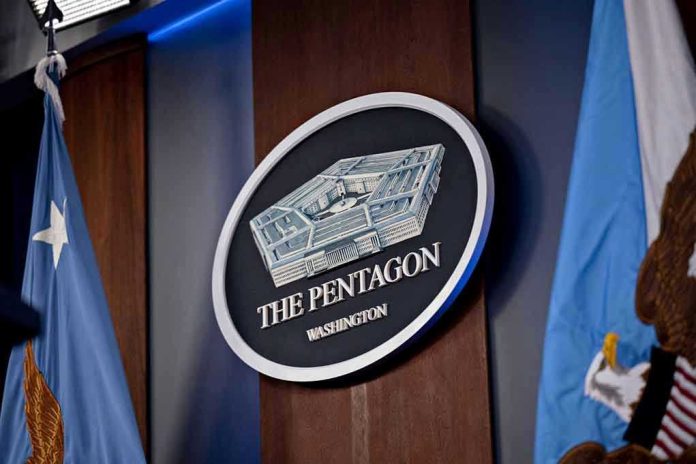
Defense Secretary Pete Hegseth just delivered the Pentagon’s most aggressive ultimatum to military contractors in decades, warning that Trump’s unprecedented $1.5 trillion war chest comes with iron-clad strings attached.
Story Highlights
- Trump’s $1.5 trillion defense budget represents a 50% spending increase over current levels
- Hegseth demands defense contractors “step up” production or face executive compensation caps and stock buyback bans
- Raytheon specifically targeted for underperformance while enriching shareholders over military needs
- Republican congressional leaders frame massive spending as essential message to China and other adversaries
Pentagon Declares War on Corporate Greed
Defense Secretary Pete Hegseth delivered a fiery ultimatum to America’s defense industrial complex, declaring the days of corporate profit over military performance are over. Speaking with the authority of Trump’s massive budget proposal behind him, Hegseth warned contractors they must choose between enriching shareholders and serving America’s warfighters. The message was crystal clear: step up production and modernize facilities, or face unprecedented government restrictions on executive pay and corporate financial maneuvers.
Pentagon spokesperson Sean Parnell pulled no punches in explaining the new reality. “After numerous years of failing to meet contractual obligations, under President Trump’s order, defense contractors will no longer be allowed to leave our warfighters behind while giving themselves massive payouts from stock buybacks.” This represents a fundamental shift from the cozy relationship between Pentagon brass and defense executives that has characterized military procurement for decades.
Raytheon Gets Singled Out for Shareholder-First Strategy
Trump’s criticism hit Raytheon with surgical precision, labeling the RTX Corporation unit as “the least responsive to the needs of the Department of War, the slowest in increasing their volume, and the most aggressive spending on their Shareholders rather than the needs and demands of the United States Military.” This public dressing-down of a major defense contractor signals a dramatic departure from traditional Pentagon diplomacy with its suppliers.
The executive order accompanying Trump’s budget announcement caps defense contractor executive compensation at $5 million for companies failing to deliver on contracts or modernize production facilities. Stock buybacks and corporate distributions face immediate prohibition when contractors underperform. These measures target the fundamental business model that has allowed defense companies to extract maximum shareholder value while delivering weapons systems years behind schedule and billions over budget.
Congressional Hawks See China Deterrent in Massive Spending
House Armed Services Committee Chairman Mike Rogers praised Trump’s proposal as “exactly the kind of investment it will take to rebuild our military and restore American leadership on the world stage.” Republican defense hawks have long advocated for spending approximately 5 percent of GDP on defense, up from the current 3.5 percent, positioning this budget as overdue rather than excessive.
Rep. Don Bacon articulated the strategic rationale driving Republican support: “We think we need a permanent 4 percent or better. That’s what it’s gonna take to build our Navy, our Air Force, our ICBMs, our bombers, and take care of our troops.” The Committee for a Responsible Federal Budget estimates the proposal would add $5.8 trillion to federal debt over the decade, but supporters argue the cost of military weakness against China exceeds fiscal concerns.
Financing Through Tariffs Faces Economic Reality Check
Trump claims tariff revenue will finance his defense spending explosion, but Congressional Budget Office projections show tariffs reducing debt by only $3 trillion through Fiscal Year 2035. This leaves a significant gap between promised revenue and proposed spending that Congress must address through either additional revenue sources or deficit spending. OMB Director Russell Vought suggests pursuing reconciliation procedures to bypass Democratic opposition, requiring only Republican votes for passage.
The proposal emerges amid what Trump characterizes as “very troubled and dangerous times,” though specific geopolitical triggers remain unclear. Defense policy experts note the budget aligns with longstanding arguments for military modernization to counter peer adversaries like China, but the $1.5 trillion figure represents an unprecedented peacetime military investment that reshapes America’s fiscal priorities for the next decade.
Sources:
Committee for a Responsible Federal Budget
House Armed Services Committee