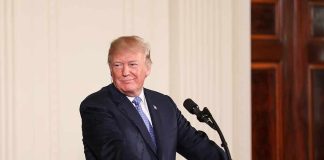
President Donald Trump stood before the Resolute Desk on Good Friday 2026 and declared something no president has claimed in decades: that religion in America is not just surviving, but experiencing a full-blown resurgence under his watch.
Story Snapshot
- Trump delivered a Good Friday video message claiming churches are “fuller, younger, and more faithful” during his second term
- The president linked national greatness directly to faith, stating “to be a great nation you must have religion and you must have God”
- He invoked his 2024 assassination survival as divine intervention meant to restore America’s spiritual foundation
- The message aligns with new White House initiatives including a Faith Office and the America 250 prayer campaign
Faith as National Policy in the Second Trump Era
Trump posted his Easter weekend message to Truth Social in the early hours of April 4, 2026, quoting John 3:16 and proclaiming that “religion is growing again in our country for the first time in decades.” The video represented more than seasonal greetings. It marked a direct assertion that his administration has reversed what he frames as decades of spiritual decline, positioning faith revival as measurable policy success alongside economic and border achievements.
The timing and setting carried deliberate weight. Speaking from the Oval Office during Holy Week, Trump connected his personal narrative of surviving the Butler, Pennsylvania assassination attempt in 2024 to a larger story of divine purpose. He had previously told Congress in 2025 that he believed God spared him specifically to complete the mission of making America great again, a theme he revisited in this Good Friday address.
The White House Faith Office and Cultural Realignment
Trump’s religious messaging coincides with concrete institutional changes. His second term launched the White House Faith Office and the America 250 prayer initiative, both designed to restore what the administration characterizes as suppressed religious expression in public life. The federal workforce received new guidance protecting religious expression, a shift Trump portrays as correcting prior administrations’ secular overreach. These aren’t symbolic gestures but policy infrastructure aimed at embedding faith considerations into governance.
The president’s claim that church pews are “fuller, younger, and more faithful” lacks empirical verification from independent religious attendance studies, but the assertion itself reveals the administration’s confidence in cultural momentum. Whether accurate or aspirational, the statement positions Trump as champion of a movement he credits to his leadership rather than organic spiritual awakening, a distinction that matters greatly to how Americans interpret religious trends in political context.
Strategic Messaging to the Evangelical Base
Trump’s Good Friday message serves dual purposes: genuine religious expression and calculated political reinforcement. Evangelical Christians form a core constituency that views religious liberty and public faith affirmation as non-negotiable values. By declaring “evil and wickedness will not prevail” and ending with “May God bless the United States of America,” Trump signals alignment with voters who measure presidential fitness partly by willingness to acknowledge divine authority over national affairs.
Conservative outlets like Fox News amplified the message by contrasting Trump’s approach with what they characterized as the Biden administration’s muted Christian holiday observances. This framing elevates Trump’s religious rhetoric beyond personal piety into a restoration narrative: America had lost its spiritual moorings and his presidency represents the correction. Critics counter that this blurs constitutional boundaries between church and state, but for Trump’s supporters, that criticism itself proves the point about secular hostility toward faith in public square.
Cultural Division and the Faith Politics Landscape
The reaction to Trump’s message predictably splits along existing fault lines. Evangelical Christians see validation and leadership courage in a president who openly declares America needs God. Secular Americans and strict separationists view the same message as divisive triumphalism that alienates non-Christian citizens and threatens pluralistic democracy. Both interpretations carry truth depending on one’s baseline assumptions about religion’s proper role in national identity.
What remains clear is that Trump has staked his second term legacy partly on claims of spiritual renewal. Whether history records an actual religious resurgence during this period or merely effective messaging to a faithful base will depend on data that doesn’t yet exist. The president’s confidence in declaring victory on faith renewal before measurable evidence appears reflects either prophetic insight or political strategy, and for millions of Americans, those categories aren’t mutually exclusive.
Sources:
Trump Touts ‘Resurgence of Religion’ in Good Friday Message – National Today
Trump says ‘America needs God’ in Good Friday message touting ‘resurgence of religion’ – Fox News