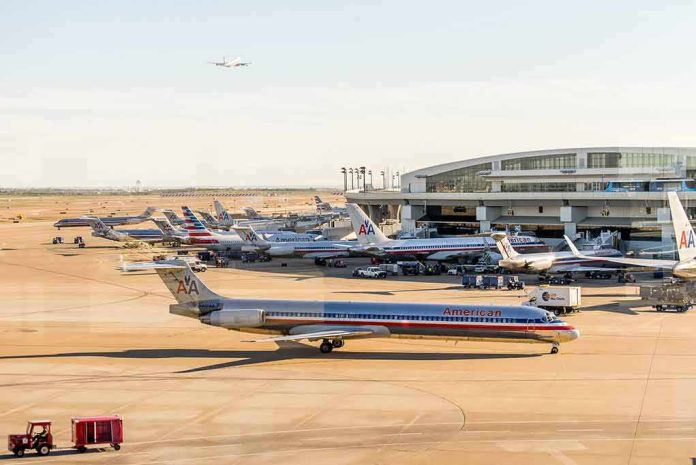
Dulles International Airport is getting a $22.5 billion makeover, and the strange “people mover” pods that have hauled passengers across the tarmac for decades are finally getting the boot.
Quick Take
- President Trump and Transportation Secretary Sean Duffy announced a $22.5 billion plan to rebuild Washington Dulles International Airport during a Wednesday Oval Office event.
- The plan adds four or five new concourses, an underground walking tunnel, more moving sidewalks, and a 32,000-space parking garage.
- The aging “people mover” shuttle system, often compared to something out of “Star Wars,” will be phased out entirely.
- Costs will be split between taxpayers, the airport authority, and airline partners like United, with a target finish date around 2034.
A Presidential Push To Fix “One Of The Worst Airports”
President Trump did not hold back when describing Dulles’s current state. He told reporters the airport is “considered one of the worst airports anywhere in the world” and vowed, “We’re going to make it maybe the best”. That blunt assessment set the tone for a rollout built around scale and spectacle, not just spreadsheets and blueprints.
Transportation Secretary Sean Duffy stood beside the president to unveil renderings of the new terminals. The project, developed with the Metropolitan Washington Airports Authority and United Airlines, will add or renovate more than 5 million square feet of terminal space. That is a serious commitment of federal attention to a facility many travelers have quietly dreaded for years.
The announcement did not come out of nowhere. Back in May, Duffy previewed the effort at a Washington conference, saying “we are set to reconstruct Dulles” and floating a price tag near $22 billion. The final figure grew slightly by July, but the direction stayed consistent for months before Wednesday’s formal unveiling.
What Actually Changes For Travelers
The most talked-about change is the death of the mobile lounges, the boxy shuttle vehicles that have ferried passengers between the main terminal and outlying gates since the 1960s. Plans call for five new concourses to replace the current four, cutting down walking and waiting time dramatically.
An underground tunnel will let passengers walk directly between terminals instead of relying on shuttles at all. Add in more moving sidewalks, an expanded AeroTrain system, and a massive 32,000-space parking garage, and the overall goal is clear: modernize an airport that architecture critics have both praised for its 1962 Eero Saarinen design and criticized for its clunky, outdated passenger flow.
Notably, the plan preserves that landmark main terminal building even as everything around it gets rebuilt. Officials want Dulles to keep its architectural identity while shedding the parts that make travel there a hassle. It is a balance between honoring history and admitting the airport’s guts need a serious overhaul.
Who Actually Pays The $22.5 Billion Bill
Big airport projects rarely run on federal tax dollars alone, and this one follows that pattern. Reporting indicates the project will be partially funded by taxpayers, with the remaining costs divided among the airport authority and airline partners. That mirrors how most American airport upgrades get financed nationwide, through a blend of bonds, passenger fees, and airline contributions rather than a simple government check.
The Metropolitan Washington Airports Authority had already approved a separate $7 billion capital plan before this larger vision emerged, showing the project built on existing groundwork rather than starting from scratch. That detail matters for taxpayers wondering whether this is a brand-new spending spree or an expansion of plans already moving through the pipeline.
President Donald Trump has unveiled a $22 billion plan to rebuild Washington Dulles airport by replacing concourses and adding a large parking garage while preserving the landmark main terminal.
The announcement is the latest in a series of major projects he has announced in… pic.twitter.com/IaRBgbHcPq
— Breaking Aviation News & Videos (@aviationbrk) July 29, 2026
Skeptics will rightly ask about the 2034 completion target and whether costs balloon along the way, since large infrastructure projects have a well-known habit of running over budget and behind schedule. That is a fair caution, not a reason to doubt what was announced. The administration has laid out a real, detailed plan with named partners and public renderings, and the next test is simply whether the construction crews can deliver what the podium promised.
Sources:
abc45.com, youtube.com, tribune.net.ph, newsfromthestates.com, reuters.com, ffxnow.com