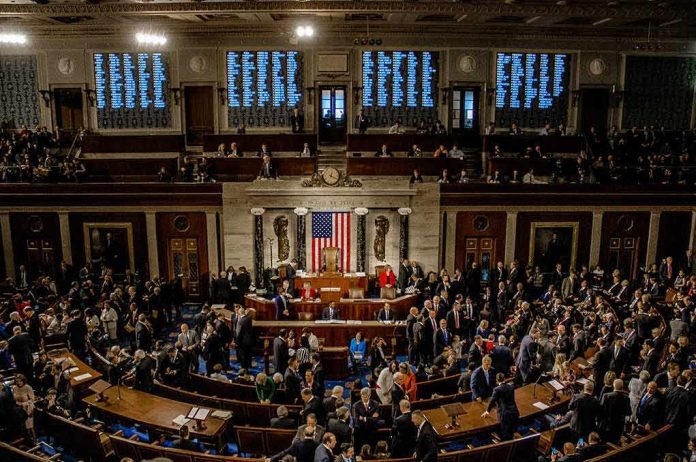
Hakeem Jeffries called his own party’s break-away vote a “significant breach of trust” after eight House Democrats joined every Republican to condemn socialism.
Story Snapshot
- The House passed a resolution denouncing socialism “in all its forms,” 220-192, with eight Democrats crossing the aisle to vote yes.
- House Minority Leader Hakeem Jeffries, Whip Katherine Clark, and Caucus Chair Pete Aguilar all voted no.
- Jeffries called the measure a “MAGA effort to rig the midterm elections” before the vote even happened.
- The resolution also endorsed the SAVE America Act, a voter ID bill most Democrats reject, complicating the socialism debate.
- Leadership warned of “consequences” for the Democrats who broke ranks, exposing a real split inside the party.
What The Resolution Actually Says
The text does not mince words. It states that “socialist ideology necessitates a concentration of power” that has “collapsed into communist regimes, totalitarian rule, and brutal dictatorships.” It blames socialism for over 100 million deaths worldwide and names Lenin, Stalin, Mao, Castro, and Maduro as examples. It also specifically calls out the Democratic Socialists of America, tying the historical argument directly to a modern American political organization.
That last detail matters. By naming the Democratic Socialists of America inside a resolution about famine, gulags, and dictators, Republicans forced a choice. Democrats could either vote for a broad statement against tyranny, or vote no and risk looking like they were defending a group increasingly tied to their party’s rising left flank. Eight of them chose to vote yes rather than take that risk.
The Vote Split Democrats Right Down The Middle Of Their Own Strategy
The final tally was 220-192, with two members voting present. Jared Golden, Vicente Gonzalez, Marie Gluesenkamp Perez, Kathy Castor, Henry Cuellar, Don Davis, Darren Soto, and Gabe Vasquez all sided with Republicans. Every one of them represents a competitive or swing district, the kind of seat that can flip fast if voters sense a lawmaker is soft on an issue like socialism heading into a midterm year.
Jeffries, by contrast, voted no alongside his top two lieutenants. He had already framed the resolution before the vote as a “MAGA effort to rig the midterm elections”, arguing Republicans built the measure to trap Democrats rather than make a genuine ideological statement. That framing gave cover to the 192 Democrats who voted no, but it left the eight defectors standing alone, and it left Jeffries explaining why his own members didn’t buy his argument.
Leadership’s Response Reveals The Real Fight
Democratic leadership did not treat the defection as a minor disagreement. A joint statement from Jeffries, Clark, and Aguilar called the move “a significant breach of trust”. That is unusually sharp language for a nonbinding resolution with no legal weight. It suggests the anger wasn’t really about socialism as an economic system. It was about discipline, optics, and control over the party’s message ahead of an election where Republicans clearly plan to make “socialism” a central attack line.
Democrats publicly justified their opposition by pointing to the resolution’s second half, which endorsed passage of the SAVE America Act, a voter identification bill they call an “election-security crackdown”. That’s a fair policy objection to raise. But it also lets the party sidestep the harder question of why 192 of its members wouldn’t vote for a standalone condemnation of socialism, DSA included, without the voter ID bill attached.
Why This Vote Won’t Just Fade Away
Nonbinding resolutions rarely change law, and this one won’t either. But messaging votes exist for a reason: they put lawmakers on the record before voters go to the polls. Republicans now have a clean, permanent list of which House Democrats voted to denounce socialism and which ones didn’t. That list will show up in campaign ads whether Jeffries likes it or not.
ANALYSIS | The House of Representatives condemns 'socialism in all its forms' with 192 Democrats voting against it
https://t.co/BFDoNLwyge— VOZ (@Voz_US) September 3, 2026
Jeffries can call the vote a trap all he wants. The plain fact is that 192 members of his caucus, including his entire leadership team, would not vote to condemn socialism by name, and eight of his own members thought that position was politically indefensible. Voters heading into the midterms will draw their own conclusions from that split, and no amount of leadership messaging is likely to erase it.
Sources:
twitchy.com, crank.house.gov, nypost.com, cbsnews.com, clerk.house.gov, congress.gov