
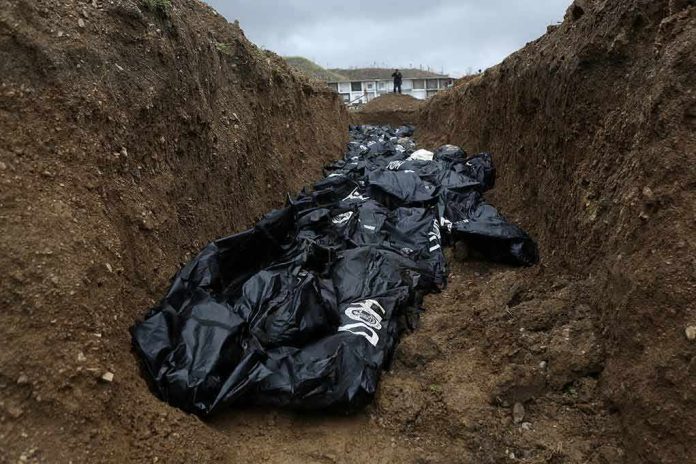
A Kenyan court convicted Paul Mackenzie and his co-accused of murder over 191 starvation deaths, sealing a doomsday cult’s legacy in law and in memory.
Story Snapshot
- The court found Good News International Ministries was a doomsday cult.
- Judges weighed testimony from more than 100 witnesses and expert reports.
- Victims included children, confirmed through exhumations and relatives’ accounts.
- The court ordered all accused to defend themselves after a prima facie case.
The Verdict That Put a Number on Horror
The High Court in Mombasa found Paul Mackenzie and several co-accused guilty on all counts tied to 191 deaths at Shakahola. The case focused on whether a religious leader and his circle turned faith into a weapon. The judge called the group, Good News International Ministries, an apocalyptic cult that met classic signs of coercive control. The conviction followed a staged process. The court ruled the prosecution had a prima facie case on April 15, 2026, requiring the defense to answer.
Prosecutors presented a large record. The Office of the Director of Public Prosecutions called survivors, relatives, detectives, and forensic experts. The state introduced postmortem findings and laboratory reports. Reporting placed the state’s witness count at 121, after earlier coverage tallied 96 when the prosecution first rested. This scale matters. Big claims need a wide base. The court said the base was there, and it moved the case to verdict.
What the Court Saw and Why It Mattered
Judicial summaries described a system with roles: village elders, guards, grave diggers, and cooks inside the settlement. That structure supported the state’s theory of control. Exhumations and family testimony confirmed the dead included children, a fact not meaningfully disputed in court. The judge described scenes of people primed for heaven, new clothes on bodies, and dug graves ready for the next burial. Those details pointed to planning, not chance.
The defense’s counter was simple and stark. At least one accused said people were there by choice and that fasting orders came from the Holy Spirit, not Mackenzie. Courts must weigh belief and blame. Free worship is a right. Causing death is a crime. The judge drew the line where the facts led. Labeling the ministry a doomsday cult clarified intent and effect, not just words and faith.
Proof, Responsibility, and the Children
The prosecution’s strength lay in survivors and facts on the ground. Testimony placed accused people in operational roles that kept the machine running. The state’s filings tied ritual fasting to death, supported by postmortems and government analyst reports. The judge’s earlier ruling that the state had met the first legal threshold set the tone for the finish. The presence of many child victims raised the stakes and underscored the duty to protect the vulnerable.
DPP secures convictions of Mackenzie, and 28 others in Shakahola massacre that led to 191 deaths.
The Director of Public Prosecutions (DPP), Renson Ingonga, CBS, OGW, has today secured the conviction of controversial preacher Paul Nthenge Mackenzie and 28 co-accused for the… pic.twitter.com/u7f5lKQLdu
— Office of The Director Of Public Prosecutions (@ODPP_KE) October 19, 2026
Conservative common sense holds two ideas at once: respect sincere faith, and draw a hard line at harm. The court’s view aligned with that. Law shields worship but punishes coercion that kills. Parents have authority in the home, but the state must act when children face lethal neglect or force. The verdict signals that charisma and end-times preaching do not excuse a chain of acts that lead to graves in a forest.
Aftermath, Accountability, and the Next Guardrails
The judgment also fits into Kenya’s larger effort to fix a system that missed warning signs. A presidential task force reviewed the legal gaps after Shakahola and urged new rules for religious groups. Proposals included a Religious Affairs Commission, fresh registration, better financial oversight, and a clear process to act when health and safety are at risk. These steps aim to separate peaceful worship from high-risk outfits before tragedy repeats.
The criminal case handled the who and what of 191 charged deaths. The policy track now handles the how to prevent the next one. Both lanes matter. Courts close the book on a crime; laws help stop the sequel. The weight of this verdict rests on evidence, not outrage. The court credited witnesses, science, and on-the-ground facts. That is how the system should work. That is also why this ruling will stand as a warning to every would-be prophet of harm.
Sources:
insiderpaper.com, tuko.co.ke, kenyanews.go.ke, the-star.co.ke, rfi.fr, allafrica.com