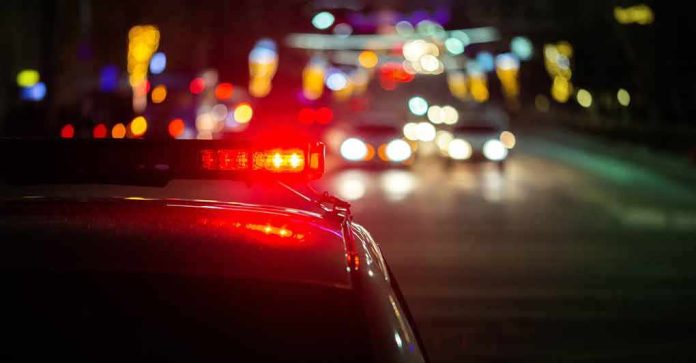
That quick tap on your trunk during a traffic stop is not a nervous habit. It is a move cops have used for decades, and it carries more than one hidden purpose.
Quick Take
- Officers touch the rear of a car for a few repeated reasons: leaving a fingerprint, checking the trunk, and reading the driver’s reaction.
- Multiple explainer sources and even a lawyer interview describe the same handful of rationales again and again.
- No official department manual or training bulletin in the public record spells out the practice as a strict, universal rule.
- The gesture may also help an officer avoid getting hit if the car suddenly moves.
The Fingerprint Theory Keeps Coming Up
Ask why a cop taps your taillight, and the same answer shows up over and over. Officers touch the car to leave a fingerprint or thumbprint behind. If the stop turns violent or the driver flees, that print can prove the officer was there. It is a low-tech backup plan, built for the moment when nothing else goes right.
One explainer video breaks this down clearly, tying it to officer safety and evidence in the same breath. The idea is simple. A print on a bumper cannot be erased as easily as a memory can fade after a chaotic encounter. It is physical proof, sitting quietly on painted metal, waiting to be useful if things go wrong.
Checking The Trunk Matters Just As Much
The second reason is just as common in the reporting. Officers tap the trunk to make sure it is shut tight, and to rule out anyone hiding inside. A loose trunk lid can pop open during a stop, and a hidden passenger is a real threat officers train to consider before they ever reach the driver’s window.
This is not paranoia. It is basic risk management for a job where every stop carries unknown danger. A trooper walking up to a car has no idea who or what is inside. A firm hand against metal answers one small question before the bigger conversation even starts, and that matters when seconds count.
Reading A Driver Before The Window Even Rolls Down
Some sources say the tap also serves as a subtle test. A light touch can startle a nervous driver, and that reaction tells the officer something before words are exchanged. If someone jumps, freezes, or seems overly anxious, that gives the approaching officer a read on the situation before it fully unfolds.
There is also a positioning angle. Approaching from the side and touching the rear keeps the officer out of the direct path if the car suddenly lurches forward or backward. It is a small step that keeps a first responder from becoming a second victim during a routine stop that turns unpredictable.
Why No One Has Produced The Official Rulebook
Here is the honest gap in this story. No public police manual, academy lesson plan, or department policy document has surfaced to confirm these reasons as required training. What exists instead is a chorus of explainer articles, videos, and social posts repeating the same handful of rationales without citing a specific written source.
That does not make the explanations false. Departments rarely publish their smallest tactical habits, and plenty of real police procedure lives in oral training and field experience rather than in a printed handbook. But it does mean the public is trusting repetition, not paperwork, and that distinction is worth remembering the next time a friend swears they have the “real” answer.
What This Means The Next Time You Get Pulled Over
Common sense says the safety explanation carries the most weight. An officer walking up to a stranger’s car alone, at night, on a shoulder with traffic roaring past, has every reason to take small precautions seriously. Touching the trunk and marking the vehicle costs nothing and could matter enormously in the rare bad outcome.
Drivers do not need to overthink the gesture. It is not an accusation, and it is not a trick aimed at catching anyone in a lie. It is a small, practiced habit built from decades of officers trying to come home safe after every single stop, whether the driver is a saint or a fool.
Congress is coming for the cameras that photograph your car.
On July 21, Rep. Tim Burchett filed H.R. 9800, the Protection Against Mass Surveillance Act. It bans every federal agency from buying, operating, or even accessing automated license plate readers. Flock Safety is named… pic.twitter.com/LoLyCTwDbj— Professor Landon Kirby (@LandonKirby6) August 12, 2026
Sources:
reddit.com, youtube.com, callutku.com, wikihow.com, english.elpais.com