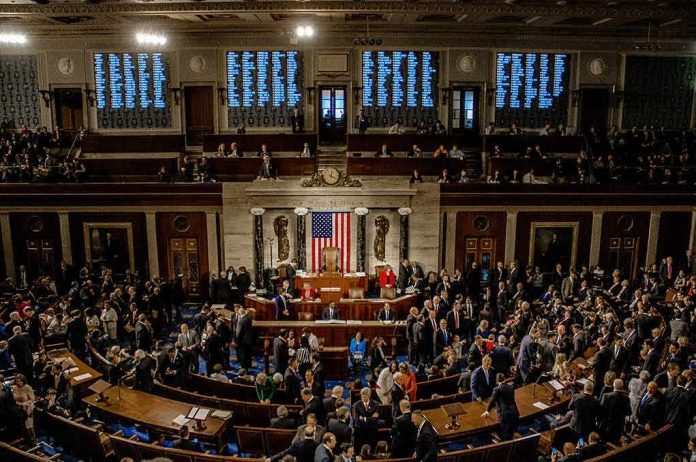
More than 700 House-passed bills are idling on the Senate’s doorstep as the lame-duck clock ticks down.
Story Snapshot
- House Republicans say the Senate has stalled hundreds of House-passed measures.
- Official trackers show high House output with far fewer measures reaching enactment.
- Senate Majority Leader John Thune blames Democratic obstruction and a shutdown.
- The Senate’s filibuster rules and scarce floor time shape what moves and what dies.
The Backlog That Defines The Session’s Final Weeks
Speaker Mike Johnson points to a crowded shelf of House work product and says the Senate is not acting. Congress.gov shows the House introduced thousands of items this Congress, moved hundreds out of committee, and passed about a thousand measures, while a far smaller share became law or received Senate floor time. The gap is not a rumor mill number. It is visible in the chamber-by-chamber activity logs that track what passed, what stalled, and where each bill sits now.
House Republicans argue that this backlog is avoidable if Senate leaders schedule votes. The Senate’s own “active legislation” page lists only a narrow slice of bills queued for action in any given week, with many House bills absent from the near-term agenda. That mismatch fuels the House claim: production without pickup. One can quibble over the exact count any day, but the directional story holds. The House moved a lot. The Senate moved a little of it.
Thune’s Defense: Democrats, Shutdowns, And The Rules Of The Game
Senate Majority Leader John Thune counters that Democrats blocked consequential bills and slowed the calendar. He says Democrats chose politics over progress on items his caucus views as core reforms. He also cites a Democratic-led shutdown as a reason appropriations work slid behind schedule. Those defenses match a known Senate reality: most bills need 60 votes to end debate, and the chamber’s rules hand a minority many ways to run out the clock. That does not erase the backlog; it explains part of it.
Thune also faces pressure from the right to “force the issue” on election and border bills. Political outlets reported he lacked the votes to blow up the debate threshold for the Safeguard American Voter Eligibility Act, and that Republicans hold 53 seats, short of the usual 60-vote mark. Conservative House voices argue the Senate majority can force a talking filibuster and drag opponents to the floor for days to secure a vote, but that path demands time, unity, and stamina rarely seen in modern practice.
What The Data Proves, And What It Does Not
Public trackers prove volume, not villainy. The House has pushed out a large stack of bills, resolutions, and message responses; the Senate has elevated only a fraction to floor debate or final passage. That is the measurable fact. Assigning sole blame to one leader goes beyond what the data alone can show. Floor time is finite. The minority uses the rules. Party brands lean into conflict on hot issues. The pileup is real; the cause is shared. That said, voters expect the majority to spend its scarce time on priorities, not process excuses.
American conservatives judge outcomes, not speeches. If border security, election integrity, and spending discipline top the list, then voters will ask why those bills did not get votes. Thune’s case that Democrats blocked movement has merit where the 60-vote wall stands tall. But leadership still sets the calendar and the fight plan. When a bill matters, the Senate can hold nights and weekends, force debate, and make the other side pay a cost. If that leverage goes unused, the backlog starts to look like a choice.
The Clock, The Cost, And The Next Move
Lame-duck sessions magnify tradeoffs. Every hour given to nominations or commemoratives is an hour not given to a House bill that could become law. Congress has moved major items in late sessions when leaders focused and cut deals, including stopgaps that kept government open and on a glidepath to conference. That history teaches a plain lesson: pick a small list, write tight text, and demand votes. If everything is a priority, nothing is.
Yup. He deliberately stalled the Senate. Mike Johnson was getting bills passed left and right in the House. They passed the SAVE America Act 9 times only to see it all die on the Senate floor
— Patrick R Courtney (@PatrickRCo70064) November 10, 2026
Here is the bottom line that should guide the final stretch. First, publish the true, time-stamped list of House-passed bills that could clear a simple majority in the Senate if brought to a vote. Second, run a visible floor plan that forces debate on two or three core items and burns the clock in full public view. Third, convert messaging bills into vehicles with pay-fors and clear enforcement so the Senate parliamentarian and swing votes cannot shrug. If the Senate does that and Democrats still block, voters will see it. If not, they will see that too.
Sources:
congress.gov, thune.senate.gov, usatoday.com, cambridge.org