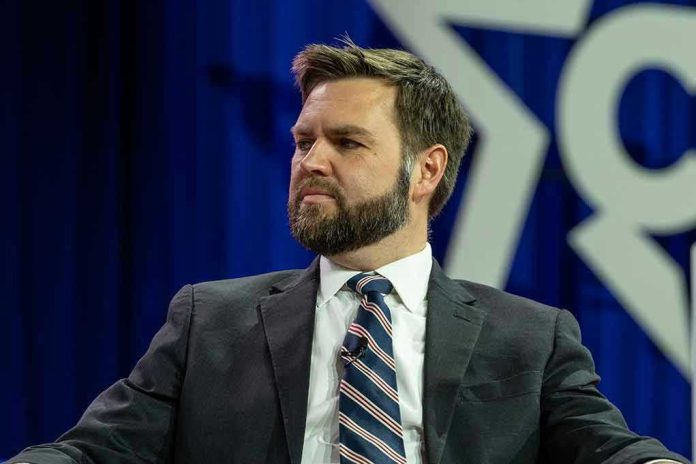
Why did Vice President JD Vance choose to skip Mar-a-Lago during Trump’s dramatic military operation capturing Venezuelan President Nicolás Maduro?
Story Overview
- Vance’s absence during the Venezuela raid raises questions about strategic decision-making.
- Trump directed operations from Mar-a-Lago, continuing a pattern of high-stakes oversight.
- Maduro was captured by U.S. Army Delta Forces, leading to regional condemnation.
- Vance’s absence could suggest operational security or political maneuvering.
The Curious Case of JD Vance’s Absence
Vice President JD Vance was notably absent from Mar-a-Lago during the significant military operation that led to the capture of Venezuelan President Nicolás Maduro. Vance had visited President Trump at a nearby golf course on Friday but chose to return to Ohio before the operation’s conclusion on Saturday. This decision leaves room for speculation about the strategic, security, or political motivations behind his absence.
While Trump was at the helm of the operation from the fortified rooms of Mar-a-Lago, Vance was in Ohio. This deliberate absence contrasts with Trump’s hands-on approach, reminiscent of his oversight of previous military operations such as the Soleimani strike. This has led to questions about whether Vance’s absence was a strategic move to avoid any potential fallout or to maintain operational security.
Trump’s Command Center: Mar-a-Lago
Mar-a-Lago has become a familiar setting for President Trump to manage high-stakes military operations. Since 2020, the resort has served as a command center, with Trump overseeing operations like the Qasem Soleimani assassination and air campaigns against Houthis from its secure facilities. The Venezuela operation fits this pattern, with Trump announcing Maduro’s capture from Mar-a-Lago’s Tea Room, asserting U.S. control over Venezuela.
The setup at Mar-a-Lago includes black drapes, monitoring equipment, and real-time intelligence feeds, allowing Trump to direct operations away from prying eyes. Despite the luxurious surroundings and the presence of guests, the resort has functioned as a crucial site for decisive military actions, blending leisure with high-level decision-making.
There's a Reason Why JD Vance Wasn't at Mar-a-Lago During Venezuela Raid. https://t.co/Ec2gHIHY3f
— Doug Bell (@therealdougbell) January 4, 2026
Regional and International Reactions
The capture of Nicolás Maduro by U.S. Army Delta Forces in Caracas has sparked regional condemnation. Critics have raised concerns about the legality of the operation, arguing that it violates Venezuelan sovereignty. Despite these criticisms, Trump has framed the operation as a necessary action to bring justice to a leader accused of narco-terrorism.
Maduro’s arrival in New York to face charges has heightened tensions between the U.S. and Latin American countries. While the Trump administration views the operation as a success, the potential for U.S. occupation of Venezuela adds complexity to the geopolitical landscape, with long-term implications for U.S.-Latin America relations.
Implications for U.S. Politics and Beyond
The Venezuela raid has significant implications for U.S. politics and international relations. Domestically, it bolsters Trump’s image among supporters who view the operation as a demonstration of decisive leadership. However, it also raises questions about the legality of extraterritorial raids and the use of private resorts as operational hubs.
For Venezuela, the operation marks a turning point, with the potential for U.S. influence over the country’s resources and political future. The international community remains divided, with some praising the action against a regime accused of narco-terrorism, while others condemn it as an overreach of U.S. power. The operation sets a precedent for future actions against indicted leaders, potentially redefining international norms and expectations.