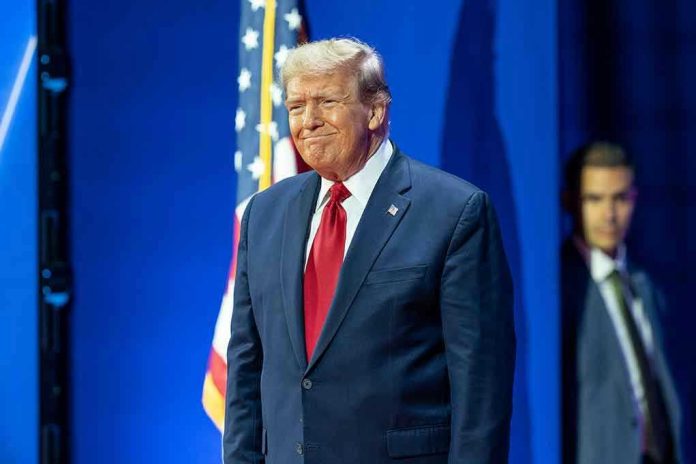
President Donald Trump just wiped clean the criminal records of five NFL legends whose falls from grace involved marijuana busts, cocaine conspiracies, counterfeiting schemes, and perjury—one even receiving his pardon from beyond the grave.
Story Snapshot
- Trump pardoned five former NFL players on February 12, 2026, including Hall of Famer Joe Klecko and three-time Super Bowl champion Nate Newton for crimes ranging from drug trafficking to perjury
- The pardons covered offenses spanning four decades, from Billy Cannon’s 1980s counterfeiting conviction to more recent drug trafficking cases involving 175 pounds of marijuana and interstate cocaine conspiracies
- Cowboys owner Jerry Jones personally delivered the news to Nate Newton, while White House pardon advisor Alice Marie Johnson framed the clemency as acts of redemption mirroring football’s themes of perseverance
- Billy Cannon received his pardon posthumously, eight years after his 2018 death, clearing the name of the 1959 Heisman Trophy winner
When Gridiron Glory Meets Federal Crime
The five men who received presidential mercy represent a startling cross-section of NFL achievement and criminal misconduct. Joe Klecko earned four Pro Bowl selections and a spot in the Pro Football Hall of Fame just three years before his pardon for perjury in an insurance fraud investigation. Nate Newton anchored the Dallas Cowboys offensive line through three Super Bowl victories and six Pro Bowls before authorities discovered 175 pounds of marijuana and ten thousand dollars cash connected to his trafficking operation in 2001. These weren’t fringe players making desperate decisions—they were elite athletes whose competitive intensity apparently extended into illegal enterprises.
The Crimes Behind the Cleats
The criminal conduct varied dramatically in scope and motivation. Jamal Lewis, the 2003 NFL Offensive Player of the Year, attempted to facilitate a cocaine transaction in 2000 shortly after the Baltimore Ravens drafted him. Travis Henry, a Pro Bowl running back who played for multiple teams, pleaded guilty to cocaine conspiracy charges involving operations stretching from Colorado to Montana. Billy Cannon’s counterfeiting conviction in the mid-1980s stemmed from financial desperation after his professional career ended, a cautionary tale about athletes unprepared for life after football’s paychecks stop arriving.
The Personal Touch of Presidential Clemency
Jerry Jones didn’t delegate the Newton notification to subordinates or issue a press release. The billionaire Cowboys owner personally called his former offensive lineman to deliver the news that his federal conviction had been erased. This personal involvement reveals the tight-knit relationships that persist between NFL ownership and players who helped deliver championships. Alice Marie Johnson, Trump’s pardon advisor who herself received clemency from the president during his first term, announced the pardons with football metaphors about grit and rising again. The White House provided no official explanation for why these specific athletes warranted presidential intervention while countless other non-celebrity offenders remain convicted.
"Trump pardons 5 ex-NFL players for crimes including drug trafficking" – CBS News #SmartNews
Pardons for sale! https://t.co/OxKtbwvxv4— Kay (@kay95404) February 13, 2026
A Pattern of High-Profile Pardons
Trump’s clemency decisions have consistently favored individuals with celebrity status, personal connections to his inner circle, or cultural resonance with his political base. The Constitution grants presidents virtually unlimited pardon power, and Trump has exercised it more liberally than many predecessors for drug offenses listed on Department of Justice records dating to 2025. These five NFL pardons fit comfortably within that pattern—famous athletes whose past glories apparently outweighed their criminal conduct in the administration’s calculus. The emphasis on second chances sounds noble in press statements, but the absence of similar mercy for unknown offenders serving time for identical crimes raises legitimate questions about equal justice.
What Pardons Actually Accomplish
For the living recipients, these pardons eliminate legal barriers to employment, restore certain civil rights, and remove the stigma of federal conviction from background checks. Joe Klecko can now enjoy his Hall of Fame status without the shadow of his perjury conviction. Nate Newton, Jamal Lewis, and Travis Henry gain practical benefits in travel, professional licensing, and social standing. Billy Cannon’s posthumous pardon provides no tangible benefit to him, but offers his family the symbolic restoration of his reputation—the 1959 Heisman winner’s legacy no longer carries the stain of counterfeiting. Whether these men deserved clemency more than thousands of other drug offenders remains a question the White House declined to address.
Sources:
Trump pardons 5 former NFL players for crimes ranging from perjury to drug trafficking – WFMJ
Trump pardons 5 ex-NFL players – AOL
Trump pardons 5 ex-NFL players for crimes ranging from perjury to drug trafficking – The Score
Clemency Grants by President Donald J. Trump (2025-Present) – U.S. Department of Justice