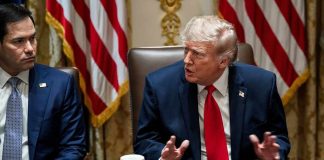
Donald Trump’s limited security guarantees for Ukraine shatter illusions of endless Western support, forcing Kyiv to confront harsh realities of survival without NATO’s embrace.
Story Snapshot
- Trump proposes 30-day ceasefire with frozen frontlines and bilateral U.S.-Ukraine pact, explicitly rejecting NATO membership.
- Zelenskyy rejects the plan, demanding full territorial restoration and NATO path amid waning public support.
- Putin accepts ceasefire but insists on recognition of Crimea and Donbas annexations.
- UK and France criticize guarantees as insufficient, leaking concerns over NATO credibility.
- Talks mediated by Turkey and Qatar stall as Trump’s January 20, 2026, inauguration looms.
Trump Unveils Bold Peace Framework
On December 15, 2025, President-elect Donald Trump announced his peace plan via Truth Social after a phone call with Vladimir Putin. The proposal demands a 30-day ceasefire and frozen frontlines. Trump offers limited U.S. security guarantees through a bilateral pact with Ukraine. This excludes NATO membership or full Western military backing. Trump’s approach prioritizes quick de-escalation under America First principles. U.S. fatigue from over $350 billion in aid drives this shift from Biden-era commitments.
Zelenskyy relies on external support as Ukraine controls only 82% of its territory. Russia’s military edge persists despite stalemates. Common sense dictates negotiating from strength, not endless war draining American resources. Trump’s plan aligns with conservative values of avoiding foreign entanglements.
Zelenskyy Rejects Concessions
Ukraine President Volodymyr Zelenskyy dismissed Trump’s framework during a December 20, 2025, Kyiv press conference. He insists on NATO accession and complete territorial restoration, including Crimea and Donbas. Polls show his approval at 60%, with public war fatigue rising. Zelenskyy views limited guarantees as surrender to Russian demands for demilitarization. His stance risks frontline collapse if U.S. aid pauses. This maximalist position overlooks Ukraine’s dependency on Western weapons and funds.
Historical precedents like Minsk agreements failed due to similar unmet demands. Zelenskyy’s impeachment-linked tension with Trump complicates direct talks. Facts support Trump’s realism: Ukraine cannot reclaim 18% of territory without escalation costing American lives and treasure.
Putin Counters with Territorial Demands
Russian President Vladimir Putin responded on December 23, 2025, via Kremlin statement. He welcomes the ceasefire but requires recognition of annexed Crimea and Donbas regions. Putin leverages Russia’s control over 18% of Ukraine and energy holds on Europe. Daily casualties near 500 underscore stalemate urgency. Putin’s openness signals negotiation willingness, contrasting Zelenskyy’s rigidity.
Trump’s direct Putin engagement bypasses traditional channels, echoing his 2019 Helsinki summit. This pragmatism pressures Russia economically through sanctions while avoiding U.S. troop commitments. Conservative wisdom favors deal-making over prolonged conflict.
European Allies Voice Opposition
Leaked EU diplomatic cables on December 26, 2025, revealed UK Prime Minister Keir Starmer and French President Emmanuel Macron’s skepticism. They label Trump’s guarantees “paper tigers” weakening NATO credibility. European nations provided over €100 billion in aid but face fatigue. Brussels meetings on December 29 oppose limited U.S. commitments. These allies lack veto power over bilateral U.S.-Ukraine deals.
EU divisions highlight transatlantic fractures. Trump’s plan shifts burden-sharing realities, compelling Europe to step up. This realignment strengthens American interests by curbing overreliance on U.S. defense spending.
Stalled Talks and Looming Deadline
Turkey and Qatar mediate talks in Istanbul and Doha. Turkish officials report 70% agreement on ceasefire technicalities as of December 28, 2025. Zelenskyy’s virtual call with Trump occurred December 29 amid Russian Foreign Minister Lavrov’s territory warnings. Markets reacted with ruble gains and oil rises. Trump’s Fox News clarification emphasized “no blank checks—peace first.”
Short-term ceasefire could save lives and stabilize global food prices. Long-term risks include frozen conflict emboldening aggressors. Expert Michael Kofman notes Ukraine’s dependency exposure. Fiona Hill warns of Munich echoes, but facts favor de-escalation over indefinite war aligning with common sense restraint.