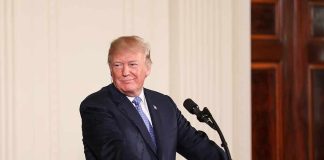
A Supreme Court loss on tariffs triggered something rarer than a courtroom upset: a president publicly torching two justices he handpicked.
Quick Take
- The Supreme Court voted 6-3 to block President Trump’s sweeping tariffs imposed under the International Emergency Economic Powers Act.
- Trump responded the same day with personal attacks aimed especially at Justices Neil Gorsuch and Amy Coney Barrett, both of whom he appointed.
- The ruling draws a hard line between “regulating trade” and imposing a tax, pushing tariff authority back toward Congress.
- Importers now stare at a messy refunds fight that could drag on for years, with estimates reaching $170 billion.
A 6-3 Decision That Turned Tariffs Into a Constitutional Flashpoint
The Supreme Court’s 6-3 ruling against Trump’s global tariffs did more than block a policy; it signaled that emergency-statute shortcuts have limits even in trade and foreign affairs. The legal question centered on whether IEEPA lets a president slap broad tariffs on imports by calling it “regulation.” The Court rejected that reading, treating tariffs as a taxing power that needs clear congressional authorization.
That distinction sounds academic until it hits your wallet and your separation of powers. Presidents can restrict imports in multiple ways, but taxation carries a different constitutional weight because it reaches into Congress’s core role. The practical result: Trump lost his most flexible lever for instant, across-the-board tariff pressure. The political result: the most scrutinized conservative legal minds in the country became targets of a presidential counterpunch.
Trump’s Public Rebuke of Gorsuch and Barrett Raises the Stakes for Judicial Independence
Trump’s response landed fast and personal. He singled out Neil Gorsuch and Amy Coney Barrett, both appointees, after they joined the majority against him. Reports describe him calling certain justices “a disgrace to our nation” and suggesting foreign interests influenced them, without providing evidence. That move matters because it shifts the argument from law to loyalty, a test no judge should have to pass.
Conservatives who value constitutional structure should feel tension here. A strong executive can negotiate hard and defend his policy goals, but the judiciary’s job is to interpret the law, not protect a president’s program. When a president implies a justice is compromised because of an adverse decision, he risks turning legitimate disagreement into a smear campaign. The facts available so far don’t support the foreign-influence insinuation, which makes that claim look like heat without light.
What the Court Actually Said: “Major Questions” Meets Emergency Powers
Legal coverage of the case highlighted how the justices approached the same question through different methods. The Court’s majority, led by Chief Justice John Roberts, concluded IEEPA didn’t clearly authorize tariffs. Gorsuch reportedly wrote a lengthy concurrence emphasizing the “major questions” doctrine, which demands unmistakable congressional clarity for economically and politically huge actions. Barrett wrote separately as well, signaling internal conservative debate even while joining the same outcome.
That internal debate is the part most casual observers miss, and it’s the real foreshadowing. The Court didn’t just rule on one tariff program; it laid down a template for scrutinizing future administrations that try to stretch old statutes into new powers. Conservatives usually cheer when courts resist bureaucratic creativity. The common-sense question is whether anyone should want a president of either party to discover brand-new taxing authority inside a law never used that way for decades.
The Money Question: Refunds, Uncertainty, and a Long Court Fight
The ruling also cracked open a pocketbook problem: what happens to tariffs already paid. Reporting describes potential refunds reaching $170 billion, and the Supreme Court did not spell out a clean process for returning money. That omission almost guarantees years of litigation, because refunds involve timing, proof, supply-chain pass-throughs, and who ultimately bore the cost—importers, businesses, or consumers paying higher prices.
Trump’s own frustration with that uncertainty became part of the storyline; he predicted extended court battles. Businesses now have to plan inventories and pricing while also treating tariff payments like disputed charges that might come back—or might not. Foreign trading partners, temporarily relieved, can’t assume the pressure disappears. They’re watching for the next mechanism Washington uses, because the Court blocked one tool, not the economic and political incentives behind it.
The Next Move: A New 10% Tariff Claim and Congress Back in the Driver’s Seat
Trump announced a new 10% global tariff concept and insisted he doesn’t need Congress because the authority “has already been approved.” The Court’s logic points the other direction: if tariffs function as taxes, Congress must authorize them clearly. That sets up a collision between presidential confidence and legal reality. The path forward likely runs through narrower statutes, targeted measures, or negotiations that use tariff threats more than tariff collections.
Congress also becomes the main stage for the next act. Republican tariff skeptics have already shown willingness to resist, and Democrats won’t hand over broad taxing authority easily. For readers over 40 who remember when “tariffs” sounded like a dusty chapter in civics class, this is the modern version of the old fight: who gets to tax, and how fast. The Court just told Washington to slow down and follow the Constitution’s map.
JUST IN: Trump Nukes Neil Gorsuch and Amy Coney Barrett Following Tariff Ruling
Jordan Conradson Feb. 20, 2026https://t.co/aPO2vwYbt9— Eduardo Barranco (@Eduardo19832958) February 21, 2026
The deeper takeaway isn’t whether you love or hate tariffs; it’s that a conservative court still refused to invent emergency taxing power for a conservative president. That should reassure anyone who wants judges to call balls and strikes rather than serve as political insurance. Trump can keep selling pressure politics, but the Court’s message stands: authority counts more than theatrics, and Congress sits closer to the tariff trigger than the Oval Office wants to admit.
Sources:
donald-trump-tariff-supreme-court-reaction-00791245
a-breakdown-of-the-courts-tariff-decision