One small civilian airplane wandering where it should not be can bring North American air defenses, presidential security, and media panic roaring to life in minutes.
Story Snapshot
- Fighter jets scramble any time a mysterious radar blip drifts toward protected airspace, especially near Washington, D.C. or a president.
- Most of these intercepts turn out to be clumsy mistakes or communication failures, not terrorists or foreign bombers.
- Every “routine” scramble still tests how seriously the government takes its duty to shield American skies.
- Media framing often leaves the public more thrilled by flares than informed about what actually went wrong.
Why Fighter Jets Launch Over A Single Wayward Plane
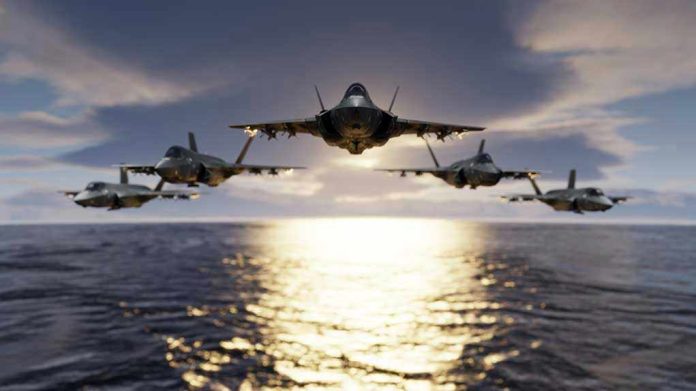
When a civilian aircraft stops talking to controllers or drifts toward a no-go zone, the North American Aerospace Defense Command, known as NORAD, does not wait to see how the story ends. It scrambles fighters, often F-15 or F-16 jets, to get eyes on the cockpit and force a decision in real time. NORAD’s own incident reports describe these launches as routine but urgent responses to a possible hijacking or airspace violation, not Hollywood-style dogfights.[3]
In one such case, NORAD launched two F-15s from Homestead Air Force Base in Florida after a civilian aircraft signaled that it was hijacked.[3] Controllers lost clarity on what was happening inside that cabin. Within minutes, armed fighters were racing to join the mystery aircraft. Once communications were restored with air traffic control in Miami, officials decided the frightening signal was a communications error, not a terrorist plot. The fighters simply shadowed the plane until it landed safely at Miami International Airport.[3]
How A “Communications Error” Becomes A National Security Event
Federal aviation and homeland security rules treat silence and confusion in the sky as a threat until proven otherwise. A transponder code suggesting hijacking or a sudden loss of radio contact triggers preplanned checklists. Controllers try alternate frequencies, relay calls through other aircraft, and coordinate with NORAD. When that fails or when a plane approaches restricted airspace without proper clearance, NORAD sends fighters to visually identify the aircraft, check the cockpit, and be ready to act if things look hostile.[3]
That posture explains why jets race up the East Coast whenever a small business jet or privately owned prop plane strays toward Washington’s Air Defense Identification Zone or a Temporary Flight Restriction established to protect a president. NORAD confirmed one event where a Beech King Air 350 violated the identification zone over Washington, D.C.; two F-16s from Andrews intercepted and escorted it to Winchester Regional Airport in Virginia. No dramatic finale followed, but the mission proved the system would not gamble with the capital’s safety.
Presidential Airspace: Why Trump’s Movements Triggered Scrambles
Temporary Flight Restriction zones follow presidents like invisible domes. When Donald Trump spent weekends at Mar-a-Lago or Bedminster, federal authorities drew rings in the sky that small-town pilots ignore at their peril. Coverage from those periods describes fighters intercepting civilian aircraft that wandered into those bubbles, sometimes firing flares to get a distracted pilot’s attention and escorting them back out.[1][2][6] The same pattern would apply around Washington, D.C., where the stakes are even higher.
Witnesses see fighters carving across the sky, hear sonic booms, or notice bright streaks of flares and assume something catastrophic is unfolding. NORAD’s public statements undercut that drama. The command explains that flares burn out quickly, are used to communicate with pilots, and are designed not to endanger people on the ground.[1] Conservative instincts about peace through strength fit neatly here: show unmistakable capability, act early, but do it with discipline and an eye toward not harming innocents.
Media Spectacle, Public Confusion, And Common-Sense Questions
Most Americans hear about these events first through breathless social clips: “breaking” alerts, shaky phone video of jets overhead, someone speculating about war or an assassination plot. The underlying stories are usually more mundane. A pilot misread a notice, busted a Temporary Flight Restriction line, or fumbled radios. NORAD’s own record in the hijack-signal incident admits the scary part boiled down to a miscommunication that officials sorted out once they got the pilot back on frequency.[3]
That gap between spectacle and substance fuels distrust. On one hand, citizens want the government to react instantly when an unknown aircraft appears near the Capitol or a president’s location. On the other hand, when the final explanation is “communications error,” some ask whether officials exaggerated the threat. The conservative common-sense view lands in the middle: better to scramble and discover a mistake than shrug and risk another September 11 style surprise. The real problem is not the response but the thin explanations afterward.
What These Scrambles Reveal About Our Security Priorities
These repeated intercepts around D.C., Mar-a-Lago, Bedminster, and even foreign flights headed to Montreal form a pattern: the system is built to treat ambiguity as danger.[5] That bias reflects a clear priority—a president’s life, the nation’s capital, and crowded air corridors matter more than a momentary scare on cable news. Fighters will continue to roar off alert ramps any time a pilot blunders into the wrong airspace or drops off the radio at the wrong moment, no matter which party holds the White House.
Yet the government does itself no favors by offering only bare-bones press notes while letting speculation run wild. A stronger model would pair tough, rapid responses with fuller after-action transparency: what signal triggered the alarm, how controllers handled it, whether the pilot faced penalties, and what training or technology changes followed. That kind of accountable toughness would reassure citizens that when jets scramble over D.C., the reaction is not theater but disciplined stewardship of the skies they trust their families to fly through.
Sources:
[1] Web – Fighter jets scrambled, flares deployed after plane spotted near …
[2] Web – Fighter jets scrambled after civilian aircraft violates Trump airspace …
[3] Web – NORAD fighters scrambled today
[5] Web – NORAD scrambles fighter jets to accompany flights to Montreal
[6] Web – Fighter jets scrambled, flares fired after planes violate Trump …