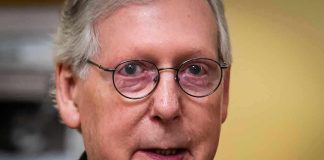
Trump’s charge that Maryland Governor Wes Moore “attacked the United States Air Force and our military” hinges on a feud where one side claims disrespect while the other insists it is defending constitutional limits and sound policing.
Story Snapshot
- Trump escalated a running dispute by casting Moore’s legal critique of troop use as an attack on the military [1].
- Moore, a veteran and state Guard commander, argued service members must reject unlawful orders, not that the military is at fault [5].
- The quarrel grew out of crime, immigration, and even sewage disputes, then migrated to troop deployment [1][4].
- The record shows policy-and-law arguments more than direct criticism of the Air Force as an institution [4][5].
How a Law-and-Order Fight Turned Into a Fight About the Military
Donald Trump and Governor Wes Moore have traded jabs for months on crime, immigration, and local management, creating a ready-made frame where every new dispute gets absorbed into a larger legitimacy brawl [1]. Trump’s recent punch line: accuse Moore of attacking the United States Air Force and the military. The core of Moore’s response did not target service members; it challenged the legality and wisdom of using troops as a tool of urban crime control, including references to National Guard deployment debates [4][5].
Trump’s style favors simple villains over legal nuance; that approach turns Moore’s constitutional language into a headline that implies anti-military animus. The coverage shows Moore criticized the idea of using American cities as training or staging grounds and labeled such directives unlawful, invoking the duty to disobey illegal orders [5]. That claim strikes at presidential decision-making, not at the integrity or valor of the forces themselves. Still, the accusation that someone is “attacking the military” travels faster than a lecture on constitutional authority.
What Moore Actually Said and Why It Matters
Moore presented himself as both a veteran and commander in chief of the Maryland National Guard while emphasizing respect for troops and their families [5]. He argued that members of the armed forces must reject unlawful orders, a principle taught from basic training upward, and he cast proposed or threatened uses of troops in domestic policing as outside proper legal bounds [5]. On network interviews responding to Trump’s barbs, Moore focused on crime policy performance and federal-state roles rather than on the United States Air Force specifically [4].
That specificity matters for readers who care about both public safety and constitutional order. The question at hand is whether a president can lean on uniformed forces for civilian law enforcement in routine urban conditions, and whether governors should accept that as “help.” Moore’s stance sought federal assistance via funding, investigators, and prosecutors rather than boots on city streets—a classic limited-government preference for targeted tools over martial optics [4][5]. Casting that position as anti-military blurs a line American conservatives have traditionally protected: support the troops while demanding lawful, appropriate missions.
The Political Incentives Behind the Air Force Flashpoint
Trump benefits from reframing complex legal objections as personal disrespect because it rallies supporters around the flag and paints opponents as culturally hostile. Local news documented how the quarrel sprawled from sewage spills to immigration to crime metrics, priming audiences to hear every new jab as proof of broader failure or malice [1]. Moore’s sharp language—using terms like “unlawful”—made it easy for critics to conflate his legal claims with hostility to the uniform, despite the record showing institutional respect paired with constitutional guardrails [5].
🚨 TRUMP JUST DROPPED A TRUTH BOMB ON GOV. WES MOORE.
The Governor of Maryland is straight up ATTACKING our Military and Wounded Warriors by halting the renovation of golf courses at Joint Base Andrews, turning dilapidated courses into world class Jack Nicklaus designs for our… pic.twitter.com/kFVDH0EIfX
— William Lucas Joe (@william_LU_joe) June 6, 2026
Common sense suggests drawing a boundary. Citizens can applaud the bravery and professionalism of the military while questioning whether politicians should deploy troops into domestic crime fights. The available interviews and clips show Moore arguing on those terms, not insulting the Air Force or rank-and-file troops [4][5]. If new documentation surfaces showing Moore naming the Air Force directly, that would change the ledger. Based on what is on tape now, this is an argument over lawful authority and sound policing strategy, not a swipe at those who wear the uniform.
Sources:
[1] Web – NEW: Trump SLAMS Maryland Governor Wes Moore for “Attacking the United …
[4] YouTube – Trump blasts Maryland Gov. Moore over Potomac sewage spill
[5] YouTube – Gov. Wes Moore responds to Trump’s attacks against him