The most revealing part of the Bronx McDonald’s crash is not the flying car, but how quickly a sketchy narrative hardened before anyone actually proved what happened.
Story Snapshot
- A car went airborne and smashed into a Bronx McDonald’s, wedging into the brick wall and shutting the restaurant down.[1][4]
- Two occupants allegedly jumped out and ran, launching a police search and a lot of instant speculation.[1][4]
- Early news hits pushed a “car plows into McDonald’s, driver flees” storyline without real evidence about speed, intent, or cause.[3][4]
- Comparable crashes at other McDonald’s locations show how storefront impacts often get overhyped before facts catch up.[2][3]
The Bronx McDonald’s crash and what we actually know
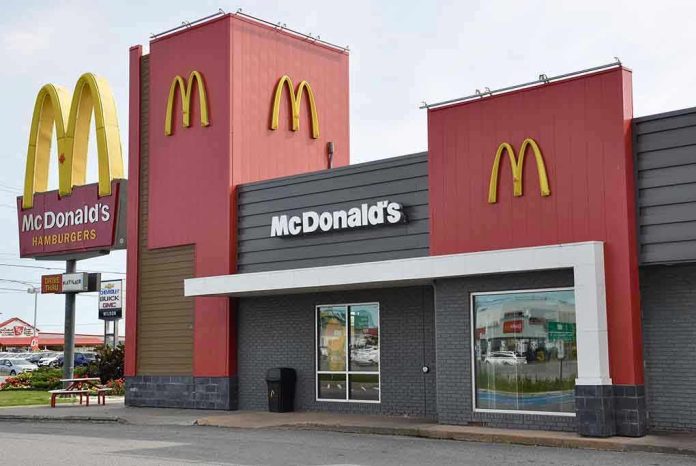
Customers at a McDonald’s on Bruckner Boulevard in the Bronx watched a car go airborne and slam into the side of the building, hard enough to punch a hole in the brick and wedge the front end into the wall.[1][4] Local television reported that police were searching for two people after the crash and showed the sedan embedded in the restaurant’s side, with the building shut down and the investigation labeled ongoing.[3][4] Officials reported no injuries but closed the location until further notice.[1]
Reporters on scene described the car as “embedded in the side wall of the fast food restaurant,” language that naturally feeds a mental picture of reckless speed and total loss of control.[3] Another outlet stated there were two people in the car and that they both fled the scene after the impact.[1] That witness-backed detail became the emotional hook: not just a freak crash, but a hit-the-building-and-run episode that pairs dramatic video with a chase narrative.[1][4]
Where the flight-and-negligence narrative outran the evidence
CBS New York’s segment framed the story around the collision and the police effort to locate “two people” but did not state who was driving or how fast the car was going.[3] The transcript even acknowledged that no further details on the cause were available at the time.[3] That gap matters. Without a speed estimate, mechanical inspection, or medical history, claiming “reckless driver plows into McDonald’s and runs” is not supported by the record; it is an assumption grafted onto a striking image.[3][4]
Eyewitness reporting that two occupants got out and ran immediately adds credibility to the claim that people fled, but not to why they crashed.[1][4] Fleeing looks bad. It can signal intoxication, fear of arrest, or simple panic. Yet early coverage included no police collision report, no event data recorder download, and no medical explanation from anyone in the car.[3][4] Conservative common sense says: if the state has proof of wrongdoing, it should present it; until then, the public should withhold judgment rather than let a headline convict.
Comparable crashes show how different these stories can be
A similar collision at a McDonald’s in Belleville, New Jersey, underscores how deceptive first impressions can be.[2] A driver left the roadway, struck the restaurant’s glass storefront, and injured two women inside, who were taken to the hospital with non-life-threatening injuries.[2] The damage looked severe, but the driver stayed at the scene, and police emphasized that the cause remained under investigation; the only proven violation was an unregistered vehicle, not a confirmed reckless stunt.[2]
Another McDonald’s crash in St. Louis produced equally dramatic footage of a car deep inside the building, yet reporters on scene repeatedly told viewers that officials still did not know what caused it and raised possibilities like a medical emergency.[3] That coverage showed a more restrained model: acknowledge what is obvious from the scene—car, damage, injuries—while openly admitting that investigators have not pinned down responsibility.[3] In the Bronx case, the temptation to lean into “airborne car, fleeing occupants” overshadowed similar caution.
Why the missing pieces matter for accountability and public trust
Vehicle-into-building crashes fall into a familiar pattern: the visible damage is immediate and obvious, while the cause is slow and technical.[3][4] Police must sort through witness accounts, surveillance footage, and mechanical evidence before they can credibly say whether this was drunk driving, a stuck throttle, a heart episode, or pure carelessness. When media and social feeds present early police sound bites as settled fact, they short-circuit that process and prime jurors, neighbors, and voters to assume guilt before proof.[3][4]
A conservative reading of this Bronx McDonald’s story demands two things at once: firm accountability when evidence proves a hit-and-run crime, and skepticism toward narratives built on partial records and sensational images. If New York City police ultimately produce a reconstruction, inspection findings, or charges that show deliberate recklessness, the driver should face the consequences. Until then, the honest position is that we know a car went airborne, crashed into a McDonald’s, and that two occupants allegedly ran—but we do not yet know why.[1][3][4]
Sources:
[1] Web – Car plows through NYC McDonald’s — then driver immediately flees the …
[2] Web – Two Injured After Car Crashes Into A Mcdonalds In Belleville
[3] YouTube – Car Crashes Into McDonald’s In Brooklyn, 1 Hurt
[4] Web – Car crashes into McDonald’s in the Bronx, 2 sought, police say