

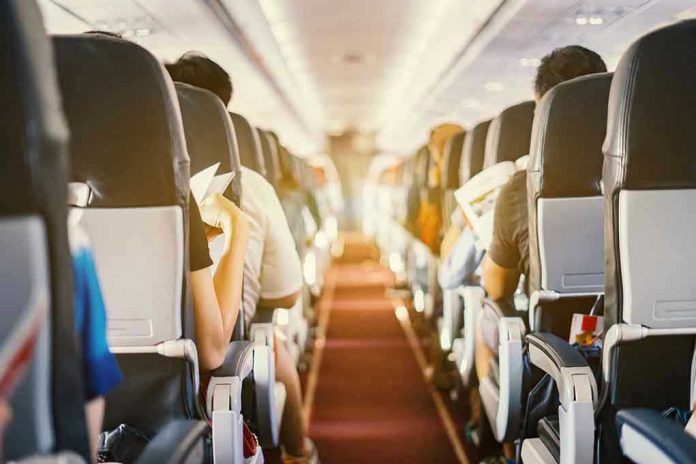
United just turned one of flying’s most common annoyances into a kick-off-the-plane offense, and that should grab every traveler’s attention.
Quick Take
- United now requires headphones or earbuds for any personal-device audio, from movies to games.
- Refusing to comply can escalate beyond a warning to removal from the aircraft or even a ban.
- Flight attendants enforce it, and the airline’s contract-of-carriage leverage tilts the power dynamic sharply.
- The policy signals a broader shift: airlines increasingly codify “common courtesy” because voluntary manners stopped working.
United’s Headphone Rule: Courtesy Became a Condition of Carriage
United Airlines’ new policy makes headphones mandatory when a passenger watches videos, streams shows, listens to music, or plays audio-enabled games on a personal device. The point isn’t subtle: no more tinny speakers blasting TikTok, Netflix, or game sound effects into a tightly packed cabin. Reports describe real enforcement teeth—non-compliant passengers can face removal from a flight and potentially a ban—moving the issue from etiquette to consequences.
The timing matters because the rollout arrived as a clear, formal line in the sand. Media reports dated March 4, 2026 framed it as active and enforceable, not a “please consider others” suggestion. That shift changes how passengers should interpret cabin announcements. United isn’t asking for a favor; it’s setting a behavioral baseline. The old social contract—most people stay quiet because they know better—apparently stopped holding.
Why This Rule Lands Now: Smartphones Turned Every Seat into a Living Room
Personal-device noise has lingered as an airborne nuisance since early cell phones and portable media players, but streaming made it constant. A full flight now means hundreds of personal entertainment systems, each tempting a passenger to treat public space like private space. Packed cabins magnify irritation; the sound doesn’t need to be loud to feel invasive. Airlines also face rising complaint volume, and complaints often become policy because policy is measurable and enforceable.
No single triggering incident appears in the reporting, and that absence is revealing. United didn’t need a viral meltdown to justify the change; the everyday drip of disruptions was enough. Stories cite familiar culprits: parents letting kids watch videos without headphones, passengers scrolling clips at full volume, even repetitive game sounds. That mix creates a uniquely modern aggravation: not a one-time disturbance, but a steady soundtrack nobody chose.
How Enforcement Works in Real Life: Warnings First, Then the Hard Stop
Flight attendants sit at the center of this policy, and the practical sequence matters. Reports suggest crews will typically start with a warning, because escalation consumes time and can inflame a situation in a confined space. Still, the endpoint is clear: if a passenger refuses to comply, the airline can deny transport or remove the passenger. That’s not a “debate it with customer service later” scenario when the door is closing.
The power dynamic favors the airline for a simple reason: the contract of carriage governs who gets transported. When a policy becomes part of the terms, arguing “I paid for this seat” doesn’t win. From a common-sense, conservative perspective, this is the correct order of operations in shared public systems: clear rules, consistent enforcement, and predictable consequences. People can dislike the rule, but they can’t claim it’s mysterious.
The Real Target: “Main Character” Behavior, Not Just Volume
The headphone mandate reads like a narrow sound rule, but it aims at something broader: the creeping belief that personal comfort outranks everyone else’s. A cabin forces compromise, and compromise has eroded across public spaces—airplanes just make the conflict unavoidable. Media coverage captured the public mood bluntly: it’s “about time,” and it’s “a shame” the airline had to mandate basic manners. That subtext matters: the industry has lost faith in self-policing.
Etiquette expert and former flight attendant Jacqueline Whitmore voiced a view many travelers already hold: pack your manners when you pack your bag. Her point carries weight because crews already juggle safety, service, and de-escalation; they shouldn’t also have to litigate whether someone’s speaker volume is “really that bad.” A bright-line rule removes ambiguity. You either have headphones on, or you don’t. That clarity protects the quiet majority.
What This Signals Next: More “Courtesy Rules” with Real Penalties
United’s move fits a wider trend: airlines increasingly codify behavior that used to be handled by social pressure. Once a company proves it can enforce a courtesy rule, the next ones become easier to justify. Whitmore and media discussion even point to other etiquette flashpoints—loud phone behavior and attire debates—as possible future targets. The bigger story isn’t headphones; it’s airlines building a more explicit behavioral playbook for modern travel.
Expect other carriers to watch the results closely. If complaints drop and confrontations remain manageable, competitors have a strong incentive to match the standard so crews don’t fight the same battle with different rulebooks. If enforcement produces ugly standoffs, airlines may refine the approach—clearer pre-boarding reminders, gate-agent checks, or more signage—rather than abandon it. The direction still points one way: less tolerance for disruptive self-indulgence at 35,000 feet.
What Smart Passengers Do Now: Avoid the Fight You Can’t Win
Travelers over 40 already know the difference between a trip that starts smoothly and one that becomes a stress test. This policy rewards preparation and punishes stubbornness. Put wired or charged wireless headphones in the same “do not forget” category as ID and a credit card. If you travel with kids, pack extras, because “they’re bored” won’t outweigh cabin rules. When a flight attendant gives a direct instruction, comply first and sort it out later.
It’s way past time Passengers refusing to wear headphones on flights could be kicked off aircraft: 'It's about time' https://t.co/RvcMkBzdsR #FoxNews
— Michael Mateyk (@MichaelRMateyk) March 5, 2026
United’s headphone rule won’t fix every modern flying frustration, but it draws a line most passengers privately want drawn. The larger lesson is uncomfortable: society’s baseline manners degraded enough that airlines now legislate what used to be obvious. Common sense says a shared space requires shared restraint. If a two-ounce pair of earbuds prevents an argument, a delay, or a diversion, that’s not corporate overreach—it’s basic order returning to a place that desperately needs it.
Sources:
United Airlines Will Now Kick Passengers off Flights for This Rude Behavior
Major US airline will start removing passengers who don’t wear headphones