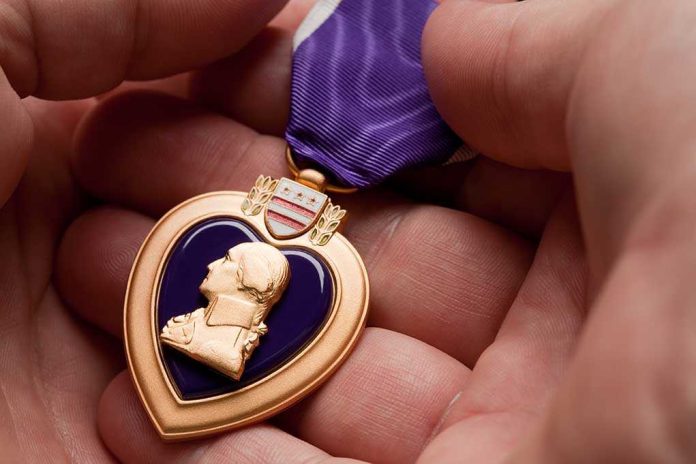
A Purple Heart on the streets of Washington, D.C. forces a hard question: when does “homeland security” become a battlefield?
Quick Take
- Two West Virginia National Guard members were ambushed near the White House area on Nov. 26, 2025; Spc. Sarah Beckstrom died the next day, and Staff Sgt. Andrew Wolfe survived a severe head wound.
- Defense Secretary Pete Hegseth announced both service members will receive Purple Hearts, a rare recognition for wounds suffered on U.S. soil.
- The accused, Rahmanullah Lakanwal, an افغان national, pleaded not guilty to nine charges as prosecutors seek death-penalty eligibility.
- The shooting unfolded during a 2,600-troop National Guard deployment supporting the D.C. Safe and Beautiful Task Force after a crime emergency declaration.
The ambush that turned a routine patrol into a defining moment
The attack happened near Farragut Square and the Farragut Square Metro station area, only blocks from the White House—an address that usually signals cameras, tourists, and bureaucracy, not an ambush. On Nov. 26, 2025, Army Spc. Sarah Beckstrom, 20, and Air Force Staff Sgt. Andrew Wolfe, 24, were shot in the head while serving on a security mission. Both were airlifted to MedStar Washington Hospital Center. Beckstrom died the next day.
Details that emerged later made the incident feel less like random street violence and more like a purposeful hit. Investigators said the accused used a .357 Magnum revolver and fired roughly 10 to 15 shots. Reports also said the shooter used a victim’s firearm after the initial shots, a grim reminder that close-range attacks can turn government-issued gear into a weapon for the attacker in seconds. Wolfe survived but faced a long recovery, including skull reconstruction surgery planned for March 2026.
Why the Purple Heart decision matters far beyond one ceremony
Defense Secretary Pete Hegseth announced the Purple Hearts during a National Guard reenlistment ceremony at the Washington Monument on Feb. 6, 2026, in front of more than 100 Guardsmen from nine states. He framed the case plainly: one service member lost, one recovered, and both were attacked by a “radical.” That label does important work, because Purple Heart eligibility typically hinges on wounds caused by enemy action, not ordinary crime.
Purple Hearts on American soil create immediate friction for the public because most people associate the award with Iraq, Afghanistan, or earlier wars. Domestic cases exist, but they often fall into a bureaucratic gray zone until investigators establish motive and classification. ABC News pointed to the Chattanooga shootings in 2015 as the modern benchmark: four Marines and a sailor died, and the Purple Hearts came after the FBI concluded the attack was driven by foreign terrorist motivation. That precedent hangs over D.C., because public evidence of foreign terror ties in this case has not been fully established in open reporting.
The accused, the charges, and the motive gap Americans should not ignore
Rahmanullah Lakanwal, 29, pleaded not guilty and faces nine charges that include first-degree murder and assault with intent to kill, with prosecutors seeking death-penalty eligibility. Reporting also described him as an Afghan national who previously worked with the CIA in Afghanistan, a detail that complicates easy narratives. A past relationship with U.S. intelligence does not excuse violence, but it does raise uncomfortable questions about vetting, resettlement pathways, and what warning signs may have been missed.
The motive discussion matters because government labels carry consequences. Conservative common sense says the country owes clarity to the victims’ families and to the public: call the act what the facts support, not what plays well at a podium. At the same time, Americans do not need a courtroom to tell them that an ambush of uniformed Guardsmen near the White House is political violence in effect, whatever the attacker’s personal mix of ideology, instability, or grievance turns out to be.
How a “crime emergency” deployment put Guardsmen on an urban front line
The Guardsmen were not deployed to D.C. for a parade route. President Donald Trump activated more than 2,600 troops in August 2025 after a declared crime emergency to support the D.C. Safe and Beautiful Task Force. That framing matters: officials essentially treated public safety conditions as severe enough to warrant a sustained military support posture. Hegseth’s “front lines” language lands differently in that context, because the risk moved from hypothetical to literal.
Urban support missions also blur the line between soldiering and policing. Guardsmen can end up exposed—visible uniforms, predictable patrol patterns, and limited ability to “blend in.” The D.C. ambush illustrates the operational reality: a determined attacker doesn’t need a battlefield, only a target and proximity. For readers who remember eras when the National Guard mostly meant floods, blizzards, and traffic control, this shift should feel like a warning light, not a footnote.
The open question after the medals: what policy changes follow the honor?
West Virginia Gov. Patrick Morrisey formally requested Purple Hearts on Dec. 19, 2025, and later thanked Hegseth for approving the “long-overdue honor.” The recognition will mean something private and permanent to the Beckstrom and Wolfe families, but it also sets a public marker: the federal government now treats at least some domestic attacks on deployed troops as qualifying combat-style wounds. That could influence future decisions when Guardsmen face violence during homeland missions.
National Guard troops shot in DC to receive Purple Hearts https://t.co/LVZjep0AZm
— Task & Purpose (@TaskandPurpose) February 7, 2026
The next step cannot be symbolism alone. Congress, the Pentagon, and local leaders should treat this as a stress test: tighter perimeter planning, smarter patrol tactics, better intelligence sharing, and clearer standards for when the Guard gets deployed into crime-heavy environments. Wolfe’s recovery and Beckstrom’s death underscore the cost of complacency. If leaders call this the front line, they owe Guardsmen front-line protection—and the public honest accounting about the risks.
Sources:
hegseth-says-national-guard-members-shot-dc-ambush-afghan-national-receive-purple-heart
west-virginia-national-guard-purple-heart-20668850
guardsmen-ambushed-dc-awarded-purple-heart
sarah-beckstrom-andrew-wolfe-to-receive-purple-heart-hegseth-says
2025 Washington, D.C., National Guard shooting
wva-adjutant-general-message-following-dc-shooting