

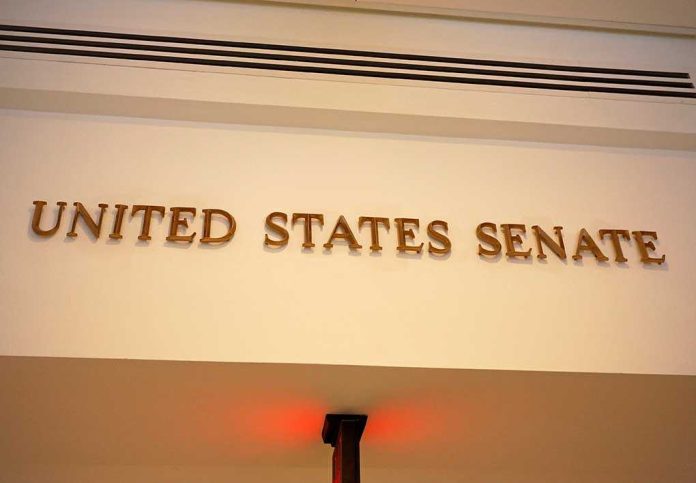
The most dangerous sentence in Washington is “an ally’s threat is our threat,” because it quietly turns someone else’s countdown into America’s war.
Quick Take
- A classified Senate briefing defended pre-emptive U.S. strikes on Iran as a move to blunt retaliation expected after Israel’s planned action.
- Sen. Mark Warner argued the briefing described a “war of choice” tied to Israel’s timeline, not an imminent threat to the United States.
- Administration officials pitched the strike as casualty prevention, even as early U.S. losses hardened congressional scrutiny.
- Trump’s publicly shifting explanations fed distrust on Capitol Hill and widened the split between hawks and anti-intervention conservatives.
A Secret Briefing, a Simple Question: “Imminent” for Whom?
The classified Monday night briefing landed after a weekend of “all-out war” strikes on Iran, delivered into a Senate already bracing for blowback. Defense Secretary Pete Hegseth, Secretary of State Marco Rubio, Joint Chiefs Chair Gen. Dan Caine, and CIA Director John Ratcliffe presented the core rationale: Israel expected an imminent threat to itself, planned to act, and the U.S. struck first to protect American assets from Iran’s retaliation.
That logic can sound tidy until the words do real work. “Imminent threat” traditionally means clear and direct danger to Americans, not danger adjacent to Americans. Warner’s criticism cut straight through the fog: if the trigger was Israel’s calendar, not a specific U.S.-bound attack, then the United States didn’t prevent a war so much as choose the timing of entering one. For voters who prefer restraint, that distinction is the whole case.
How Pre-emption Morphs into Permission for Endless Engagements
Pre-emption has a narrow moral and legal lane: hit first only when evidence shows an attack is about to land. The briefing, as described by attendees, sounded broader—closer to a doctrine that treats foreseeable retaliation against U.S. forces as sufficient justification whenever a partner initiates action. That shift matters because it flips responsibility. Israel acts; Iran reacts; America “must” pre-empt. The chain makes escalation feel automatic instead of deliberative.
Conservative common sense resists automaticity. The United States can support allies without subcontracting its war powers to their intelligence estimates or strategic urgency. The moment Washington implies that any Israeli “imminent threat” equals an American “imminent threat,” it reduces Congress to a spectator and turns U.S. troops into a standing tripwire. Six American servicemembers reportedly died in the initial exchange. Those families don’t care about doctrinal creativity; they care about necessity.
Trump’s Shifting Justifications Fed the Suspicion He Was Searching for One That Stuck
Presidents can persuade the country to endure hardship when they keep their story consistent. Reports of Trump offering multiple justifications in a short window—protecting U.S. bases, ending Iran’s nuclear ambitions, pursuing regime change, even invoking Iranian “freedom”—did the opposite. Each new rationale suggested the previous one lacked weight, and it gave skeptics permission to assume politics drove the sequence. In war, inconsistency reads like improvisation.
Rubio’s defense was the cleanest: the strikes supposedly prevented higher casualties later. That argument has merit in the abstract; force protection is a commander’s duty. The question Congress will keep asking is concrete: what intelligence showed that waiting would kill more Americans than acting first? If the administration can’t share specifics even in classified settings, lawmakers can’t separate prudent prevention from a blank check that invites more retaliation.
The Real Split Isn’t Left vs. Right; It’s Interventionists vs. “No More Blank Checks”
The coverage surrounding the briefings showed something Washington hates to admit: the old pro-war consensus is brittle. Critics now include conservative voices who see foreign entanglements as a tax on American sovereignty and working-class families. Tucker Carlson’s harsh condemnation and Rep. Thomas Massie’s opposition signal a faction that views “forever war” not as a Democratic critique, but as a betrayal of America-first priorities—secure borders, stable prices, and troops used only when vital interests demand.
That internal Republican tension is the story’s quiet engine. The administration must keep hawks satisfied while preventing a rupture among voters tired of trillion-dollar detours. Democrats, for their part, gain leverage by framing the operation as Israel-driven rather than America-driven. Warner’s “war of choice” line is politically potent because it forces the simplest test: would the U.S. have struck Iran this weekend if Israel had not been poised to strike first?
Congressional Briefings and War Powers Votes: The Constitutional Fight Behind the War
The planned Tuesday briefing for lawmakers, paired with looming war powers action, puts process back at the center. The Constitution gives Congress the power to declare war, while modern practice lets presidents move first and explain later. Classified briefings are supposed to narrow that gap—evidence in, oversight out. When lawmakers walk away unconvinced, it usually means the briefers offered policy arguments where intelligence was expected.
The conservative view of strong national defense still depends on constitutional clarity. Quick strikes might win tactical moments, but blurred authority erodes public buy-in and recruiting, and it rewards the worst habit in Washington: treating military action as a reversible decision. It isn’t. Every missile invites a response, every response demands another “pre-emptive” answer, and soon the country is fighting to avoid losing face rather than to win peace.
The “Terrifying Conclusion” Isn’t About Iran; It’s About Precedent
The scariest takeaway from this episode isn’t that Iran is dangerous—Americans already know Tehran funds proxies and threatens U.S. interests. The terrifying part is precedent: a newly normalized standard where an ally’s coming strike becomes America’s justification to start the next phase. That doctrine would guarantee more “surprise” wars, more rushed briefings, and more grieving families told the escalation was unavoidable.
Americans over 40 have seen this movie: shifting rationales, confidential briefings, and promises that one more decisive action will prevent something worse. Sometimes action is necessary. The country still deserves proof, not slogans, and a strategy measured in U.S. interests—not in how fast another nation needs the U.S. to move. If the briefers can’t supply that, Congress should slow the train before “pre-emptive” becomes permanent.
Sources:
Terrifying Conclusion of Secret Senate War Briefing Revealed
Trump Will Brief Lawmakers on Iran War on Tuesday, Sources Say, as Reaction to Conflict Seems Split
Trump Administration Set to Brief Congress on Iran Operation as War Powers Resolution Vote Looms
Fox Business Video 6358434211112