In a Utah courtroom, a swirl of surveillance clips, DNA charts, and intimate messages raised a stark question: is the case against Tyler Robinson already overwhelming, or still wide open?
Story Snapshot
- Donald Trump Jr. says the evidence against Tyler Robinson leaves “little room for doubt.”
- Prosecutors point to surveillance video, DNA on a rifle towel, and a text to an ex-lover as core proof.
- Defense lawyers attack the DNA science and win limits on key video, arguing the case is far from airtight.
- The fight over this evidence shows how political violence cases turn courtrooms into battlegrounds over truth itself.
Trump Jr.’s claim: why he sees a nearly closed case
Donald Trump Jr. sat in the gallery as investigators walked the court through a tight timeline that would make any juror sit up. Surveillance footage showed Tyler Robinson on Utah Valley University’s campus again and again on the day Charlie Kirk was killed. One clip captured him climbing onto a rooftop that overlooked the amphitheater where Kirk was speaking. Prosecutors say that rooftop became the firing position. To a security-minded conservative, that looks like planning, not chaos.
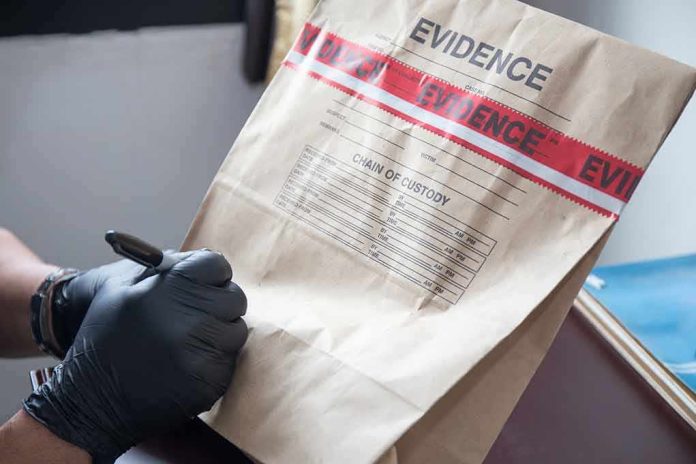
Prosecutors did not stop at video. They introduced DNA results from a rifle found wrapped in a towel near the escape path investigators say Robinson used after leaving the roof. A state forensic witness testified that DNA on that towel matched Robinson’s former roommate and romantic partner, Lance Twiggs, and very likely Robinson himself. Then came the most personal piece: a message to Twiggs where Robinson allegedly wrote he had the chance to “take out Charlie Kirk” and was going to do it. Taken together, Trump Jr. saw a simple story: motive, movement, weapon, confession.
The defense counterattack on DNA and video evidence
Defense lawyers did what good defense lawyers always do in a high stakes case: they went straight at the science. In court, attorney Michael Burt grilled Federal Bureau of Investigation (FBI) DNA analyst Amanda Bakker about how she tested the samples. Burt forced an admission that, at several spots on the genetic profile, she could not clearly tell the difference between Robinson’s sample and the crime scene DNA. He hammered the point with a line meant for the record and the evening news: “She can’t match Mr. Robinson to the questioned samples.”
Defense attorneys also scored a win on the surveillance video that Trump Jr. found so convincing. Judge Tony Graf ruled that a key edited clip showing Robinson’s movements could not be used in its altered form because prosecutors had added zooms and effects. The judge left the door open for an unedited version later, but for now the most dramatic visual in the state’s case is sidelined. For a viewer at home, that looks like a technical fight. For a jury, it can mean the difference between “I see it” and “I’m not sure.” Conservative common sense says evidence should be clean, not enhanced like a political ad.
The roommate, immunity, and the uneasy weight of confession
At the center of the story sits Lance Twiggs, the ex-roommate and ex-lover whose words may decide Robinson’s fate. Twiggs gave police a recorded interview and a DNA sample after the killing. Prosecutors say he received use immunity in exchange for those statements, meaning his own words will not be used to charge him. That deal helps the state but makes some conservatives uneasy. When the government protects one man to nail another, people naturally ask whose story got shaped.
The state says Twiggs described a confession from Robinson, including language about targeting Kirk for his politics and hate-filled speech. A recorded interview played in court lets jurors watch Twiggs recount that moment. Yet for now, Twiggs has not taken the stand live, and the defense failed to force him to travel and testify at the preliminary hearing. That limits cross-examination, the core tool to test a witness. American conservative values stress due process and the right to confront your accuser. When a case leans so heavily on a protected witness seen only on video, many on the right will feel the state has stacked the deck.
Security failures, political violence, and what conservatives see in this case
While lawyers spar over lab methods and video edits, Donald Trump Jr. keeps pointing to something simpler and more damning: how easy it apparently was to kill Charlie Kirk on a college campus. Trump Jr. has highlighted that only a handful of officers were on duty and that campus security had no serious briefing before a nationally known conservative arrived to speak. For many right-leaning Americans, that sounds less like an oversight and more like a pattern, where institutions treat conservative lives as less urgent to protect.
This is exactly why the Charlie Kirk case is moving so fast in court right now.
Donald Trump Jr. just left the preliminary hearing and said the evidence surveillance footage, DNA, and testimony makes the case “very cut and dry.” He also pushed back hard on the online conspiracy…
— 𝐌𝐈𝐂𝐇𝐀𝐄𝐋 𝐎𝐋𝐈𝐏𝐇𝐀𝐍𝐓 (@MichaelOliphant) July 10, 2026
Experts say political violence in the United States now rides on top of deep polarization and social media, turning activists into targets and trials into national events. Kirk’s assassination sits in a growing list that includes a mass shooting of Republican lawmakers at a baseball practice and attempts on major national figures. Data show these attacks are still rare compared with other murders, but they carry huge symbolic weight. For conservatives, every unsolved question in the Robinson case feels like part of a larger fight: will the system treat attacks on the right with the same seriousness, the same precision, and the same fairness it claims to offer everyone?
Sources:
facebook.com, cbsnews.com, apnews.com, abc7chicago.com, pbs.org, instagram.com, youtube.com, reddit.com, themedialine.org, cato.org, yougov.com