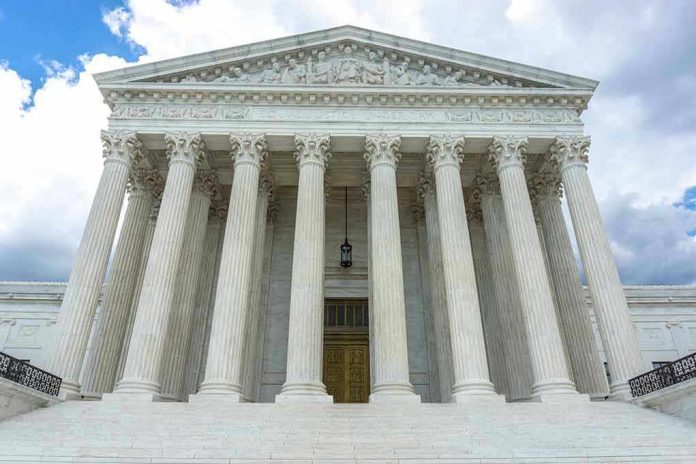
Justice Amy Coney Barrett just handed conservatives a harsh civics lesson: you can cheer a justice’s ideology and still lose the fight over how elections and citizenship actually work.
Story Snapshot
- Barrett wrote the 5-4 Supreme Court opinion that let Mississippi count mail ballots arriving up to five days after Election Day, enraging many conservatives.
- She joined the majority in Trump v. Barbara to uphold birthright citizenship for children born in the United States to parents here illegally.
- She still votes mostly conservative, yet her recent rulings show she will cross over when text and structure push her that way.
- These cases expose a split inside conservatism: rule-of-law textualism versus hardline election and immigration politics.
Barrett’s Mail-Ballot Ruling That Set Off the Firestorm
Justice Barrett’s opinion in Watson v. Republican National Committee did something simple yet explosive: it said states may count mail ballots that are postmarked by Election Day but arrive a few days later, if state law allows it. In that case, Mississippi let ballots come in up to five days after Election Day. Barrett wrote that the “electorate’s choice is made when voting is complete, not when ballots are received,” and read the federal election-day statute as setting the voting day, not a hard receipt deadline.
Conservatives who focus on election security saw red. Senator Eric Schmitt blasted the ruling as “terrible for election integrity” and “shockingly wrong,” and many on the right framed it as giving Democrats more time to “find” votes. Justice Samuel Alito’s dissent, joined by Justices Thomas, Gorsuch, and Kavanaugh, argued that the plain text and history of federal election laws meant ballots must be received by Election Day, not just mailed by then. To them, Barrett had sided with the left on the core question: when the election actually ends.
Why Barrett Said Federal Law Does Not Lock Down Receipt Deadlines
Barrett’s logic in Watson looked less like a political move and more like her usual legal method. She treated the federal election statute as defining a single national day for casting votes, while leaving states room to handle how and when mailed votes are processed and received, so long as they are sent on time. That approach fits her broader record of strong respect for state authority and federalism in other cases, especially on controversial issues like abortion and criminal law.
For many conservatives, though, that distinction feels too clever. They see any delay in counting as a crack in the wall that protects trust in elections. Yet Barrett’s opinion lines up with a long pattern of the Supreme Court deciding detailed election rules as technical statutory questions, not partisan fights. In a 6-3 court, conservative justices sometimes cross over in these kinds of procedural cases, as Chief Justice Roberts and Justice Gorsuch have done in other 5-4 rulings. That pattern weakens the claim that Barrett’s vote was a sudden betrayal, and makes it look more like another instance of a justice following her reading of text even when it cuts against party talking points.
The Birthright Citizenship Case That Tested Immigration Politics
If Watson rattled conservatives on elections, Trump v. Barbara shook them on immigration. In that case, the Court struck down Donald Trump’s effort to limit birthright citizenship for children born in the United States to parents who are in the country illegally. The majority, written by Chief Justice John Roberts and joined by Barrett, read the Fourteenth Amendment’s Citizenship Clause to mean what it has meant for over a century: if you are born on American soil and subject to American law, you are a citizen, with very narrow exceptions.
During oral arguments, Barrett pressed a basic practical question: how would the government even decide, at the moment of birth, whether the parents intend to stay or leave the country? That simple doubt hit at the core of Trump’s policy idea. Enforcing a new intent-based rule would turn hospitals and county clerks into immigration tribunals. The majority leaned on both the constitutional text and the old Wong Kim Ark precedent, which already protects birthright citizenship, rather than on any president’s agenda. For conservatives who want tougher rules on “birth tourism” or illegal immigration, the ruling felt like the Court slamming the door.
Is Barrett Really Betraying Conservative Principles?
Critics on the right say these rulings prove Barrett has gone rogue. That charge sounds strong, but it does not fit the full record. Careful studies of her voting patterns show she is still one of the most conservative justices on the Court, far more conservative than the justice she replaced, Ruth Bader Ginsburg. She played a key role in overturning Roe v. Wade and has backed broad state power on issues like criminal sentencing, religion, and gun rights. She also joined the conservative majority to end Temporary Protected Status for Haitian nationals, which matched Trump’s strict immigration stance.
What these new decisions really expose is a split inside the conservative camp itself. One side prioritizes bright-line rules that seem to protect the nation: ballots stop on election night, citizenship goes only to the “right” families, federal judges block as little as possible of a president’s agenda. The other side, where Barrett often stands, insists on sticking to the words of the Constitution and federal statutes, even when that means leaving some political goals to Congress or the states. For conservatives who value the rule of law and limited judicial power, that second path is not betrayal. It is the hard work of saying “no” when your own team wants the courts to fix what legislatures will not.
Sources:
redstate.com, nytimes.com, cbsnews.com, youtube.com, ballsandstrikes.org, supremecourt.gov, theusconstitution.org, facebook.com