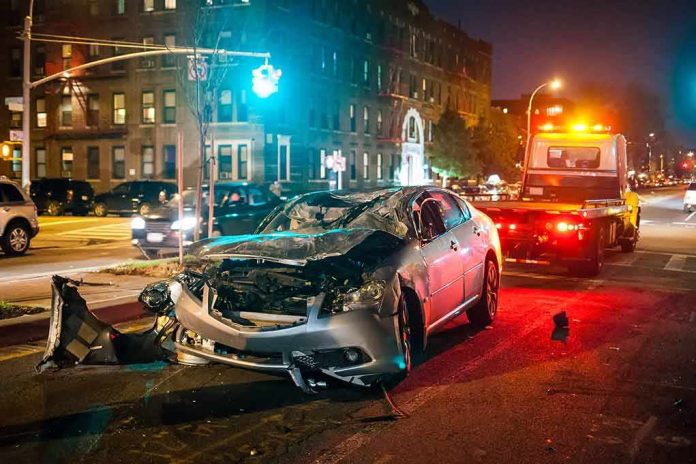
A driver charged with murdering an off-duty police sergeant and a grocery worker reportedly launched a fundraiser for himself days later—and that single detail could sway a jury.
Story Snapshot
- Police charged Mario Bickham, 36, with two counts of second-degree murder.[2]
- Reports say he sped and even drove on the sidewalk before the deadly crash.[1][2]
- Media say he started a fundraiser for himself after the killings.[2]
- The victims were Los Angeles Police Department Sgt. Shiou Deng and Jesus Melendez-Ortiz.[2]
What prosecutors say happened and why it matters
Los Angeles authorities charged Mario Bickham with two counts of second-degree murder after a fatal crash that killed Los Angeles Police Department Sgt. Shiou Deng and Whole Foods employee Jesus Melendez-Ortiz. The charging report and press coverage identify high-speed driving and sidewalk maneuvers before impact. These facts, if proven, match a rising trend in which prosecutors frame extreme reckless driving during flight as murder, not just manslaughter, due to clear disregard for human life.[2]
Second-degree murder hinges on intent implied by conduct, not a plan to kill. A jury will ask whether the driver knew the risk and chose it anyway. Witness video and any vehicle data recorder could decide that question. Speed estimates, braking traces, and path of travel will matter more than rhetoric. Without a confirmed top speed on record yet, the state will lean on sidewalk driving and pattern of risk-taking to show implied malice.[2]
The fundraiser twist and how a jury could read it
Media say Bickham launched a fundraiser for himself after the crash. That detail will not prove murder by itself. But it may color how jurors see his mindset. Prosecutors may argue it shows callousness or awareness of guilt. The defense will likely call it spin and point out that people seek money for legal fees or medical needs all the time. Still, first impressions stick, and this one is rough for the accused.[2]
Courts limit what comes in at trial. A judge could bar the fundraiser evidence if it is more unfairly prejudicial than probative. If it comes in, the state will use it to say he put himself first while two families grieved. Common-sense jurors care about character signals. That is why defense counsel will fight this issue hard before trial. The state will push to keep it in to frame a story of choices, not an accident.[2]
The victims, the community, and the policy debate you are not hearing
The victims are not footnotes. Sgt. Deng wore a badge. Melendez-Ortiz delivered groceries to feed families. Their deaths sparked grief and a public memorial by family and fellow delivery drivers, who gathered to honor a life taken on the job. That human cost raises pressure on police and politicians to show results and push for harsh charges when drivers flee and kill bystanders.[1]
Police pursuit policy sits in the backdrop. National research shows a clear rise in deaths tied to chases. Public health studies estimate thousands of fatalities in recent years, with a meaningful share being bystanders. Reform groups and police leaders now urge limits on chases to violent offenders who pose an ongoing threat. That debate does not excuse a driver’s choices, but it does shape the risk landscape on city streets.[11][13][17]
What the defense can argue and what still decides the case
The defense can challenge speed claims, the timeline, and whether the crash dynamics prove implied malice. Without a locked-in speed figure, they may say the case rests on emotion and media spin. They can seek the full crash reconstruction, video from nearby cameras, and black box data. If they show lower speeds or evasive actions, they can push the case toward manslaughter or negligent homicide instead of murder.[2]
Jurors will weigh five things: how fast he drove, where he drove, what warnings or signals were present, how avoidable the deaths were, and what he did afterward. The sidewalk allegation is the state’s strongest fact if proven. The fundraiser is a narrative enhancer, not the core. The most conservative view here is also the simplest: actions have consequences. If you turn a car into a weapon, expect the law to treat you like you used one.[2]
Sources:
[1] Web – Driver who held fundraiser for himself after killing LAPD cop and …
[2] Web – Family and fellow delivery drivers gathered to honor his life. Click …
[11] Web – Mycobacteria-Specific T Cells Are Generated in the Lung During …
[13] Web – Offense has to score TDS defense keeping us in the game today
[17] Web – Fiona!! Our 8th grade student highlight of the week. She said in her …