
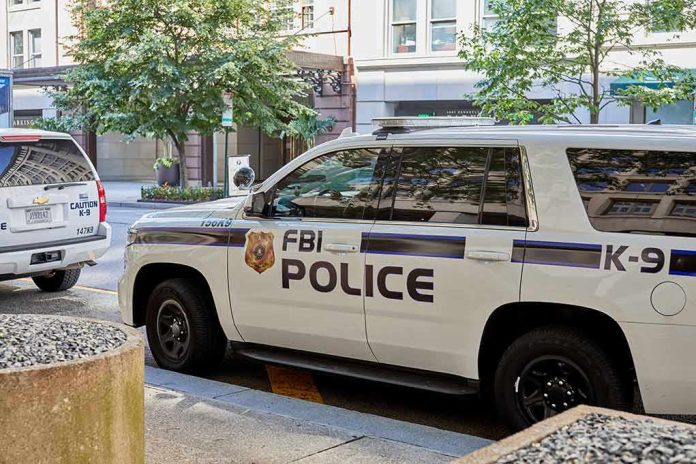
Federal agents say a California man urged an armed mob to storm an immigration detention center, then found the gear to match the talk.
Story Snapshot
- Prosecutors say Instagram posts called for violent attacks on an Immigration and Customs Enforcement facility.
- Agents report seizing a firearm, 19 loaded magazines, armor, and gear consistent with planning.
- The alleged target named in posts was the Adelanto immigration detention center.
- The charge is interstate threats under federal law, which punishes “true threats”.
What Prosecutors Say Happened And Why It Matters
The United States Attorney’s Office for the Central District of California announced the arrest of Leonard Michael Fierro, 37, of Hacienda Heights, on a federal complaint for interstate threats. The complaint says Fierro used an Instagram account to call for an armed uprising and urged attacks on federal agents. Prosecutors say he singled out the Adelanto immigration detention center and urged others to storm it and free detainees. The charge carries serious penalties if a jury finds a true threat.
The government describes a pattern that moved from words to means. Agents say Fierro bought roughly 700 rounds of 9 millimeter ammunition in October and early November, including hollow points. The affidavit recounts searches for tactical armor, surveillance countermeasures, and the Adelanto site. That timeline gives prosecutors a through line: online calls for violence, research into gear, and recent ammunition buys. The United States Attorney called such threats a present and persistent danger.
What Agents Say They Found When They Searched
Federal agents served court-approved warrants and say they recovered a firearm, 19 loaded magazines, more than 400 additional rounds, tactical body armor with ballistic plates, Global Positioning System trackers, bolt cutters, and several digital devices. Each item points to a concrete task in a violent plan: protection, breaching, navigation, transport, and communication. A local report adds that investigators found a planning checklist for gear, ammunition, trackers, a rental car, and comms equipment, citing federal officials.
The distance between rant and risk often shows up in details. Ammunition type signals intent. Hollow points expand and are designed to stop a target fast. Body armor and plates assume a firefight. Bolt cutters suggest forced entry. Global Positioning System trackers suggest route planning or target tracking. One news account says the checklist tied many of these pieces together. This is the kind of mosaic that persuades judges that danger is real enough to act.
The Law On Threats And How This Case Fits
Federal law makes it a crime to send interstate communications that contain a threat to injure. The Supreme Court has said the First Amendment does not protect “true threats,” which are serious expressions of an intent to commit unlawful violence. The Court has also held the government must show the speaker had at least a reckless awareness of the threatening nature of the words. That standard puts weight on what Fierro allegedly said and how he said it, not only on how listeners felt.
Prosecutors will point to alleged direct calls to storm a named facility, free detainees, and overthrow the government. Those claims, if proven with authenticated posts and context, land close to the heart of the “true threat” rule. Defense lawyers often argue hyperbole, satire, or rage without intent. That can defeat a charge when the record shows no plan. Here, agents say they found magazines loaded, armor staged, and a list that reads like a kit. That crosses from talk into capability in the eyes of many citizens.
Why This Case Strikes A Nerve On Public Safety And Free Speech
Americans expect the government to stop violence against officers before it starts. Americans also expect the government to leave strong political speech alone. This case sits on that line. The state says the words were not just hot takes; they were commands to assemble a mob at a named site, backed by ammunition, armor, and a shopping list. A brief reminder applies: a complaint is an allegation, not a conviction. A jury will decide intent if this case goes to trial.
Threats of violence against ICE agents must stop.
Leonard Michael Fierro, 37, of Hacienda Heights, is under arrest for using social media to threaten violence against ICE agents and facilities.
In one post he stated:
“Let’s get an armed mob together, break out all the… pic.twitter.com/5UGzCPtkmz
— F.A. United States Attorney Bill Essayli (@USAttyEssayli) November 23, 2026
Common sense says you judge risk by pattern, not by one post or one purchase. One gun does not prove a plot. Nineteen loaded magazines, hundreds of hollow points, body armor, Global Positioning System trackers, bolt cutters, and a named target start to look like a plan. That is why federal agents moved fast. The law gives room to act when speech turns into a serious signal of violence. The public expects nothing less when officers and detainees may be in the crosshairs.
Sources:
redstate.com, ktla.com, truthout.org