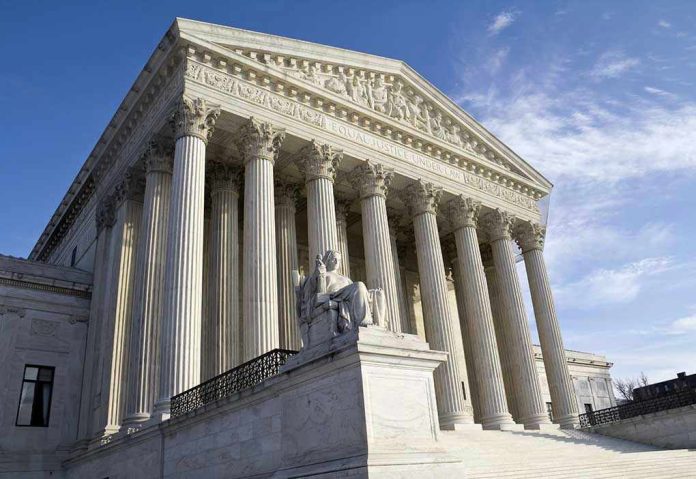
The Supreme Court prepares to hear arguments that could dismantle a constitutional principle older than your grandparents, their grandparents, and the Civil War amendments that built modern America.
Story Snapshot
- Supreme Court will hear challenges to Executive Order 14160, which denies citizenship to U.S.-born children of undocumented immigrants and temporary visa holders
- The case directly challenges the 1898 United States v. Wong Kim Ark precedent that has stood for 128 years
- Federal courts have already blocked the executive order multiple times, finding it violates the Constitution and over a century of precedent
- Millions of children born on U.S. soil could potentially lose citizenship status if the order is upheld
- The dispute centers on interpreting the Fourteenth Amendment’s “subject to the jurisdiction thereof” clause
The Constitutional Foundation Under Attack
Birthright citizenship entered the Constitution in 1868 through the Fourteenth Amendment, a direct response to the grotesque Dred Scott decision that denied citizenship to people of African descent. The amendment’s Citizenship Clause declares that all persons born or naturalized in the United States, and subject to the jurisdiction thereof, are citizens. This wasn’t accidental language or legislative oversight. Congress passed the Civil Rights Act of 1866 establishing this principle first, then constitutionalized it to ensure no future Congress could strip it away. The framers understood what they were doing.
When Wong Kim Ark Settled the Question
In 1898, the Supreme Court confronted this exact issue when Wong Kim Ark, born in San Francisco to Chinese parents, returned from visiting China and immigration officials refused him entry. The Court ruled 6-2 that the Fourteenth Amendment guarantees citizenship to anyone born in the United States, regardless of parental immigration status. Justice Horace Gray wrote that while the amendment’s main purpose was establishing citizenship for Black Americans, it applies broadly and is not restricted by color, race, or immigration status. The only exceptions are children of foreign ambassadors. That precedent has stood unchallenged for 128 years.
The Executive Order That Sparked Constitutional Crisis
Executive Order 14160, signed January 20, 2025, attempts to deny citizenship to babies born in the United States to mothers present unlawfully or lawfully but temporarily, and fathers who are not citizens or lawful permanent residents. This sweeps in children of undocumented immigrants and children whose parents hold student visas or work visas. The order claims the Fourteenth Amendment has always excluded such children from birthright citizenship. Federal courts weren’t buying it. Multiple judges blocked implementation, finding the order violates the Constitution, Supreme Court precedent, and longstanding federal statute.
The Legal Arguments Colliding at the High Court
The administration’s argument hinges on reinterpreting “subject to the jurisdiction thereof” to exclude children whose parents lack permanent legal status. This reading contradicts how all three branches of government have interpreted the Fourteenth Amendment for over a century. The Brennan Center for Justice notes that a 1952 federal statute, descended from 1940 legislation and a 1938 report, made crystal clear that birth within the territory and jurisdiction determines citizenship, not parental domicile or immigration status. Constitutional scholars including Gregory Downs of UC Davis and professors Martha Jones and Kate Masur filed friend-of-the-court briefs emphasizing that the Fourteenth Amendment intentionally removed citizenship questions from political manipulation.
What Hangs in the Balance
If the Supreme Court upholds this executive order, millions of children born on American soil could lose citizenship. This includes children of undocumented immigrants, children of parents on temporary visas, and children in mixed-status families. The United States would join the minority of nations denying citizenship based on birth within borders. America currently stands with roughly 30 countries including Canada and Mexico offering automatic citizenship to everyone born there. More troubling, upholding the order would create a new class of stateless persons born in the United States, individuals who belong nowhere despite being born here.
No More ANCHOR BABIES!
High Court Set To Hear Oral Argument This Week On Birthright Citizenship Case https://t.co/c2ZETpgLa5 #gatewaypundit via @gatewaypundit
— Ares Unchained (@AresUnchained) March 30, 2026
The practical consequences extend beyond legal status. Affected children would lose access to federal benefits, employment protections, and educational opportunities. Government agencies would shoulder massive administrative burdens determining citizenship status at birth, scrutinizing maternal immigration paperwork in delivery rooms. Existing citizenship records could face challenges. The social fabric tears when you tell children born in America they don’t belong here, creating permanent underclasses and deepening divisions that serve no legitimate governmental interest.
The Precedent Problem Nobody Wants to Say Out Loud
Overturning Wong Kim Ark would rank among the most significant reversals of constitutional doctrine in American history. The case has anchored citizenship law longer than most Supreme Court precedents conservatives and liberals both cite as untouchable. Stare decisis, the principle that courts should respect established precedent, exists precisely to prevent political winds from reshaping foundational constitutional interpretations. If a 128-year-old precedent interpreting explicit constitutional text can fall because a new administration disagrees, what precedent remains safe? The implications extend far beyond immigration policy into the stability of constitutional law itself.
Sources:
Origins of Birthright Citizenship in the United States Explained – American Immigration Council
A History of Birthright Citizenship at the Supreme Court – SCOTUSblog
Birthright Citizenship Under the US Constitution – Brennan Center for Justice
Protecting the Meaning and Value of American Citizenship – White House
Birthright Citizenship Legal Analysis – American University Law Review
Know Your Rights: Birthright Citizenship – NAACP Legal Defense Fund