
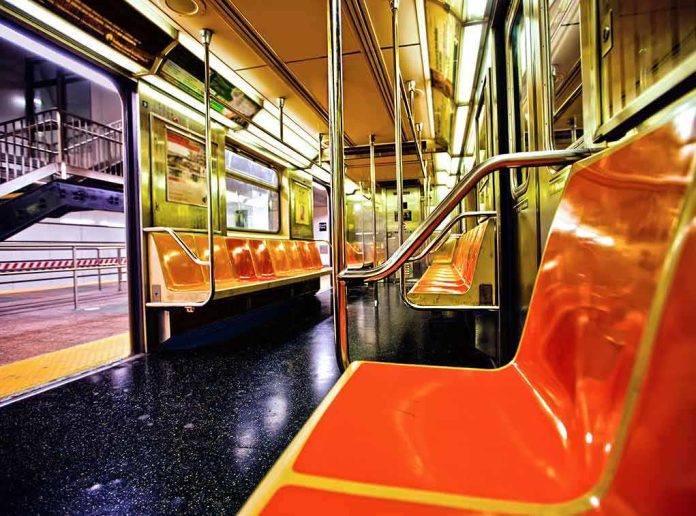
A subway argument on a northbound 2 train in the Bronx ended with a man stabbed in the chest and a suspect in cuffs, a swift tragedy that shows how fast words can turn deadly.
Story Snapshot
- Police say a verbal dispute on a Bronx 2 train led to a fatal stabbing.
- A 36-year-old suspect was taken into custody soon after the attack.
- The 33-year-old victim died at Lincoln Hospital from a chest wound.
- The 149th Street–Third Avenue Station closed for the investigation.
What Police Confirmed And What Remains Unknown
New York City Police Department officials reported that two men argued on a northbound 2 train in the Bronx. The fight escalated. One man stabbed the other in the chest. Medics took the 33-year-old to Lincoln Hospital, where doctors pronounced him dead. Officers quickly detained a 36-year-old suspect. Detectives shut down the 149th Street–Third Avenue Station to secure evidence and take witness statements. Police did not share the cause of the argument or whether the men knew each other.
Surveillance clips and recent local reports show how fast disputes in the Bronx can boil over. One video from Mount Eden shows a shouting match turning into a brawl, ending with a man stabbed and rushed to a hospital. Those scenes echo the subway case. The pattern is not about a grand plan. It is about flash anger, close quarters, and a knife at arm’s reach. When that mix lands on a packed train, riders cannot step away in time.
The Subway Risk Picture: Rare But Rattling
Transit leaders and crime analysts agree on two truths at once. First, violence on the subway is rare per ride. Felony assaults happen about once every 2.3 million trips, a tiny slice of daily ridership. Second, assaults have surged over the long arc, tripling since 2009. That rise makes each incident feel less like a shock and more like a warning that tempers and blades now shape too many conflicts underground.
Federal transit officials also flagged the trend. They reported felony assaults rose more than fifty percent systemwide since 2019, even as other categories shifted. That signals a change in the nature of subway risk. Fewer crimes seek wallets. More crimes spring from sudden fights and personal grudges. That shift calls for better presence, faster response, and a clear message that carrying a knife on a train means a fast trip to jail.
Accountability, Clarity, And The Conservative Test
Public safety demands facts first. The New York City Police Department account in this case rests on clear elements: an argument, a chest stabbing, a death at a named hospital, and an arrest. No public counter-evidence challenges those core claims. The missing pieces—weapon recovery, prior ties, and full video—matter for court, but they do not blur the basics. A justice system worthy of trust moves fast on arrests and careful on proof. That balance serves victims and the public.
Common sense and conservative values point to basics that work. Flood hot spots with visible officers during peak hours. Enforce knife and weapon laws without excuses. Back swift charging decisions when evidence is strong. Support judges who weigh danger to the public when setting bail. Keep public dashboards that show where and when assaults happen. Riders do not want spin. They want a cop on the platform, a camera that works, and a rule set with teeth.
From Platform To Policy: What Would Actually Help Riders
Transit and city leaders can close key gaps now. Place trained uniformed teams at transfer hubs like 149th Street–Third Avenue at known flash times. Use live monitoring to dispatch within seconds when a fight starts. Post clear signs on every car that weapons bring felony charges and fast bans from the system. Pair that with court orders that keep violent offenders off trains while cases proceed. Publish monthly assault maps so the public sees action, not slogans.
⚠️⚠️ BULL SHIT ⚠️⚠️
🚨🚨 20 years of INCOMPETENT DEMOCRAT GOVERNING in NYS🚨🚨
🚨Crime, Especially Violent Crime is UP ⬆️ under YOUR WATCH
The list below ⬇️ is just from June 2026 through July 06, 2026…
(LAST MONTH)⚠️East New York Double Homicide (July 6, 2026):
A… pic.twitter.com/AiCypiaBdP— Michael Duffy (@MichaelDuffy4_4) July 6, 2026
Riders also play a part. Step back from arguments in tight cars. Change cars at the next stop if a dispute starts. Use the help point intercom or the emergency bar to alert the conductor. Record only if safe and then give the video straight to police. None of that shifts blame from the attacker. It gives bystanders tools that shave seconds off response time. On a moving train, seconds decide whether a wound is a scare or a funeral.
Sources:
thegatewaypundit.com, abc7ny.com, youtube.com, facebook.com