
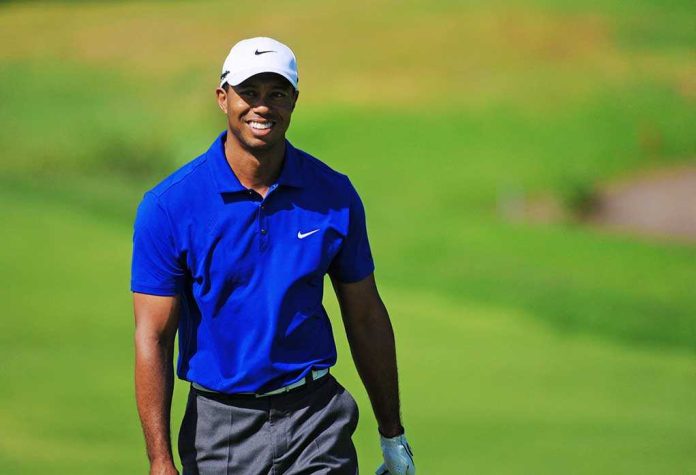
Tiger Woods, at 50 years old and seven back surgeries deep, refuses to close the door on walking Augusta National’s punishing hills this April—a declaration that says more about the human will to compete than any medical prognosis ever could.
Story Snapshot
- Woods confirmed he hasn’t ruled out competing in the 2026 Masters despite recovering from October 2025 disc replacement surgery
- The 15-time major champion can now hit full shots inconsistently and describes his back as “just sore” four months post-surgery
- Woods turned 50 in December 2025, making him eligible for the Champions Tour where cart usage is permitted—an option he’s now considering
- His last competitive appearance was July 2024, and he holds no established timeline for return to tournament play
- Woods is weighing a potential 2027 U.S. Ryder Cup captaincy role, though his physical condition creates uncertainty
The Body That Refuses to Quit
Woods sat before reporters at the Genesis Invitational on February 17, 2026, and delivered a single word that sent shockwaves through golf: “No.” The question was whether the Masters was off the table. His answer wasn’t a promise or a prediction—it was a refusal to surrender. Four months removed from his seventh known back procedure, a disc replacement that followed a torn Achilles and decades of accumulated trauma, Woods has progressed to hitting full shots. Not consistently. Not pain-free. But he’s hitting them, which is more than most medical professionals would have predicted for a 50-year-old with his surgical history.
Augusta’s Unforgiving Geography
Augusta National isn’t just another golf course—it’s 18 holes of elevation changes and uneven lies that test the healthiest athletes. Woods knows this terrain intimately. He’s won there five times and made 24 consecutive cuts, a Masters record. But that was before the car accident in February 2021, before the fusion surgery, before the disc replacement. Walking Augusta requires more than skill; it demands physical endurance that even healthy players find exhausting. Woods acknowledges the challenge exists, yet he won’t definitively say he can’t do it. That distinction matters.
The Champions Tour Alternative
Woods’ willingness to consider the Champions Tour represents a philosophical evolution. He’s repeatedly stated he won’t use a cart on the PGA Tour because he “doesn’t believe in it”—a principled stance rooted in competitive purity. But turning 50 opened a new door. The Champions Tour allows carts, and Woods now openly discusses this option as potentially signaling “a long-term competitive future rather than isolated appearances.” This isn’t retirement talk; it’s strategic recalibration. If his body can’t withstand the PGA Tour grind, he’s exploring alternatives that extend his competitive life without compromising what his body can reasonably handle.
Recovery Reality Versus Competitive Drive
Woods referenced Will Zalatoris when discussing his disc replacement recovery, noting that the younger player “took a while to come back” and that Woods being “a little bit older than Willy Z” means his recovery will “probably take a little bit longer.” This acknowledgment demonstrates rare vulnerability from an athlete whose career has been defined by defying physical limitations. Woods has no established timetable for return. He hasn’t competed in TGL matches despite owning a team. His back remains “just sore,” and recovery “takes time”—words that sound reasonable but ring hollow against the backdrop of April rapidly approaching.
The Ryder Cup Captaincy Question
Beyond his playing future, Woods faces a decision about captaining the 2027 U.S. Ryder Cup team. This role demands physical stamina—captains walk the course, manage players, and maintain intense focus throughout competition. Woods’ current physical state creates legitimate questions about his capacity to fulfill these duties effectively. The offer represents recognition of his leadership and competitive insight, but accepting it while managing chronic back issues and uncertain competitive status presents practical challenges. Woods has kept his intentions private, acknowledging the opportunity exists without committing either direction. His physical recovery will likely determine whether this role becomes realistic or simply honorific.
What the Masters Decision Really Means
Woods keeping the Masters “on the table” isn’t about probability—it’s about possibility. He’s a five-time champion at a venue where his presence remains significant regardless of his scoring. Augusta National benefits enormously from Woods’ participation, which generates viewership and narrative appeal that no other active player can match. But this isn’t about sentimentality. Woods has demonstrated throughout his career an ability to return from injuries that would end most careers. His 2022 Masters appearance just 14 months after his catastrophic car accident established precedent for what seems medically improbable. Whether that precedent applies to his current situation—chronic back issues rather than acute trauma—remains the central question. Woods isn’t answering it definitively because he genuinely doesn’t know yet.
Sources:
Tiger Woods Masters 2026 Playing – CBS Sports
Tiger Woods 2026 Masters Augusta Genesis Invitational – LA Times
Tiger Woods Doesn’t Rule Out Possible Return at Masters – Golf Channel
Tiger Woods Is Not Ruling Out a Return to the Masters – PGA Tour