One warehouse roof caught fire, and for a few tense hours Los Angeles got a real-time lesson in what “toxic smoke” actually means.
Story Snapshot
- A massive fire tore across the solar-covered roof of a Lineage cold storage warehouse in Boyle Heights, sending dark smoke over much of Los Angeles.
- Officials ordered thousands of residents to shelter indoors because of hazardous smoke and an ammonia leak tied to the building’s refrigeration system.
- Firefighters pulled back from the interior, used helicopters and defensive tactics, and kept the blaze mostly on the roof with no reported injuries.
- The scare exposed how modern “green” infrastructure and industrial chemicals collide with public safety, especially in working-class neighborhoods.
How A Routine Workday Turned Into A Toxic Skyline
Late on a weekday afternoon, just after the school run and before the evening commute, thick black smoke began curling up from an enormous warehouse roof in Boyle Heights. The building, nearly 500,000 square feet and owned by cold-storage giant Lineage Logistics, sits along a major freeway and under busy flight paths, so cameras found it fast.[1][9] Within minutes, live shots showed a wall of dark smoke stretching over downtown and across the Los Angeles basin.
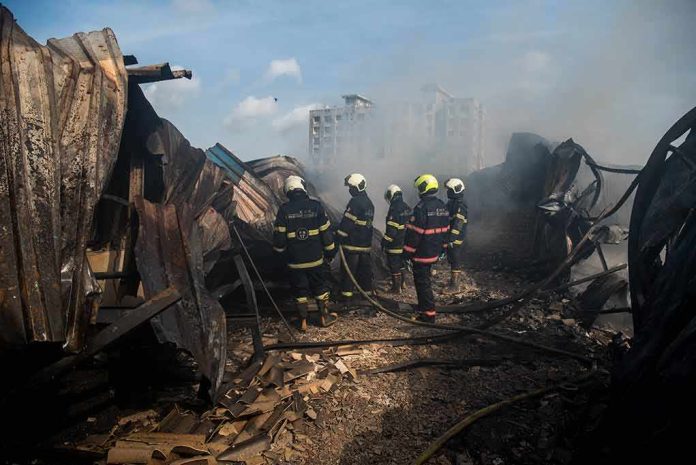
Fire crews got the call around 2:30 p.m. and arrived to find flames racing along rows of roof-mounted solar panels.[1][4] That matters, because solar arrays do two things firefighters hate: they keep generating power even when shut off, and they clutter the very roof you need to stand on to fight the fire. Crews started on the roof in an aggressive attack, then had to back off as the fire outpaced hose lines and small explosions popped across the panel field.[4]
Why The Shelter-In-Place Order Hit So Fast
While the cameras focused on the flames, the real worry was invisible: the chemicals inside and around that building. This was not a random storage shed; it was a cold-storage hub, which means large ammonia refrigeration systems and lots of freight moving in and out every day.[4][9] When flames compromised a pressurized ammonia line, firefighters suddenly faced both a roof fire and an active chemical release in one of the densest urban areas in the country.[4][9]
City officials did what responsible emergency managers do when they do not yet know the exact concentrations in the air: they hit the alert button. Phones buzzed with warnings about “hazardous materials nearby.” Residents from south of the 101 Freeway down to Washington Boulevard, and between Soto and Indiana, were told to get inside, shut doors and windows, turn off air conditioning, and keep people and pets in an inner room.[1][4] That is classic chemical safety playbook, not panic.
How Dangerous Was The Smoke, Really?
This is where headlines and hard numbers start to part ways. “Toxic smoke” makes for dramatic copy and viral posts. The facts are more mixed. Los Angeles Fire Department Chief Jaime Moore said the compromised ammonia line did release pressurized gas, and that is nothing to shrug off.[4][9] But he also stressed that, based on air monitoring, the ammonia and smoke were not expected to harm the general public unless people had respiratory problems or came into direct contact with it.[9]
At the same time, the South Coast Air Quality Management District issued an air quality advisory for areas east of downtown and into parts of the San Gabriel Valley until the next morning.[1] That kind of advisory is not issued for fun. It means fine particles and chemical irritants in the air are high enough that people with asthma, heart disease, or other issues should stay indoors and avoid heavy activity. From a common-sense, conservative point of view, that is government doing its basic job: warning people, not telling them the sky is falling.
Fire Tactics, Helicopters, And A Rooftop Battlefield
Once the ammonia line was known to be involved, commanders pulled firefighters off the roof and out of the interior. No fire is worth a crew’s lungs or lives. The operation shifted to a defensive mode backed by serious air power: three to four water-dropping helicopters hammered the fire from above, dropping thousands of gallons to keep flames from chewing into the warehouse interior and its contents.[1][4] By about 5:30 p.m., officials said they had halted the fire’s forward progress on the roof.[1][2]
🚨🇺🇸 BREAKING: A massive fire has engulfed a Los Angeles cold storage warehouse, sending toxic smoke into the sky and triggering shelter-in-place orders.
🔥 Nearly 500,000 sq ft facility
☣️ Hazardous air warnings issued
🚁 Firefighters battling the blaze from the airDeveloping… pic.twitter.com/JD1rRk227G
— ABV 🇺🇸 (@ABV1174288) June 18, 2026
For people watching from their porches, the smoke still made it look like half the city was burning. Reports and local write-ups describe the plume visible all the way to the San Fernando Valley, where residents could see the dark column from miles away.[7] Yet inside the perimeter, the story was more contained: a roof-focused fire, a damaged ammonia line, and a deliberate choice to accept visible smoke in exchange for keeping firefighters alive and the blaze on top of the building, not inside it.
Who Bears The Risk When Infrastructure Meets Ideology
One Boyle Heights resident, watching officials tell her working-class neighborhood to hunker down while traffic rolled on elsewhere, put it bluntly: if this were Beverly Hills, people would be evacuated, not told to shelter in place.[1] That complaint taps into a wider pattern. Facilities that mix heavy industry, chemical systems, and “green” tech like rooftop solar often end up in cheaper land zones, which means lower-income and minority communities eat the risk when things go wrong.
Ammonia itself is not some fringe hazard. It is a workhorse chemical in cold storage, and federal agencies classify anhydrous ammonia as corrosive and potentially deadly at high doses.[1][24] Industry and labor groups warn that leaks are not freak accidents; they repeat when training, maintenance, and culture slip.[20][23] From a conservative, responsibility-first lens, that raises hard questions for a logistics giant like Lineage and for regulators: are safety investments keeping up with the scale and complexity of these hubs, or are we counting on luck and helicopter pilots?
After The Flames: What This Fire Quietly Exposed
By Wednesday night, the immediate crisis began to wind down. Shelter-in-place orders were lifted, though a smoke advisory stayed in effect out of caution.[1][11] No injuries were reported. Firefighters started the slow, careful work of checking the interior, watching for lingering hot spots, and measuring gases that could still pool inside the cavernous space.[11] On paper, that sounds like a win: big fire, scary smoke, no deaths.
But for anyone paying attention, the Boyle Heights blaze was also a warning shot. Modern cities now stack solar arrays, chemical refrigeration, and massive logistics operations right next to homes, schools, and freeways. When a single rooftop failure can send a “not quite toxic, but do not breathe it” cloud over half of Los Angeles, the question is not whether the smoke was technically hazardous. The question is how many more of these near-misses we are willing to accept before we demand tougher maintenance, stricter placement of facilities, and real accountability when corporations park their risks in someone else’s backyard.
Sources:
[1] YouTube – Los Angeles warehouse fire engulfs the city in toxic smoke
[2] Web – Massive fire at warehouse in Boyle Heights triggers shelter-in-place …
[4] Web – Los Angeles Warehouse Fire Prompts Thousands to Shelter in Place
[7] Web – Crews have contained a fire at a Boyle Heights cold storage facility …
[9] Web – BOYLE HEIGHTS: A fire erupted in a cold storage facility … – …
[11] Web – Toxic smoke engulfs Los Angeles as massive warehouse fire sparks …
[20] Web – Ammonia leak prompts hazmat response at Delano cold storage …
[23] Web – Millard Refrigerated Services Ammonia Release – CSB
[24] Web – Ammonia Refrigeration in Warehouses