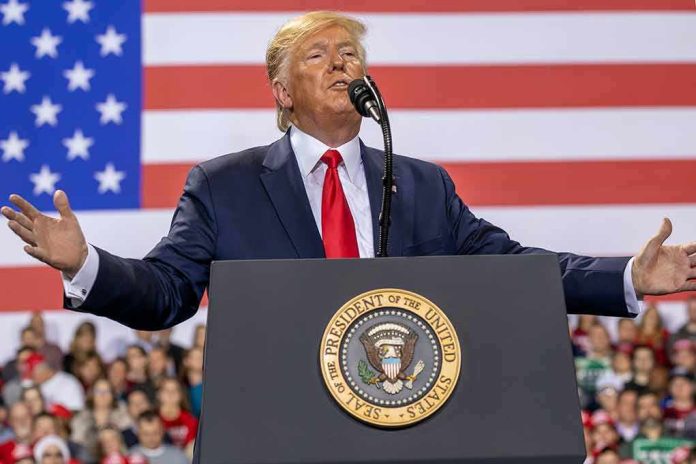
When Donald Trump stood at Mount Rushmore and called English “the language of freedom,” he was locking a culture war speech, a monument, and a brand‑new federal language order into one explosive message about what it means to be American.
Story Snapshot
- Trump used Mount Rushmore to link American history, national identity, and speaking English as one package.
- He announced big symbolic moves: a National Garden of American Heroes and English as the official U.S. language.
- Supporters saw defense of culture and common sense; critics saw divisive rhetoric and a solution to a “non‑problem.”
- The speech fits a long trend of using monuments and language to fight over who defines America.
Trump’s Mount Rushmore moment and the fight over who defines America
Trump did not pick Mount Rushmore by accident. The presidents carved in stone behind him are symbols of American founding, survival, and growth. In 2020 he used that backdrop to warn about a “merciless campaign to wipe out our history” and “defame our heroes,” tying attacks on statues and monuments to a larger struggle over American identity. He framed himself as the one standing between those carvings and a left‑wing movement he said wanted to tear them down.
Trump slams communism in Mount Rushmore speech marking America’s 250th b… https://t.co/EFPDVwA1GH via @YouTube
— HUYNH HOANG (@huynhhoang986) July 4, 2026
Most media called the speech divisive and a culture war stunt, but few challenged the basic facts he cited about the broader wave of statue toppling in the country. From a conservative, common‑sense view, defending monuments to Washington and Lincoln is hardly radical. What rubbed critics raw was his blunt claim that this was not about a few bad actors with spray paint, but about an organized “cultural revolution” that rejected the American story itself.
From statues to a National Garden of American Heroes
Trump did more than complain about vandals. At Mount Rushmore he announced an executive order to build a “National Garden of American Heroes,” a large outdoor park of statues to the greatest Americans who ever lived. The idea was simple and very American: if activists tear down figures from our past, the federal government will build more of them. It answered icon smashing with icon building, in stone and bronze instead of social media threads.
Critics pointed out that the order had almost no details on where the garden would be, how much it would cost, or when it would open. That is fair. But symbolism is not nothing in politics, especially for a patriotic base that sees schools, media, and universities tilting against traditional heroes. To those voters, the garden signaled that at least someone in Washington thought George Washington and Frederick Douglass deserved more statues, not fewer.
“In America, we speak English” and the 2025 language order
Trump’s Mount Rushmore line that “in America, we speak English” later turned into a full policy move. In March 2025, he signed an executive order titled “Designating English as the Official Language of the United States.” The order argued that English has always been the language of our founding documents and that making it official would promote unity, shared culture, and clearer government communication.
🇺🇸🎆 TRUMP'S MOUNT RUSHMORE SPEECH Cuts Straight To The Truth On America's 250th — Top Posts Today Affirm This STAND For EXCEPTIONALISM And REAL FREEDOM.
One fact rises clear above the noise: America is the MOST SUCCESSFUL, MOST ACCOMPLISHED, MOST EXCEPTIONAL NATION EVER TO… pic.twitter.com/IrelRjR3e0
— SilentPatriot47 (@ShadowPatriotUS) July 4, 2026
The order did not ban other languages, and it did not force agencies to scrap non‑English materials overnight. It did roll back a Clinton‑era requirement that agencies provide language assistance for people with limited English, and it told the Attorney General to revisit rules built on that mandate. Critics in the press and in academia called it “unkind” and said it attacked immigrants to solve a “nonexistent problem.” That complaint says a lot: for them, the status quo was fine; for many conservatives, it was not.
Culture, common sense, and why language feels like a battlefield
From a conservative standpoint, the idea that a nation should have one shared language is not xenophobia, it is basic social glue. You cannot run elections, courts, or civic life in a dozen tongues without confusion and chaos. That is why more than 30 states had already named English their official language before Trump acted. The federal order simply pulled Washington in line with what most states and many voters already assumed was reality.
Opponents worry about people who struggle with English now. That concern is real. But the long‑term answer is not to freeze the country in permanent translation. It is to help new Americans learn the language that opens doors in business, education, and public life. Trump’s “language of freedom” line captured that belief: English is not about blood or race; it is the tool that lets a kid from anywhere read the Constitution and argue back.
Monuments, language, and the next chapter of the American story
The Mount Rushmore moment and the English‑language order are two parts of the same fight: who gets to tell America’s story, and in what words. Trump used a monument carved into a mountain to say the story is worth defending, flaws and all. Then he used an executive pen to say that story has a primary language, and it is the one of the Declaration and the Constitution. Supporters heard backbone; critics heard exclusion.
History will sort out how these moves age. But one fact is hard to ignore: in a time when many leaders duck hard questions about national identity, Trump did the opposite. He picked a mountain, picked a language, and told the country, “This is our culture. This is our character.” Voters now have to decide whether that sounds like a threat—or like home.
Sources:
insiderpaper.com, youtube.com, trumpwhitehouse.archives.gov, cnn.com, npr.org, nytimes.com, en.wikipedia.org, aei.org