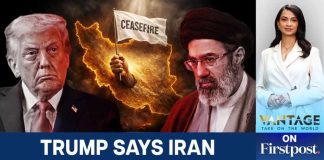
Trump just claimed Iran’s president requested a ceasefire, but Tehran immediately called it false—and the real leverage play is over control of the Strait of Hormuz, where 20 percent of the world’s oil flows.
Story Snapshot
- Trump announced Iran’s president requested a ceasefire, conditioning any deal on the Strait of Hormuz being “open, free, and clear”
- Iranian officials denied the claim within hours as “false and baseless,” creating immediate diplomatic confusion
- Trump signaled the U.S. will exit the Iran war within two to three weeks, claiming nuclear and regime-change objectives already met
- The real battleground is the Strait of Hormuz—Trump’s non-negotiable demand that Iran cannot easily concede without appearing defeated
- Markets remain volatile as oil prices swing on uncertainty over whether this conflict ends in negotiated settlement or continued strikes
The Ceasefire Claim Nobody Believes
President Trump posted on social media that Iran’s President Masoud Pezeshkian requested a ceasefire, framing it as evidence of American military dominance and Iranian weakness. The announcement came after two months of relentless U.S.-Israeli strikes that began February 28, targeting over 15,000 Iranian military sites. Trump’s condition was stark: the Strait of Hormuz must reopen to normal traffic, or the U.S. would continue “blasting Iran into oblivion.” Within two to three hours, Iranian officials flatly rejected the claim as fabricated, calling it a propaganda stunt designed to demoralize their population and justify continued American strikes.
The denial matters because it exposes the real negotiating posture. Pezeshkian, in office since 2024, holds limited power—the Islamic Revolutionary Guard Corps controls actual military decisions. Trump’s social media strategy bypasses formal diplomatic channels, creating noise rather than clarity. This approach worked during the 2025 ceasefire with Israel, which held despite violations, but Iran’s immediate pushback suggests Tehran won’t be stampeded into concessions through public shaming.
The Hormuz Trap
Trump’s insistence on reopening the Strait of Hormuz reveals the actual sticking point. This waterway handles roughly 20 percent of global oil supply, and Iran’s control over it gives Tehran asymmetric leverage. For Iran to agree to “open, free, and clear” passage would signal capitulation—admitting defeat in the only arena where it can inflict economic pain on the West. Trump knows this, which is why he made it non-negotiable rather than a bargaining chip. Iran’s retaliatory drones and missiles have proven largely ineffective against U.S. air defenses, so disrupting oil flows remains Tehran’s only credible threat.
Energy markets are already pricing in this impasse. Oil traders face a binary choice: either Trump achieves a breakthrough and Hormuz stabilizes, or the conflict drags on and supply uncertainty persists. Neither scenario favors a quick resolution. If Trump pulls out in two to three weeks as promised, Iran might interpret it as American exhaustion rather than victory, emboldening future aggression. If negotiations drag past that timeline, Trump’s credibility takes a hit domestically.
The Regime-Change Subtext
Trump’s framing of Pezeshkian as “less radicalized” than previous Iranian leaders hints at a deeper objective beyond ceasefire terms. The massive strikes—decapitating Iranian regime leadership, degrading air defenses, and destroying drone manufacturing—suggest regime change remains an unstated goal. By claiming nuclear and military objectives are already met, Trump can declare victory and withdraw, leaving Iran weakened but intact. This preserves the option for future strikes without committing to permanent occupation or nation-building, a lesson learned from Iraq and Afghanistan.
Israeli interests align here. Israel struck Iranian targets in prior conflicts and benefits from a degraded Iranian military apparatus. Qatar, which mediated the 2025 ceasefire and hosts critical U.S. bases, faces pressure to broker talks again. Yet without formal Iranian confirmation of Pezeshkian’s supposed ceasefire request, mediators lack credible ground truth—they’re working from Trump’s social media post, which is inherently unreliable for diplomacy.
The real test comes in the next 14 to 21 days. If Trump withdraws as promised, the question becomes whether Iran interprets it as American victory or strategic pause. Either way, the Strait of Hormuz remains contested, global energy prices stay elevated, and the underlying grievances that sparked this conflict—Iranian nuclear ambitions, U.S. military presence, Israeli security demands—remain unresolved. Trump’s ceasefire announcement may be political theater, but the economic consequences are very real.
Sources:
Iran live updates: Trump touts ‘big day’ on Iran
Iran live updates: Trump threatens infrastructure strikes if talks fail
Israel-Iran ceasefire agreement reached through Trump administration