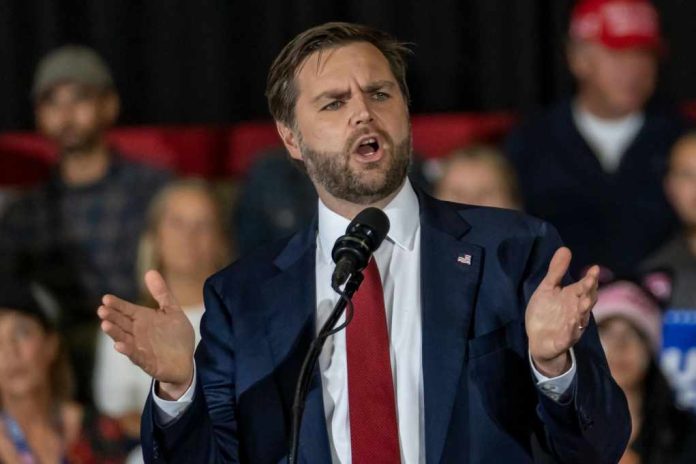
President Trump signed a deal meant to end the Iran war, then months later called it a “waste of time” anyway.
Quick Take
- Trump and Vice President JD Vance signed a U.S.-Iran memorandum of understanding on June 17, promising a “historic breakthrough” toward peace.
- The deal was always temporary, giving both sides 60 days to reach a final agreement on sanctions, nuclear limits, and reconstruction funds.
- By August, the memorandum had expired amid stalled talks, and fighting flared again near the Strait of Hormuz.
- Trump later called the agreement his own vice president negotiated a “waste of time,” even as he stopped short of calling it a mistake.
A Signed Deal That Was Never Meant to Be Final
The White House billed the June 17 memorandum as a game-changer. Officials said it would stop Iran from ever getting a nuclear weapon and reopen the Strait of Hormuz to free shipping. But the text itself told a different story. It gave both countries only 60 days to hammer out a real, final agreement, extendable only if both sides agreed.
That distinction matters. A memorandum of understanding is not a treaty. It is a starting point, not a finish line. The document called for ending the naval blockade and halting military operations right away, but left the biggest questions, sanctions relief, nuclear material disposal, and more than $300 billion in promised reconstruction funds, for later talks that never fully happened.
The Fine Print Nobody Finished Writing
Reporters who got hold of the full text found plenty of big promises but few operational details. Iran agreed not to pursue nuclear weapons, but the memorandum never spelled out how enriched uranium would be verified, stored, or destroyed. No inspection schedule. No enrichment cap written in stone. Just an agreement to keep talking about it later, which is exactly the kind of gap that gives skeptics ammunition.
Trump’s own words at the time hinted he knew the deal was shaky. According to a transcript summary, he described it as “not final” and warned that if a lasting agreement didn’t come together within 60 days, “we go back to bombing”. That’s not the language of a man who believed he’d locked in peace. It’s the language of a man buying time.
From Breakthrough to Breakdown in Two Months
The clock ran out. Reporting from mid-August confirmed the memorandum had expired, talks had stalled, and the fragile ceasefire it created was falling apart. By November, outlets described the agreement as having collapsed entirely, with renewed hostility replacing the brief calm the deal had bought.
That collapse is the backdrop for Trump’s blunt verdict. He didn’t just criticize the policy in the abstract. He called the ceasefire memorandum his own vice president negotiated a “waste of time,” a remarkable admission that lands weeks after midterm losses and months after the deal fell apart.
First time seeing this Islamabad Memorandum aka the MOU that J.D. Vance brokered, drafted on June 14, 2026, signed on June 17, 2026, and promptly ended by President Trump on July 8, 2026 after Iran violated the Terms by striking multiple commercial ships. Lasted a mere 22 days.
— Oath Is For Life (@bratNvetII) November 19, 2026
Praise From Allies Doesn’t Erase the Weak Spots
To be fair, the deal had defenders. France, Germany, Italy, and the United Kingdom called it a genuine diplomatic breakthrough and urged both sides to finish the detailed follow-up negotiations quickly. G7 leaders went further, framing it as a historic chance to stop Iran’s nuclear ambitions and rein in its ballistic missile program. Those are credible voices, and their optimism wasn’t baseless at the time.
Independent analysts also noted the memorandum produced real, immediate results: a halt to hostilities, a lifted naval blockade, and safe passage for ships through the Persian Gulf. Those wins happened. But short-term relief is not the same as a durable settlement, and the deal’s own supporters admitted the hard work still lay ahead in follow-on talks that ultimately never landed.
A Familiar Pattern in Iran Diplomacy
This isn’t the first time Washington has tried a stopgap with Tehran. The 2013 Joint Plan of Action came before the more detailed 2015 nuclear deal, using a similar playbook of temporary limits while negotiators worked out the real terms. That history shows interim deals can work, but only when both sides actually finish the job. This one didn’t.
Conservatives watching this unfold have reason to feel vindicated by Trump’s blunt assessment. A deal that trades concrete, immediate U.S. concessions, lifting a naval blockade, easing pressure, for vague promises about nuclear compliance and reconstruction cash was always a gamble. When Iran didn’t hold up its end, the gamble didn’t pay off. Calling that outcome a “waste of time” isn’t spin. It’s an honest scorecard.
Sources:
redstate.com, whitehouse.gov, bbc.com, cnbc.com, foreignpolicy.com, aljazeera.com, hindustantimes.com, npr.org