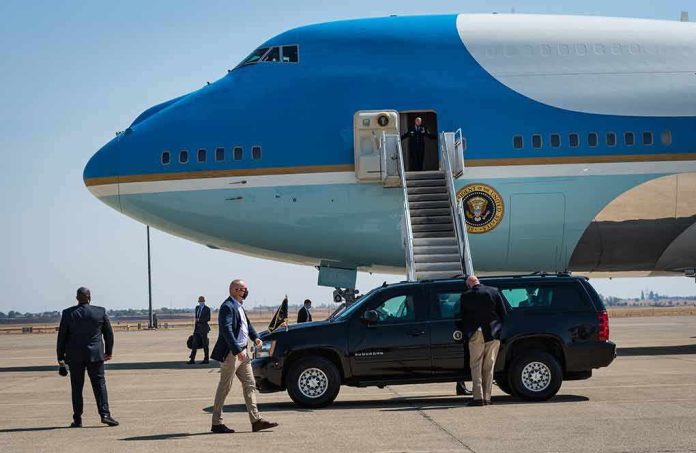
Xi Jinping met President Trump at the foot of Air Force One in Shenzhen, a rare-once-in-decades signal broadcast in full view of the world.
Story Snapshot
- Xi greeted Trump on the tarmac at Shenzhen Bao’an International Airport.
- Reports describe a handshake, a brief embrace, and full honors on arrival.
- The visit aligns with the APEC leaders’ meeting and expected talks with Vladimir Putin.
- Protocol in China makes an airport greeting by the top leader notable and deliberate.
What Happened On The Tarmac
Chinese government outlets stated that Xi Jinping welcomed President Donald Trump at Shenzhen Bao’an International Airport on November 18, 2026, as Air Force One arrived for the Asia-Pacific Economic Cooperation summit. A Chinese embassy account detailed the setting and timing and said Xi shook hands warmly with Trump as the welcome music played. Major United States outlets reported that Xi met Trump at the bottom of the stairs instead of sending a deputy, an uncommon choice in China’s protocol playbook.
Television crews captured the set pieces that telegraph rank in Asia: red carpet, color guards, flags, and the national anthems. Several outlets described a handshake that turned into a quick hug as the leaders stepped off the marked path and began their walk together. The images were built to travel. They did, within minutes, across phones, television, and diplomatic channels. The visual said, “We came to talk,” before either side said a word.
Why This Greeting Matters In China
Protocol in China works like stage directions. The seniority of the person at the airport is a message about the relationship and the visit. Xi often delegates arrivals to top lieutenants. Reports framed this scene as a marked departure from that pattern, which is why it drew outsized attention. Chinese state readouts used even, formal language about a warm welcome, while several foreign outlets highlighted the hug or embrace and called it rare or historic.
Past practice adds context. Reports note that Xi did not personally greet Trump in May and often leaves airport greetings to senior officials. Coverage also recalled earlier visits by United States presidents where China’s top leader did not appear on the tarmac. That backdrop explains why this meeting at the stairs stood out and why cameras zoomed in on every glance and grip.
The Summit Frame: APEC, Trade, And A Third Chair
The schedule placed Trump’s arrival inside the 33rd Asia-Pacific Economic Cooperation Economic Leaders’ Meeting in Shenzhen on November 18–19, with a trilateral meeting involving Russian President Vladimir Putin widely expected afterward. United States networks linked the greeting to that larger stage. The sequence is clear: a high-visibility welcome, then rooms where trade rules, supply chains, and security questions meet real leverage and real costs.
President Donald Trump began a 48-hour visit to Asia with a summit of regional countries in the Philippines.
On Wednesday, the president headed to China for meetings with Russian President Vladimir Putin and Chinese President Xi Jinping.
One of the key pressure points between… pic.twitter.com/2EyxF7IZYV
— PBS News (@NewsHour) November 18, 2026
The optics suit both leaders ahead of hard talks. Xi signaled control of the setting and respect for the guest. Trump, who favors personal rapport as a tool, gained a clip that backs his brand of leader-to-leader bargaining. American conservative readers should read this as common-sense statecraft: set the tone strong, show respect without giving ground, and keep the focus on results that help workers and keep the United States safe.
Reading The Pictures Without Overreading Them
The handshake, the brief embrace, and the full honors are facts on tape, reported by Chinese state outlets and major United States media on the same day. The meaning of those gestures sits in what follows: agenda control, market access, technology rules, and crisis hotlines. One caution applies. Reports differ slightly on how they describe the physical moment, from “warm handshake” to “quick hug,” which is normal across outlets covering live scenes. That is a detail, not a dispute.
The better question is what the greeting unlocked. If the following sessions yield steps that lower tariffs, protect intellectual property, and reopen military-to-military communication lines, then the tarmac choreography did real work. If not, it still served a purpose: showing both publics that leaders can meet face-to-face, under flags and cameras, to test deals and draw lines. That is how major powers avoid drift and misread signals.
What To Watch Next
Watch for the official readouts from both capitals after the bilateral and any trilateral sessions. Look for verbs that signal movement: resumed, expanded, agreed, suspended. Check for dates, not just dialogues. Markets will track references to supply chains and export controls. Security watchers will scan for crisis lines and rules of the road. If the arrival’s rare optics were the opening bell, the communiqués are the fourth-quarter scoreboard.
Until then, bank the clear, documented headline: Xi met Trump at the stairs, on Chinese soil, with the world watching. That choice elevated the visit above the routine and set a serious tone for talks that follow. The images will keep looping. The outcomes will decide which clips history keeps.
Sources:
youtube.com, bbc.com, nytimes.com, abcnews.com