The most powerful navy on earth just fired missiles into a foreign-flagged oil tanker to enforce a unilateral blockade on Iran, and almost everything we know about it comes from carefully worded press releases and grainy video.
Story Snapshot
- The United States Central Command (CENTCOM) says it disabled an Iran-bound tanker after the crew ignored repeated orders to stop.
- Washington now openly talks about a “blockade” on Iranian ports, raising serious questions about legality and escalation.
- Critics point out the public record still lacks clear proof that this specific ship was in unlawful violation when it was hit.
- The showdown fits a larger pattern: quiet sanctions wars at sea that voters only see when a missile video makes cable news.
What CENTCOM says happened in the Gulf
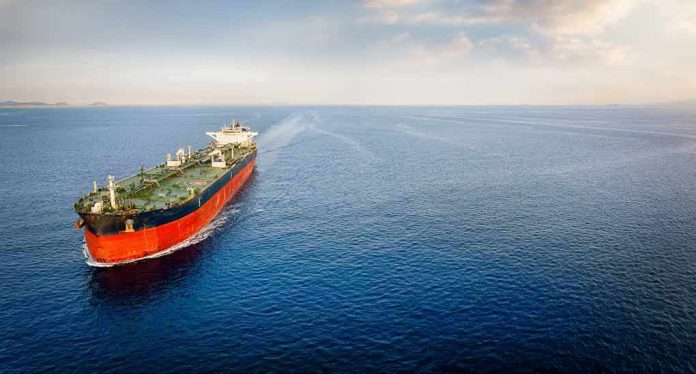
United States Central Command states that American forces disabled an empty oil tanker in the Arabian Gulf that was “reportedly heading to an Iranian port” and refused to comply with instructions from U.S. forces.[1] CENTCOM describes the ship as flying the flag of Botswana and says a U.S. aircraft fired a Hellfire missile into the engine room to stop it from continuing toward Iran.[1] Official photos and video released later show a precision strike and a burning aft section consistent with that narrative.[4]
In a separate but closely related announcement, CENTCOM detailed how U.S. forces disabled multiple Iranian-flagged tankers in the Gulf of Oman that it says were attempting to enter an Iranian port “in violation of the ongoing U.S. blockade.”[2] According to the command, a U.S. Navy F/A-18 Super Hornet from the carrier USS George H.W. Bush struck the smokestacks of M/T Sea Star III and M/T Sevda, while another F/A-18 from USS Abraham Lincoln disabled the rudder of M/T Hasna with 20 millimeter cannon fire.[2] All three vessels, CENTCOM says, are no longer transiting to Iran.[2]
The blockade claim and the question of legal authority
CENTCOM does not just describe isolated “maritime security operations”; it explicitly frames these actions as enforcing a “U.S. blockade” on Iranian ports in the Gulf of Oman.[2] That word matters. Under traditional law of armed conflict, a blockade is usually associated with a declared state of hostilities, notice to third states, and clear rules about which ships can be stopped or attacked. CENTCOM’s public materials, at least so far, do not include a published, detailed blockade order spelling out that legal basis and its geographic scope.[2][3]
From a conservative, rule-of-law standpoint, that gap is not a small footnote. If the United States expects other nations to respect freedom of navigation and the open sea, it strengthens its position when it can point to clear, public authority for its own use of force. Right now, the public sees precise weapons employment and strong rhetoric about Tehran, but not the underlying document that would show how Washington justifies striking a foreign-flagged, reportedly unladen commercial ship in peacetime waters.[1][2] That disconnect fuels doubts abroad and cynicism at home.
What is known about the tanker’s behavior and intent
In the Arabian Gulf incident, CENTCOM’s statement offers three key factual claims: the tanker was empty, it was heading toward an Iranian port, and it failed to comply with U.S. instructions.[1] If all three are accurate, then the operational logic is straightforward: stop a vessel before it can load sanctioned oil and join Iran’s “shadow fleet.” Boarding operations described in an earlier case, where U.S. Marines inspected the Iranian-flagged M/T Celestial Sea and then ordered it to change course instead of disabling it, show that less-lethal tools exist when a crew cooperates.[3]
However, external ship-tracking analysis referenced in maritime reporting on similar seizures points out that declared destinations and course over ground often change, and that tankers can head for places like China or United Arab Emirates ports before or after shadow dealings near Iran.[4] In this case, the public has not yet seen a full track log for the Botswana-flagged tanker that would independently confirm that it was committed to an Iranian port approach at the moment it was struck.[1][4] That missing piece leaves room for both CENTCOM’s claim and skepticism to coexist.
The shadow fleet, sanctions pressure, and escalation risk
Maritime analysts have documented a growing Iranian “shadow fleet” of tankers that move sanctioned oil using tactics such as false flags, shell-company ownership, and deliberate switching off of transponders.[4] U.S. Treasury sanctions and naval seizures aim to raise the cost of that trade, which aligns with a conservative preference for financial and targeted pressure instead of large-scale ground wars. Every time the U.S. enforces sanctions at sea, though, it edges closer to a line where economic pressure shades into active warfare, especially when aircraft fire on commercial hulls.
Seizure and inspection of a sanctioned ship linked to the Islamic Republic in the Indo-Pacific region
US naval forces, during a maritime operation in the Indian Ocean, have inspected and intercepted a stateless and sanctioned vessel linked to the Islamic Republic named "MT… pic.twitter.com/CjeCkFOvoe
— Iran Observatory (@IRObservatory) June 5, 2026
Common sense asks two questions. First, does disabling a ship’s rudder or engine room with precision weapons achieve a clear strategic gain that justifies the risk of miscalculation with a regional power that sponsors terrorism and threatens U.S. partners? Second, does Washington maintain enough transparency with its own citizens about these operations to earn their trust? On both counts, the answer depends less on the quality of the missile strike and more on the clarity of the mission and the honesty of the explanation that follows.
Sources:
[1] Web – US says it fired on, disabled tanker that violated Iran port blockade
[2] Web – US seized Iran-linked oil tanker in the Indian ocean, WSJ reports
[3] Web – US seizes Iran-linked oil tanker in Indian Ocean – WSJ
[4] YouTube – Video: US seizes Iranian linked oil tanker