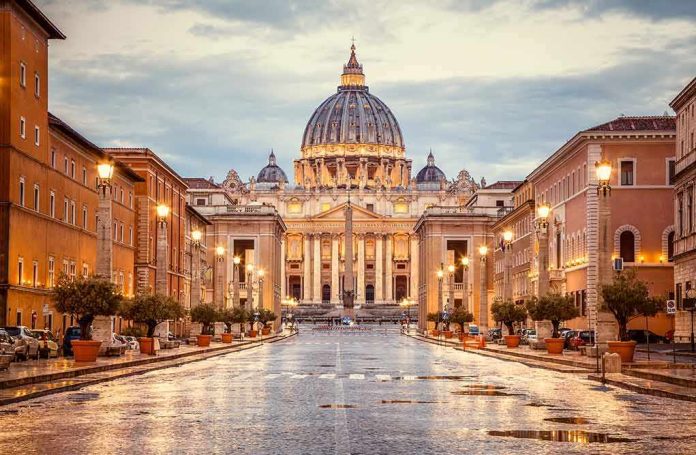
The Vatican confirmed Pope Leo XIV has lung adenocarcinoma after surgeons removed the lower lobe of his right lung.
Story Snapshot
- The Holy See said intraoperative tests confirmed lung adenocarcinoma.
- Surgeons removed the lower lobe of the right lung in Rome’s Gemelli Hospital.
- The operation lasted about 90 minutes and ended without complications.
- The Pope had warned days earlier that doctors found a small, localized nodule.
What Happened In The Operating Room
The Holy See Press Office reported that Pope Leo XIV underwent surgery at Gemelli Hospital on October 13 to remove the lower lobe of his right lung. The statement said the procedure took about 90 minutes within a roughly three-hour operating room window and concluded without complications. Doctors confirmed the diagnosis of lung adenocarcinoma during surgery through microscopic tissue analysis, which is the medical gold standard for confirming cancer type before planning treatment.
Vatican News had announced the plan days earlier: admission on October 13, surgery for a suspicious nodule, and an expected hospital stay of about one week. That advance notice set public expectations around timing and early recovery steps, including breathing exercises, pain control, and gradual walking in the ward. The medical team named in reports included thoracic specialists, underscoring a standard path for localized lung surgery in a high-volume center.
How The Diagnosis Emerged So Quickly
The speed from “nodule” to “cancer” can feel abrupt, but it follows a normal medical arc. Imaging first flags a spot that raises concern. Surgeons then remove the suspicious area when the nodule appears operable, and pathologists examine the tissue in real time to guide the extent of resection. The Vatican’s statement mirrors that script: preoperative tests raised concern, intraoperative histology confirmed adenocarcinoma, and surgeons completed the lobectomy as planned.
Pope Leo had prepared the world for this possibility. Two days before surgery, he told the faithful that doctors found a small, well-localized nodule and advised action. That message matched the clinical logic for an early-stage, operable lesion: when a nodule appears confined and removable, surgery both diagnoses and treats in one step. News outlets emphasized that many nodules are benign, but tissue proof ends the guessing.
What We Know Now, And What Comes Next
The confirmed facts are straightforward. The Pope has lung adenocarcinoma. Surgeons removed the right lower lobe without complications. He is recovering in the hospital with a target stay of about a week. These building blocks usually lead to a standard next phase: a full pathology report that details tumor size, margins, and lymph nodes. Those findings determine the stage and whether the care team advises more treatment or simple surveillance.
Pope Leo XIV has been diagnosed with lung cancer.
Source: Vatican
— Papa Marc Macuda (@Marc_Macuda) October 14, 2026
Common sense says two truths can stand together. First, the surgery went well and removed the known tumor. Second, doctors will wait for complete pathology before final plans. That is not hedging; it is good medicine. For many early lung adenocarcinomas, surgery alone can suffice. If pathology shows close margins or involved nodes, doctors may discuss additional therapy. Until then, rest, breathing exercises, and infection prevention top the list.
Why This Moment Matters Beyond The Hospital Room
The papacy is global, yet illness is personal. The Vatican balanced both by sharing timely facts: the diagnosis, the operation details, and the early recovery notes. That openness shaped calm headlines and focused attention on early detection and action. Newsrooms tracked the sequence from planned admission to confirmed cancer with steady updates, underscoring a simple civic lesson: say what you know, when you know it, and avoid hype.
Sources:
lifesitenews.com, abcnews.com, abc13.com, vaticannews.va, apnews.com, bbc.co.uk, pmc.ncbi.nlm.nih.gov