
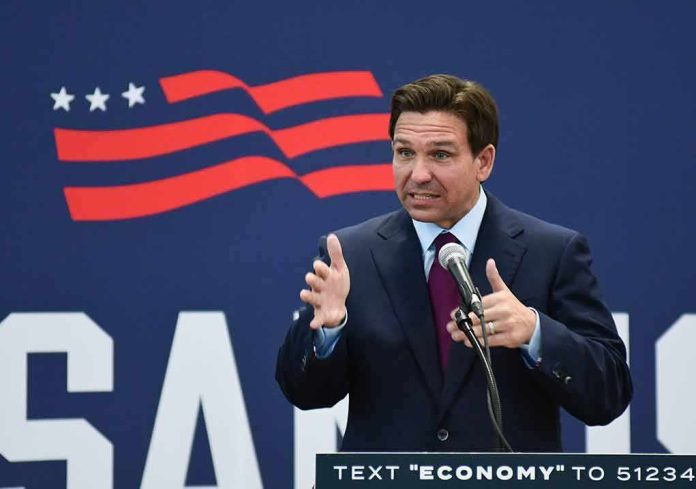
Ron DeSantis tore into Vivek Ramaswamy on a podcast this week, and the Florida governor didn’t hold back on why Ramaswamy got crushed in Ohio.
Quick Take
- DeSantis said Ramaswamy’s support for foreign worker visas made him a bad fit for Ohio’s working-class voters
- Ramaswamy lost the Ohio Republican gubernatorial race by 7.9 percentage points
- DeSantis called Ramaswamy a “tech guy” out of step with blue-collar Ohioans
- The two have clashed repeatedly since the 2024 Republican presidential primary
DeSantis Names the Issue He Says Sank Ramaswamy
Speaking on The Sage Steele Show in November 2026, DeSantis said Ramaswamy “wants to bring in people, foreign worker on visas” and argued that stance doesn’t fly in Ohio. He said flatly that Ramaswamy is “not the type of person that’s going to sell” with the state’s voters, tying his criticism directly to Ramaswamy’s known support for changing the H-1B visa system.
DeSantis didn’t stop at policy. He described Ohio as “a working-class state” and said Ramaswamy, whom he labeled a “tech guy” linked to an Alzheimer’s drug business, simply wasn’t “in tune” with the people he needed to win over. It’s a blunt argument: biography and policy together made Ramaswamy a mismatch for the electorate he was courting.
The Loss Behind the Attack
DeSantis wasn’t speaking in a vacuum. Ramaswamy lost the Ohio Republican gubernatorial race by nearly eight points, a defeat DeSantis described as getting “beat like a drum.” That number gives his criticism a real foundation, even though the reporting doesn’t break down exactly how much the visa stance, Ramaswamy’s business background, or other factors each contributed to the final tally.
Ramaswamy’s actual campaign platform covered plenty of ground beyond visas. He pushed phasing out Ohio’s income tax, rolling back property taxes toward 2020 levels, and consolidating public universities to pay for the cuts. He also proposed restricting data centers in ways meant to protect local power bills. None of that, on its face, screams “out of touch” with working voters.
A Visa Position More Nuanced Than the Soundbite
Ramaswamy’s actual H-1B position called for gutting the current lottery system in favor of a merit-based approach, not simply flooding Ohio with foreign labor. DeSantis’s shorthand compresses that nuance into a simpler, more combustible line. It’s effective rhetoric, but it leaves out some of the texture of what Ramaswamy actually proposed on the trail.
Old Rivals, New Round
This isn’t the first time these two have gone after each other. During the 2024 Republican presidential primary, DeSantis and Ramaswamy traded sharp barbs on debate stages and in interviews. Ramaswamy at one point accused DeSantis of being “complicit” against President Trump unless he dropped off certain ballots, a charge DeSantis dismissed outright.
Ramaswamy’s debate style has drawn scrutiny from other outlets, too. CNN’s coverage of a December 2023 primary debate described him promoting what it called a “widely debunked conspiracy theory” about the January 6 Capitol riot and launching into a broader rant about the so-called deep state. That history gives DeSantis’s “out of touch” framing some added weight, since it wasn’t the first time Ramaswamy’s rhetoric drew pushback.
What the Research Says About Attacks Like This
Political science on negative campaigning suggests voters actually separate substantive criticism from petty insults. Studies show policy-based attacks can inform voters, while personal or irrelevant jabs often backfire on the attacker instead. DeSantis’s critique leans heavily on a real electoral result and a documented policy position, which puts it closer to the “substantive” end of that spectrum than pure mudslinging.
That said, broader research on attack campaigning finds mixed results on whether these moments actually move voters at all. A review of dozens of studies found no measurable turnout effect in nearly two-thirds of cases, a reminder that viral soundbites don’t always translate into electoral consequences down the road.
Why This Exchange Resonates Beyond Ohio
For conservative voters watching the fallout, the bigger point lands cleanly: a candidate’s stance on immigration and labor policy isn’t abstract, it shows up at the ballot box. DeSantis is making the case that championing more foreign worker visas is a losing message in working-class America, and Ohio’s results give him a concrete example to point to rather than just a hunch.
Whether or not Ramaswamy’s visa position was the deciding factor in his defeat, the episode highlights a real tension inside the Republican coalition between tech-industry voices favoring expanded visa programs and a base increasingly skeptical of that approach. That fight isn’t going away, and DeSantis just made sure it stays in the headlines.
Sources:
mediaite.com, ncnewsline.com, mezha.net