
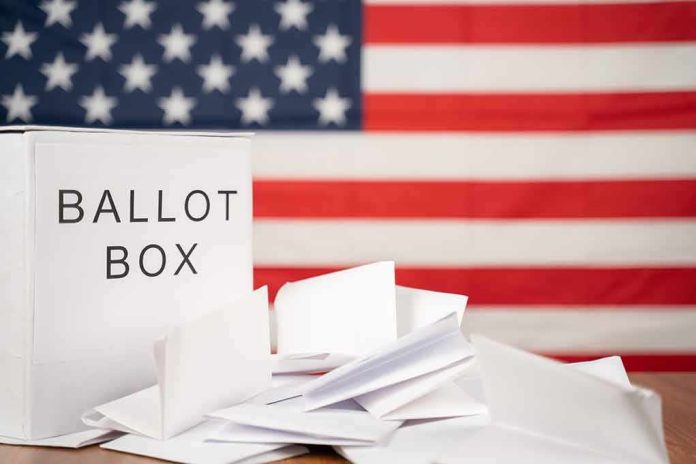
A sealed ballot box with 333 Election Day votes sat for a week in a poll worker’s pickup truck.
Story Snapshot
- Officials found a sealed Pocatello Precinct 2 ballot box one week after Election Day.
- The 333 ballots matched 333 election-day check-ins and were later counted.
- Outcomes did not change; the closest affected race stayed separated by 2,024 votes.
- The state drew Bannock County for a hand-count audit days later.
What Happened And Why It Matters
Bannock County elections staff found a missing ballot box during a supply search one week after Election Day. The sealed container, tied to Pocatello Precinct 2, held 333 ballots that did not enter the election-night count. The county said the box had slid from the tailgate toward the cab of a poll worker’s truck and was missed during unloading. Officials notified the Secretary of State and then counted the ballots. They said the box’s seals were intact and matched records.
County staff reported the 333 ballots matched exactly 333 electronic poll-book check-ins from that precinct. They also said the late count did not change any race. The closest affected contest stayed separated by 2,024 votes after adding the ballots. County leaders called the lapse unacceptable and pledged more transparency and fixes. The headline is memorable. The cause is familiar: human error in transport and inventory, not proven fraud or tampering, based on the available facts.
Chain Of Custody Broke Where It Should Not
Election-night controls failed at a basic step: return and intake of ballot boxes from polling places. Volunteers drove materials back, including in pickup trucks. Staff missed one sealed box during unloading and inventory. That is a real control failure because the ballots were outside the counting process for a week. The county later reconciled the box with check-ins and seals and added the votes. The lapse still exposes weak spots in transport, two-person checks, and load verification.
From a conservative, common-sense view, government should not run critical materials like a lost-and-found bin. Clear logs, two-person sign-offs, and secure, professional transport are not luxuries. They are minimum standards for public trust. The U.S. Election Assistance Commission urges strict chain-of-custody, fewer hands on materials, and documented transfers with witnesses. Those basics prevent exactly this kind of miss and help answer doubts fast when problems arise.
What The State Did Next
The Idaho Secretary of State’s Office drew Bannock County for a hand-count audit days after the discovery. State and county officials said the box’s seals were intact and unique to the precinct, which argued against tampering. They also said the added ballots did not flip any results. The state pledged to determine how the ballots missed the election-night process and to reinforce procedures ahead of certification and future elections.
Audits exist for moments like this. A state hand-count audit can test whether machine counts match paper and whether the late-added ballots were processed right. Audits do not fix the original mistake, but they can confirm the totals and show whether controls worked once the box entered the system. That is accountability in action, and it should be public, documented, and repeatable after every election cycle.
Separate The Drama From The Data
The image of 333 ballots in a pickup truck invites hot claims. The facts on record show a sealed box, matching seals, matching check-ins, and no changed outcomes after tabulation. Those points argue for a serious process failure rather than an intent to cheat. That said, trust needs receipts, not vibes. Publish the precinct seal log, transfer forms, intake records, and canvass updates. Put the audit worksheets online. Sunlight calms nerves and deters repeat mistakes.
Idaho Discovers 333 Uncounted Ballots Sitting in a Poll Worker’s Pickup Truck a Week After Election https://t.co/BwBRM2loCM #gatewaypundit via @gatewaypundit
— Vote RED! (@PetsRescues) November 16, 2026
Count on this story to echo beyond Idaho. Volunteers and long nights are the norm across many counties. That is why simple steps pay off: professional transport or dedicated couriers; barcode or radio tags on containers; load-out and load-in checklists with two signatures; and a final, same-night reconciliation that ties every box to a line on a manifest. If a box exists, a log should prove where it is at every moment. That is how confidence is built, one form at a time.
Sources:
thegatewaypundit.com, eastidahonews.com, eac.gov