
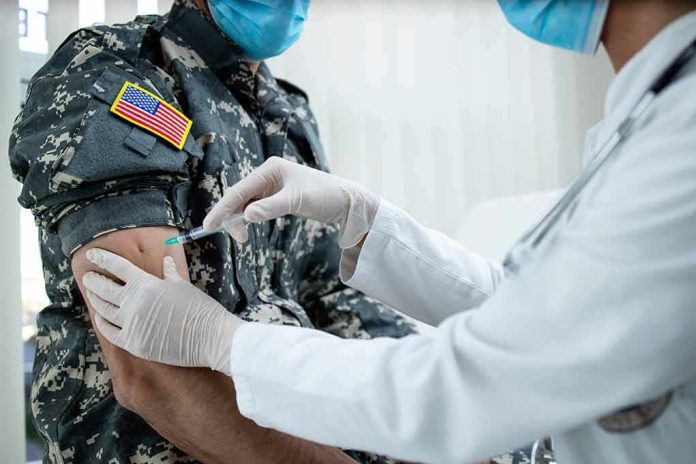
An Army flight surgeon says she is reviewing 2,544 troop death reports filed after COVID shots, and the Pentagon signed off on the dig.
Story Snapshot
- Army Lt. Col. Theresa Long told a federal court she is probing 2,544 reported post-vaccine deaths among service members.
- Long says the review also spans tens of thousands of adverse-event reports tied to the shots.
- Health officials say Vaccine Adverse Event Reporting System (VAERS) entries are unverified and do not prove causation.
- The review aims to test whether a signal exists or the reports reflect coincidence or reporting bias.
The trigger: a sworn claim, a massive dataset, and a permission slip
Army Lt. Col. Theresa Long told a federal court in Virginia that she is working with Health and Human Services Secretary Robert F. Kennedy Jr. and Defense Secretary Pete Hegseth to review whether 2,544 reported post-vaccine deaths among troops were caused by COVID vaccines. She also described a broader look at tens of thousands of adverse-event reports, a figure echoed in health policy summaries of her testimony. The Defense Department allowed the inquiry. That matters because access to records and data will decide whether this is noise or a real signal.
VAERS is the starting point and the problem. Anyone can file a report. A report only says an event happened after a shot. It does not prove the shot caused it. The Centers for Disease Control and Prevention (CDC) says a VAERS report alone cannot show causation, and the data cannot determine if a vaccine caused an event. The official VAERS data guide states the system accepts all reports without proof of cause. The review must move beyond raw entries and into medical records, autopsies, and timelines.
What a serious military review should do, step by step
Investigators will need clear case definitions, access to service records, and independent pathology. First, split deaths by time from vaccination and by known mechanisms, like myocarditis, clotting, or arrhythmia. Second, compare observed events to expected background rates in a matched force. Third, verify each case with death certificates, autopsy reports, and clinical notes. Fourth, run a sensitivity check for reporting spikes after media coverage. This is basic accountability and is standard in safety science.
Clear rules matter because VAERS invites both underreporting and overreporting. Publicity can spike filings. Routine illnesses can cluster by chance in large populations. A military cohort is young, fit, and tracked. That makes the denominator strong and the baseline stable. If a true safety signal exists, a disciplined review can find it. If not, a disciplined review can clear the air and let commanders focus on readiness and care for actual injuries without noise.
The claim, the caution, and the stakes for trust
Politico reported Long’s deposition and her role under Kennedy and Hegseth, which places the review inside the chain of command and public health leadership. Advisory’s summary added that Long lacks specialized vaccine training, which critics cite to question her judgment, but the test is the method, not the resume line. The CDC and major fact-checkers have long warned that VAERS numbers do not equal causation, and past reviews did not find a broad link to deaths. That caution is sound as a starting point.
Conservatives should back two ideas at once: do not exaggerate raw reports, and do not bury credible signals. You earn trust with sunlight and standards. Family members of troops deserve straight answers based on records, not vibes. If a subset of deaths links to shots, own it, care for the injured, and adjust policy. If not, publish the proof and move on. Either way, leadership wins by finishing the job and releasing the methods and results.
How this could reshape military medicine and policy
A transparent report could standardize how the services handle post-vaccine events. Expect clearer protocols for grounding aircrew with chest pain, faster specialty consults, and better tracking of return-to-duty times. Expect tighter informed-consent briefs, with plain language on rare risks and benefits by age and job. If no excess risk appears, expect stronger messaging to counter rumor mills. If a signal appears, expect targeted restrictions, expanded exemptions, and medical monitoring for affected groups.
The bottom line is simple. Finish the review, show the work, and set a repeatable model for future vaccines. The military runs on checklists and after-action reports. Treat this the same way. Close the loop with a public summary that cites how many cases were verified, how many were not, which mechanisms were plausible, and how policy will change. That approach fits common sense, respects the ranks, and protects readiness without gambling with trust.
Sources:
military.com, tasnimnews.ir, fakti.bg, militarybackpay.com