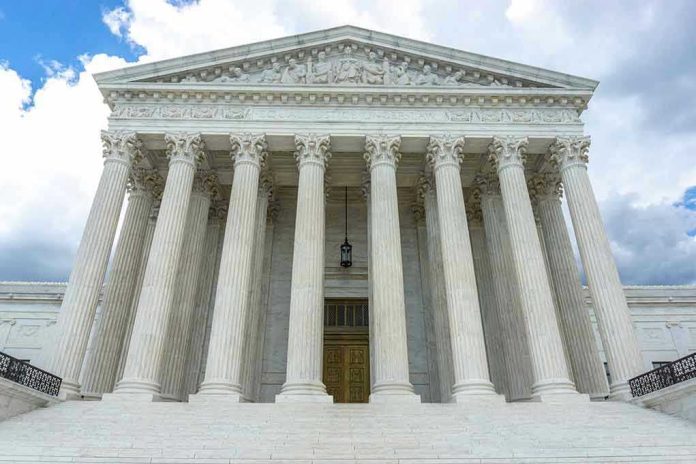
A Reagan-appointed federal judge called President Trump’s executive order targeting birthright citizenship the most blatantly unconstitutional action he had witnessed in over four decades on the bench.
Story Snapshot
- Judge John Coughenour, appointed by Reagan, blocked Trump’s birthright citizenship order in strong terms
- The case represents a direct challenge to the 14th Amendment’s citizenship clause
- Supreme Court consideration would mark unprecedented constitutional territory
- Conservative legal scholars remain divided on executive power versus constitutional text
A Constitutional Collision Course
Judge John Coughenour’s scathing rebuke of Trump’s executive action sent shockwaves through legal circles nationwide. The veteran jurist, who has presided over countless cases since his Reagan-era appointment, characterized the birthright citizenship order as fundamentally incompatible with constitutional principles. His decision to block the order represented more than judicial disagreement; it signaled a potential constitutional crisis brewing between executive ambition and established law.
The Supreme Court takes up the most unconstitutional thing Trump has done – Vox https://t.co/uFOcT3RtWE
— Susan (@RKGrammy) December 7, 2025
The Fourteenth Amendment Under Fire
Trump’s executive order directly challenged the 14th Amendment’s citizenship clause, which states that “all persons born or naturalized in the United States, and subject to the jurisdiction thereof, are citizens of the United States.” This language, ratified in 1868, has governed American citizenship for over 150 years. The administration argued that children of illegal immigrants fall outside the “jurisdiction” requirement, despite Supreme Court precedent suggesting otherwise in cases like United States v. Wong Kim Ark.
Constitutional scholars across the political spectrum expressed alarm at the precedent such an order would establish. Even conservative legal minds questioned whether executive action could effectively nullify constitutional text without the formal amendment process outlined in Article V.
Executive Power Meets Judicial Reality
Coughenour’s blocking order highlighted the tension between presidential authority and constitutional limits. The judge emphasized that presidents cannot simply reinterpret constitutional provisions through executive decree, regardless of policy preferences or political pressure. This principle resonates with conservative values of limited government and constitutional restraint, even when applied against Republican initiatives.
The case illuminated broader questions about executive overreach that transcend partisan politics. If presidents can unilaterally redefine citizenship through administrative action, what constitutional protections remain secure from future executive whims? This concern should alarm anyone who values stable, predictable governance under law.
Supreme Court Stakes and Conservative Principles
Should this case reach the Supreme Court, justices would face unprecedented questions about citizenship, executive power, and constitutional interpretation. The Court’s conservative majority would need to balance respect for executive authority against fundamental constitutional text and precedent. This tension exemplifies the difference between principled conservatism and mere political loyalty.
The outcome would establish crucial precedents for future constitutional challenges. A ruling favoring executive reinterpretation of clear constitutional language could invite future presidents of any party to similarly bypass established procedures. Conversely, upholding traditional constitutional interpretation would reinforce the rule of law over political expedience, a cornerstone of American governance that conservatives should champion regardless of which party occupies the White House.
Sources:
U.S. Supreme Court Significantly Limits Restraints on Unconstitutional Presidential Actions