
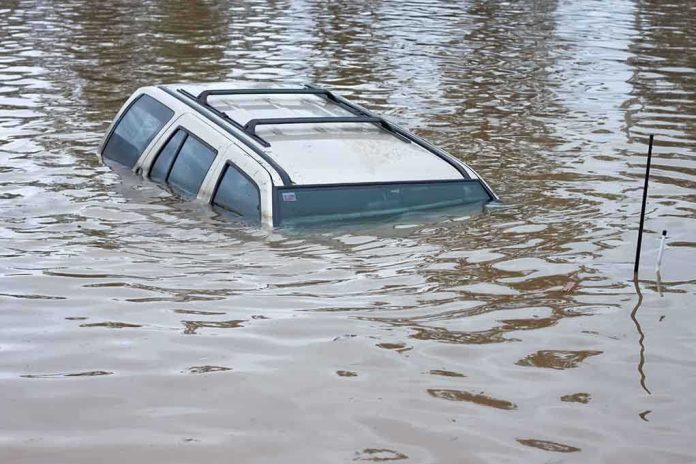
When 100,000 people are told to “GO NOW” in the middle of the night, you learn very quickly whether your community is truly prepared for disaster, or just pretending.
Story Snapshot
- An “atmospheric river” hammered western Washington, pushing major rivers toward “catastrophic” flood levels.
- Up to 100,000 Skagit Valley residents in floodplains were urged to evacuate immediately as levees faced unprecedented stress.
- Gov. Bob Ferguson declared a statewide emergency and moved to unlock federal disaster support.
- Back-to-back storms exposed how years of debate over levees, land use, and preparedness left many families in the crosshairs.
When A Fairly Normal Week Turns Into “GO NOW” Territory
Western Washington families went to bed expecting another gray December week and woke up to find rivers chewing their way toward front doors. An atmospheric river, essentially a firehose of Pacific moisture, is parked over the Cascades and lowlands, dumping multiple inches of rain into already swollen basins. Forecasts from the Skagit to the Nooksack flipped from “watchful” to “record or near-record” in hours, and Skagit County officials dropped the polite language and told up to 100,000 people in the floodplain to “GO NOW.”
That blunt order cut through the noise in a way no color-coded map ever does. Residents in Mount Vernon and Sedro-Woolley suddenly faced a hard choice: stay to defend homes, barns, and businesses, or leave before the Skagit River climbed into “almost unthinkable” territory. For many in their 50s and 60s who remembered big floods in the 1990s and 2000s, this was not theoretical. They had watched this river before, but local leaders warned this time might be worse than anything they had seen.
How Back-to-Back Atmospheric Rivers Broke The System
The crisis did not come from a single rogue storm; it came from two atmospheric rivers in rapid succession hitting ground already primed to fail. Earlier fall rains had saturated soils, filled tributaries, and left rivers running high. When the first December system rolled in around Monday, Dec. 8, it loaded the Skagit, Nooksack, Green, White, and Yakima basins with another round of heavy rain. The second wave then slammed into a state with no storage capacity left, every drop became runoff, and every river surge became a direct threat to levees and low-lying towns.
Hydrologists at the National Weather Service and Northwest River Forecast Center translated those numbers into plain English for emergency managers: major to record flooding was on the table. Skagit County officials did not wait for perfect certainty. They saw the trend line and moved to mandatory evacuations in parts of Mount Vernon and Sedro-Woolley, while strongly urging tens of thousands across the valley floodplain to get out before the river decided for them. That kind of proactive call reflects a simple conservative instinct: human life comes first, and you do not gamble it against the chance that a model might be a little off.
Evacuations ordered amid threat of 'catastrophic' flooding in Washington state https://t.co/oZYsQoe6AQ
— Chris Smith (@jchrissmith0007) December 11, 2025
The Statewide Emergency And A Stress Test Of Preparedness
As the Skagit grabbed headlines, a broader map of trouble filled in. Ferndale faced a surging Nooksack River pressing toward record levels. Auburn watched both the Green and White rivers with unease as crews stacked sandbags and monitored levees. In Central Washington, the Yakima River pushed into flood stage, worrying Benton City and West Richland before slowly easing as crests moved downstream. One storm track had effectively connected farming towns, bedroom communities, and industrial corridors in a single chain of risk.
Gov. Bob Ferguson responded by declaring a statewide emergency and signaling his plan to seek a federal disaster declaration. That move unlocked coordination, resources, and the option of National Guard support, but it also served a political purpose: acknowledging that this was not just “a Skagit problem” or “a Ferndale problem.” Spokane’s swift-water rescue team deploying to Puget Sound underscored that point; eastern Washington firefighters were suddenly fishing stranded residents out of western Washington floodwaters. When one side of a state needs the other’s boats and training, you find out whether all the speeches about “one Washington” hold water.
Who Pays The Price For Waiting On Infrastructure Decisions
Every floodplain homeowner in that week’s evacuation zone lives downstream of decades of policy arguments. The Skagit River’s long history of big floods has sparked recurring fights over levee upgrades, dam operations, zoning, and buyouts. Each proposal carries a price tag, and taxpayers rightly ask if the benefits justify the cost. But when local leaders describe current forecasts as “a flood that we haven’t seen before,” the bill for delay arrives in a different currency: emergency rescues, lost inventory, ruined fields, and insurance headaches that last years.
American conservative values favor personal responsibility, but they also recognize that government has a limited, essential job: build and maintain basic infrastructure, warn people honestly, and then get out of the way. In this flood, the warnings were refreshingly direct, Skagit’s “GO NOW” messaging left no room for wishful thinking. The harder question is whether previous legislatures and agencies truly respected taxpayers by either fortifying levees and roads or drawing firm lines against building in the highest-risk zones.
What This Flood Reveals About The Next One
As rivers crest and slowly recede, the temptation will be to frame this as a freak “historic” event and move on. But atmospheric river science, from national climate assessments to West Coast water agencies, points in a different direction: warmer air holds more moisture, and the Pacific conveyor belt that fed this storm pattern will likely deliver more intense events in coming decades. That does not excuse panic; it demands controlled, disciplined preparation grounded in real data and sober cost-benefit math.
The people sandbagging barns in Skagit County and watching the Nooksack creep toward their backyards are not thinking in IPCC citations; they are asking simple questions. Will the levee hold next time? Will my insurance company still write a policy here? If I rebuild, is the state going to change the rules again in five years? Smart policy going forward will avoid utopian promises and focus instead on three tangible goals: protect life, harden what must remain in harm’s way, and stop pretending that every acre in a floodplain can be “saved” without tradeoffs.
Sources:
Thursday, December 11 – Washington State House Democrats
“‘Catastrophic’ flooding forces emergency rescues in the Pacific Northwest” – ABC News