When a sitting president gets inches from a reporter’s face on Air Force One and calls his journalism treasonous, something has shifted far beyond a routine press squabble.
Story Snapshot
- President Trump confronted New York Times national security correspondent David Sanger directly on Air Force One, calling his reporting “treasonous” and labeling him a “fake guy”
- The exchange was captured on video during an official White House press gaggle en route to Anchorage, Alaska, on May 15, 2026
- Trump specifically challenged Sanger’s coverage of Iran, claiming reporters like him write “incorrectly” about military victories
- Sanger is a veteran White House and national security correspondent who has participated in formal Oval Office interviews with Trump himself
What Actually Happened on That Plane
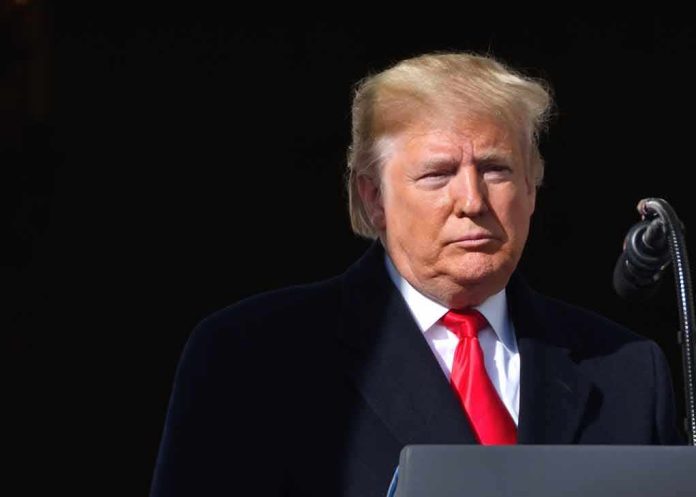
During a press gaggle aboard Air Force One on May 15, 2026, Trump turned his attention directly to New York Times correspondent David Sanger and delivered a pointed, face-to-face accusation. Trump told Sanger that reporters like him write incorrectly about military matters, specifically referencing Iran coverage, and escalated quickly to calling the reporting “treasonous.” The exchange was not a passing remark. Trump held his position, sustained the attack, and the whole thing played out on camera for the world to see.
What made the moment visually striking, and what spread it across social media within hours, was the physical proximity. This was not a podium swipe at an abstract “fake news media.” Trump was standing close enough to make it personal, and Sanger responded with an awkward grin rather than a rebuttal. That image alone told a story that no caption needed to explain. The White House itself released footage of the gaggle, which means the administration had no interest in burying what happened.
The Treason Label Is Not Casual Language
Calling a journalist’s work treasonous is not a throwaway insult. Treason is one of only two crimes defined directly in the United States Constitution, and it carries the potential for the most severe legal consequences available under federal law. When a president uses that word about a reporter covering national security, it sends a signal to every journalist in that beat. Whether Trump intended the full legal weight of the word or deployed it as rhetorical ammunition, the effect on the press corps is the same: cover this administration’s military decisions carefully, or face the most loaded accusation in the American political vocabulary.
God bless Donald Trump! God bless Israel! God bless Netanyahu just like king David may his baskets runuth over with the forskins of the enemies!
— MeanMistweater (@DavidDa36461707) May 15, 2026
Sanger Is Not a Fringe Figure Trump Can Easily Dismiss
David Sanger is not a junior reporter who wandered onto the wrong beat. He is a senior White House and national security correspondent for the New York Times with decades of experience covering intelligence, nuclear policy, and military affairs. He has participated in formal, extended Oval Office interviews with Trump alongside other Times reporters. The accusation of being “fake” sits awkwardly against that record. Calling a reporter fake while simultaneously granting him Oval Office access is a contradiction the White House has never bothered to resolve, and probably never will.
That tension is actually the most revealing part of this story. If Sanger’s reporting is genuinely treasonous, why does the administration keep talking to him? The answer, of course, is that “treasonous” and “fake” are political tools, not legal assessments. Trump uses them to shape how his supporters receive coverage, not to make a case before a judge. It works because it reframes every critical story as an act of disloyalty rather than an act of journalism, and that reframing has proven durable across two terms.
The Broader Pattern Behind One Heated Moment
This confrontation fits a well-worn playbook. Presidents from both parties have clashed with reporters over national security coverage, but the Trump era normalized something different: direct, named, personalized attacks delivered in real time with cameras rolling. The goal is not to correct the record. The goal is to discredit the messenger before the audience even reads the story. From a conservative common-sense standpoint, a free press asking hard questions about military operations near Iran is not treason. It is the job. Disagreeing with the framing is fair. Reaching for constitutional language to silence it is a different matter entirely.
Sources:
[1] Web – An Interview With the President – Apple Podcasts