The most hunted man in the Islamic State’s African network thought the dark Sahel sky would hide him; instead, it lit up with American jets and Nigerian ground troops closing in on his last safe house.
Story Snapshot
- U.S. and Nigerian forces say they killed Abu-Bilal al-Minuki, described as ISIS’s global number two.
- Trump calls it a “meticulously planned and very complex” mission ordered directly by him.[1][4]
- Nigerian commanders describe a midnight assault with precision air strikes and blocked escape routes.[5]
- Disputes over al-Minuki’s exact rank reveal how wars on terror are also wars over narrative.[6]
The Night A Joint Strike Rewrote The Battlefield In Nigeria
Just after midnight over Nigeria’s troubled northeast, the kind of operation most people only see in movies unfolded in real time. Nigerian officers with Joint Task Force North-East, Operation Hadin Kai, say the mission began around 12:01 a.m. near Metele in Borno State, deep in territory long stalked by jihadist factions.[5] As local residents tried to sleep through distant artillery echoes, American surveillance aircraft and Nigerian spotters fixed on one high-value compound that had drawn months of attention.
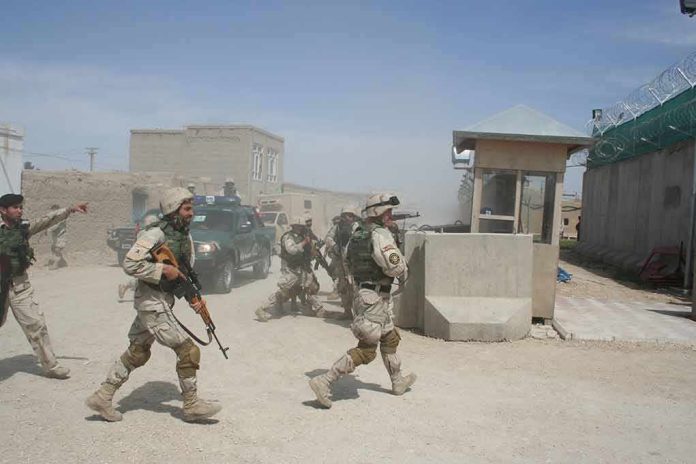
According to the Nigerian military account, the choreography looked ruthless and precise: first, targeted air strikes hammered the compound, then ground troops advanced as special forces teams sealed off escape corridors.[5] United States intelligence, Trump later claimed, had “sources who kept us informed on what he was doing” and believed Abu-Bilal al-Minuki, a senior Islamic State figure, was inside.[4] The goal was simple in concept and brutal in practice: no breakout, no second chance, no propaganda video boasting of survival.
How Trump Framed The Kill And Why The Words Matter
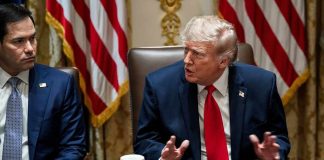
Hours later, Donald Trump took to his social media platform with language sharpened for maximum impact. “At my direction,” he wrote, American forces and the Armed Forces of Nigeria “flawlessly executed a meticulously planned and very complex mission” that eliminated “the most active terrorist in the world.”[4] He called Abu-Bilal al-Minuki the “second in command of ISIS globally,” insisting he would “no longer terrorize the people of Africa, or help plan operations to target Americans.”[1][4]
That kind of framing lands squarely with conservative instincts about peace through strength. A president taking ownership of a dangerous mission, praising front-line troops, and thanking a foreign partner aligns with the idea that American power, rightly used, protects both Americans and vulnerable Christians and Muslims in terror-hit regions.[3][4] Trump also reminded listeners he had promised action to defend Nigerian Christians, casting the strike as fulfillment of a moral and strategic obligation rather than a one-off headline.[3]
What Nigerian Commanders Say Really Happened On The Ground
Behind the dramatic presidential language sits a more granular Nigerian narrative that gives the mission weight. Nigerian reporting quotes Operation Hadin Kai confirming that Abu-Bilal al-Minuki, also known as Abu Bakr ibn Muhammad ibn Ali al-Mainuki, died during that coordinated offensive in Metele.[5] Their description stresses precision air power, supporting ground elements, and special forces units positioned to cut off flight routes, a textbook example of how to trap a high-value target who relies on chaos and porous borders for survival.[5]
This matters for more than battlefield theater. Nigerian officers reportedly highlighted that multiple terrorists, including senior lieutenants, were killed inside the same compound on the Lake Chad Basin.[2][5] That suggests the target was not just hiding but actively working, hosting planners in the hub of a regional network. From a common-sense perspective, knocking out a commander plus his inner circle in one blow is exactly the kind of focused violence most Americans want when government reaches for military force.
The Rank Dispute: ISIS Number Two Or Regional Power Broker?
Here is where the story gets more complicated, and more revealing. While Trump and several media outlets repeated the phrase “second in command of ISIS globally,” counterterrorism analysis points to a narrower, though still serious, role. The United Nations Analytical Support and Sanctions Monitoring Team’s reporting, summarized by Long War Journal, described al-Minuki as the head of the Islamic State’s Al Furqan office, a senior regional command node, not formally the global deputy leader.[6]
That gap between “world number two” and “top regional director” may sound like semantics, but it speaks to how modern counterterrorism narratives are built. Governments under political fire often emphasize decisive, historic victories. Terrorist groups, for their part, downplay losses or bury them in jargon about “martyrdom.” The public sits in the middle, treated less like a jury weighing evidence and more like an audience for dueling press releases. Conservative common sense suggests a prudential approach: applaud when evil men are removed, but stay skeptical of spin from any side.
Proof, Propaganda, And What We Still Do Not Know
For all the confident language, some key questions remain unanswered in the public record. None of the available material shows biometric confirmation, DNA testing, or detailed after-action reports tying the corpse in Metele beyond doubt to the man listed in prior sanctions notices.[4][5] United States and Nigerian officials speak in the assured tones you expect after a successful strike, but named, on-the-record technical briefings from defense or intelligence leaders have not yet surfaced in open sources.[4][5]
💥 BREAKING: AFRICOM confirms airstrike kills Abu-Bilal al-Minuki, ISIS deputy in Nigeria. Major blow to terror network, but retaliation fears loom. Oil & security risks in focus. pic.twitter.com/ikzbC5qSL7
— Dino breaking news (@DinoLeadingNews) May 16, 2026
Conservatives who value both strong defense and limited government should see the tension clearly. On one hand, classified methods and sources cannot simply be dumped online for the sake of curiosity. On the other, citizens deserve more than “trust us, big win” when lethal force is used abroad in their name. The wisest course is to press for more verifiable detail—strike logs, clearer Nigerian briefings, declassified designation records—without reflexively dismissing the operation as fake simply because it is politically useful to Trump.[4][5][6]
Why This Strike Still Matters For The War On Terror
Even if al-Minuki sat a rung or two lower than some headlines suggest, killing a man described as a specially designated global terrorist who oversaw attacks, hostage taking, and financing represents a serious tactical gain.[4][5] Networked extremists adapt, but they do not shrug off the loss of experienced commanders and financiers like a social media ban. Removing such figures forces reorganization, exposes new communications, and buys time for local governments to strengthen security if they choose to use that window.
The enduring lesson for American readers is simple and sobering. Real security work usually looks like this operation: uncomfortable alliances, midnight raids in forgotten borderlands, and announcements where certainty and salesmanship blur at the edges. A healthy conservative response is not cynicism or blind cheerleading, but watchful gratitude—thank the warriors who flew into the dark over Metele, then keep demanding the kind of hard evidence and honest follow-up that prevents necessary force from drifting into self-serving mythology.[4][5][6]
Sources:
[1] YouTube – US President Trump Announces ISIS Deputy Abu-Bilal al …
[2] YouTube – Top ISIS Commander, Abu-Bilal Al-minuki Killed In U.S-Nigeria Joint …
[3] YouTube – Trump eliminates ‘world’s most active terrorist’ & ISIS deputy Abu …
[4] Web – Trump says ‘most active terrorist in the world’ killed by US and …
[5] Web – How we killed ISIS leader in collaboration with US forces – Nigerian …
[6] Web – US, Nigerian forces kill senior Islamic State leader – Long War …