Iran’s latest Hormuz move is less a clean shutdown than a legal and military pressure test, and that distinction matters more than the headline suggests.
Quick Take
- Iranian reporting says officials announced a closure of the Strait of Hormuz after accusing the United States and Israel of violations.
- U.S. Vice President JD Vance said the Strait is still open and that traffic is continuing.
- The core dispute is authority versus action: a political announcement does not always equal an enforceable shutdown.
- Iran has used Hormuz threats before, but the waterway has rarely been fully closed in practice.
What Iran Said And What That Actually Means
Iranian state-linked reporting says the country’s top joint military command announced a closure of the Strait of Hormuz to vessel traffic after accusing the United States and Israel of violating a ceasefire memorandum. The report says Tehran called the move a response to a “clear breach of trust” and framed it as the “first step” in a wider answer if the pressure continued.[1]
That sounds decisive, but the real question is whether the announcement changed shipping on the water. In crises like this, governments often use the Strait as a signal of strength. They do not always turn that signal into a full, sustained blockade. The gap between a declared closure and an actual stoppage is where most of the confusion lives.
Why JD Vance Says The Strait Is Still Open
Vance said the United States sees the Strait as open and said more than 12.5 million barrels of oil passed through it, which he used as proof that traffic is still moving.[2] He also described a deal that provides toll-free passage for a set period, saying the Strait is “going to be open immediately.” That is not the language of a closed waterway. It is the language of a corridor still in use.[3]
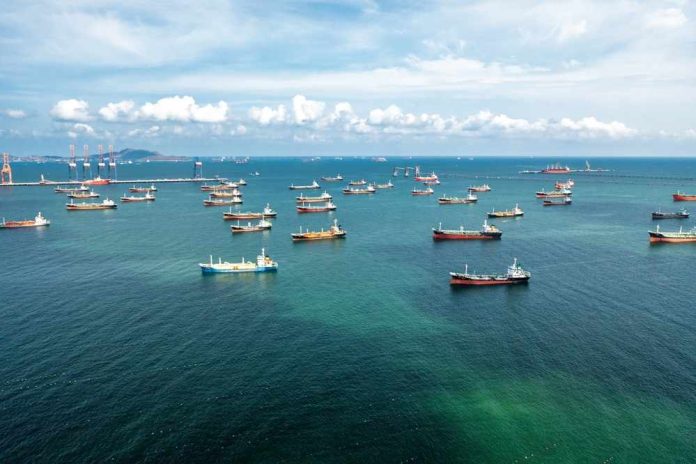
Other reporting cited by Vance’s side says roughly 25 ships were passing through daily, with expectations for that number to rise.[4] That kind of traffic does not fit a true shutdown. It fits a tense, contested route where ships are still moving, even if the politics around them are hot and unstable.
The Legal Catch Behind Iran’s Announcement
The strongest detail working against a “closed Strait” reading is authority. Several reports say Iran’s parliament can endorse or advance a closure idea, but the final decision rests elsewhere, including the Supreme National Security Council and, in practice, the Supreme Leader’s circle.[5][6] One transcript also says parliament acted only in a “consultative capacity,” which suggests political pressure rather than a binding order.[6]
That matters because a legislature can back a move without having the power to carry it out. Iran’s lawmakers may be sending a warning, not issuing a final command. If so, the announcement is serious, but it is not the same as a confirmed operational blockade. That difference is easy to miss and costly to ignore.
Why The Strait Keeps Becoming A Global Flashpoint
The Strait of Hormuz is one of the world’s most sensitive chokepoints because so much oil moves through it. That makes it a natural pressure point whenever Iran wants leverage against the United States or regional rivals.[8] It also means every hint of closure can move markets fast, long before lawyers, naval officers, or shipping firms sort out what is actually happening.
History gives the public a useful warning. The Strait has been threatened often, but it has never been truly closed for long, and in many cases it has not been closed at all.[8] That is why headlines can sound firmer than reality. A threat can be real without becoming a shutdown, and a shutdown claim can be less solid than it first appears.
⚠️ IRAN THREATENS HORMUZ CLOSURE AND BLOCKS IAEA ACCESS AS ISRAELI OFFICIALS WARN OF SHIFTING U.S. SUPPORT AND RISING TURKISH INFLUENCE
⚓ HORMUZ THREATS ESCALATE: Iranian state media and hardline Islamic Revolutionary Guard Corps-linked reports threatened the indefinite closure… pic.twitter.com/TLsCxMjZFF
— Israel Realtime (@IsraelRealtime) June 19, 2026
The safest reading is this: Iran appears to have escalated its threat, while the United States says shipping still continues. Until there is a formal order, a verifiable drop in vessel traffic, or an official maritime notice that confirms a blockade, the smarter conclusion is that the Strait is under intense pressure, not clearly sealed.
Sources:
[1] Web – JUST IN: Iran Says It’s Closing the Strait of Hormuz After Accusing US …
[2] Web – Iran Parliament Backs Strait of Hormuz Closure After US Strikes
[3] YouTube – Iran Parliament votes to back Hormuz closure, top security body …
[4] Web – Iran parliament moves to legislate control over Strait of Hormuz
[5] Web – Iran’s Parliament Speaker Says Strait of Hormuz “Won’t Return to Its …
[6] Web – UN / STRAIT OF HORMUZ RESOLUTION | UNifeed
[8] Web – An anti-Iran resolution related to the Strait of Hormuz has failed …