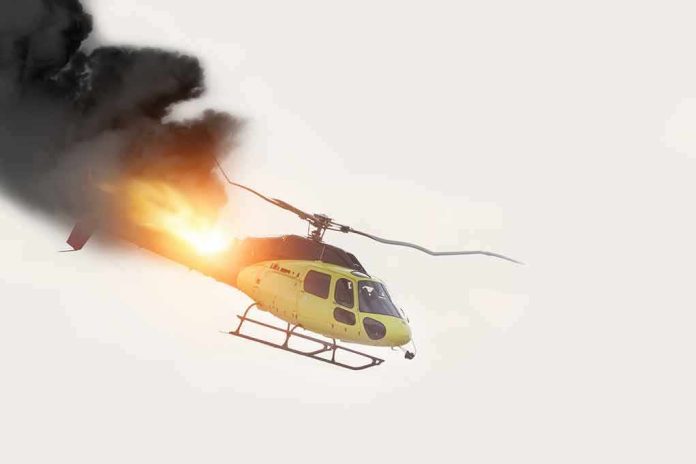
Two helicopter crew members died after their firefighting aircraft crashed during an active Utah wildfire, and the fire itself made the first hours of the response brutally slow.
Quick Take
- The crash involved a Sikorsky S-64 helicopter working on the Widemouth 2 Fire near Richfield, Utah.
- Officials said two people were on board, and both later were confirmed dead.
- Fire conditions blocked early access to the wreckage and delayed the rescue effort.
- The crash sparked a new fire and sent investigators from the National Transportation Safety Board to the scene.
What Officials Say Happened
The helicopter went down Friday morning while supporting wildfire suppression near Richfield. The Federal Aviation Administration said a Sikorsky S-64 crashed around 10 a.m., and news reports tied the aircraft to firefighting work on the Widemouth 2 Fire. The National Interagency Fire Center later confirmed that both occupants died, turning an urgent rescue situation into a recovery operation.
The aircraft was a heavy-lift helicopter built for tough jobs, which is why its loss drew immediate attention from fire crews and aviation watchers. KUTV and the Associated Press both reported that two people were aboard, and later reporting identified the crew as a pilot and a crew member employed by Helicopter Transport Services under contract with the United States Forest Service. That detail matters because it shows this was not a routine flight. It was part of a larger fight against a fast-moving fire.
Why The Response Took So Long
Fire conditions did more than feed the wildfire. They also kept responders away from the crash site. Multiple reports said crews could not reach the wreckage right away because flames and rough terrain made access unsafe. That delay helped shape the first public reports, which moved from uncertainty about the occupants’ condition to later confirmation that both had died.
The site was described as being near Richfield and near the southeastern edge of the Widemouth 2 Fire, with some reports placing it in the Three Creeks Reservoir area. That is typical of wildfire accidents in remote ground. The first account is often messy. The facts sharpen only after ground crews can get in, see the wreckage, and confirm what happened.
The Fire Was Not Just The Background
The crash did not happen outside the fire problem. It became part of it. Reports said the helicopter ignited a new blaze when it went down, adding another hazard to an already dangerous scene. KUTV also reported that the aircraft was one of several helicopters working the fire, which shows how closely air support and ground fire control were tied together in this operation.
🔥 BREAKING NEWS: Two firefighting pilots are dead after their Sikorsky S-64 helicopter crashed while battling the massive Widemouth 2 Fire in Utah's Fishlake National Forest, officials confirmed .
🚁 The Crash and the Fire
The helicopter, operated by Helicopter Transport… https://t.co/WKVRtrX8zK— The World Correspondent (@TheWorldCorresp) August 9, 2026
That is the hard truth of wildfire aviation. The aircraft exist to fight the fire, but they must work inside the fire’s own danger zone. Heat, smoke, steep terrain, and limited access all raise the risk. In this case, the helicopter crew kept flying into that environment until the mission ended in tragedy. The final outcome was confirmed only after crews could safely reach the scene and investigators began their work.
What Remains Under Investigation
The immediate cause of the crash has not been publicly settled in the supplied record. The National Transportation Safety Board will investigate, along with the Federal Aviation Administration. That means the known facts are clear, but the mechanical or operational reason for the crash is still open. For now, the record supports one solid conclusion: two crew members died while doing hazardous work over a wildfire.
Sources:
nypost.com, kutv.com, apnews.com, youtube.com, aol.com