
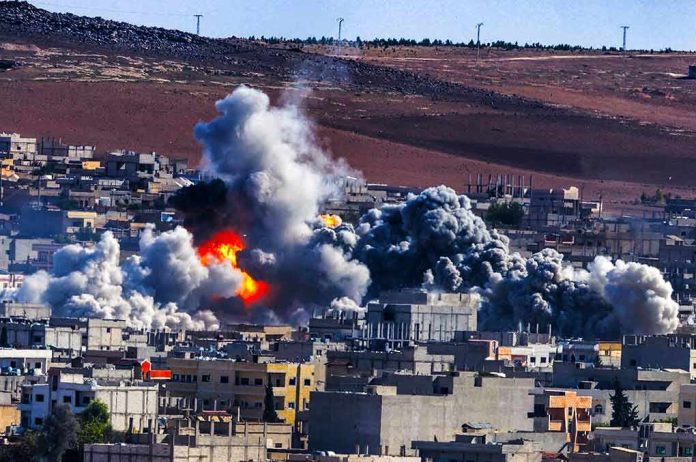
Houthi rebels claim they hit Saudi Arabia’s busiest airport and shut down air traffic in the capital, while Saudi officials confirm strikes elsewhere that left people hurt and airports damaged.
Quick Take
- Houthi spokesman Yahya Saree says drones struck King Khalid International Airport in Riyadh and disrupted flights there.
- Saudi aviation officials confirm separate attacks on Jazan and Najran airports, with three people injured.
- Later reporting says attacks on Abha and King Khalid airports killed three people and wounded 36 more.
- A Saudi-led coalition intercepted a missile headed toward the Riyadh area, Reuters reports.
- The strikes mark a sharp escalation in the Yemen war’s cross-border fight with Saudi Arabia.
Houthi Spokesman Claims Precision Strike on Riyadh’s Main Airport
Yahya Saree, the Houthi military spokesman, said his forces launched several drones at King Khalid International Airport in Riyadh. He called the strike “precise” and said it disrupted air traffic at the airport, according to his statement on social media. Loud explosions rattled the Saudi capital that evening, a detail reported independently of the Houthi claim.
Saree described the Riyadh strike as part of a wider operation. He said Houthi forces also hit Abha International Airport, Khamis Mushait Air Base, and an Aramco oil refinery in the coastal city of Rabigh on the same day. He framed the attacks as three separate “qualitative military operations” using a mix of ballistic missiles, cruise missiles, and drones.
Saudi Officials Confirm Damage, Though Not at Every Claimed Site
Saudi Arabia’s General Authority of Civil Aviation confirmed attacks on two airports in the kingdom’s south, King Abdullah bin Abdulaziz International Airport in Jazan and Najran International Airport. The authority said three people were hurt and the attacks caused damage. Officials said they were assessing the full extent and working to keep passengers and staff safe.
That early statement did not confirm a hit on King Khalid International Airport in Riyadh. Later reporting filled in more of the picture. Outlets citing the Saudi aviation authority said attacks on Abha and King Khalid airports killed three people and injured 36 others, including a Sudanese resident who died near the Riyadh airport. The gap between the first statement and later casualty figures shows how fast-moving and messy this kind of reporting can get.
A Coalition Intercept Adds Another Layer to the Story
Reuters reported that a Saudi-led coalition intercepted a missile fired toward the Riyadh area. The same report said the Houthis have been striking Saudi airports, oil facilities, and military sites for weeks. An interception does not prove whether a separate projectile reached King Khalid airport, which is why the Riyadh disruption claim and the confirmed Jazan-Najran attacks are being treated as related but distinct events.
None of this happened in a vacuum. The Houthis have been ramping up cross-border attacks on Saudi Arabia since this past summer, hitting oil infrastructure, airbases, and now a major international airport. Each new strike raises the stakes for a kingdom that has spent years trying to keep its energy exports and air travel running smoothly despite a hostile, Iran-backed militia on its southern border.
Why This Escalation Matters Beyond One Night’s Headlines
Saudi Arabia built its modern economy on the promise of stability, from oil shipments to tourism to foreign investment. A credible claim of disrupted air traffic at its flagship Riyadh airport strikes at that promise directly, regardless of how much physical damage is ultimately confirmed. Confidence, not just concrete, is the target here, and that is exactly why Riyadh has strong reasons to manage what it confirms and when.
For American readers watching the broader Middle East picture, this is another reminder that Iran’s proxy network keeps probing for weak spots even as other fronts get more attention. A Saudi ally under sustained missile and drone pressure is not a side story. It is a direct test of whether regional deterrence still holds, and the answer so far looks shakier than anyone in Riyadh would like to admit.
Saudi Arabia says Houthi attacks on Abha and Riyadh airports killed three civilians and injured 36, as Yemen fighting displaces more than 200,000 people pic.twitter.com/eDRM4JQGFm
— Eastora News (@eastoranews) October 8, 2026
Expect more claims and counterclaims as both sides fight for the narrative as hard as they fight on the battlefield. Saudi Arabia has every incentive to downplay a successful hit on its capital’s airport, and the Houthis have every incentive to inflate their reach. Readers should watch for official flight-delay records, independent damage imagery, and Saudi government statements on Riyadh specifically before treating the full scope of the claim as settled fact.
Sources:
aa.com.tr, islamtimes.com, iranintl.com