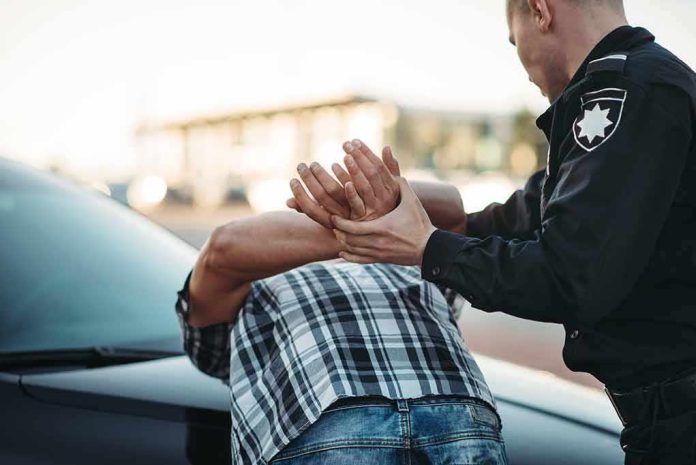
The state’s top record-keeper ended up in handcuffs outside a McDonald’s, and the bodycam leaves little mystery why.
Story Snapshot
- Edmond police arrested Oklahoma Secretary of State Benjamin Lepak outside a McDonald’s for suspected public intoxication.
- Bodycam captures officers citing slurred speech, odor of alcohol, and conflicting stories; the officer states the arrest reason on camera.
- Attorney General Gentner Drummond reviewed the video and urged Lepak’s removal, calling him “thoroughly inebriated”.
- Lepak’s office says he waited for dinner and was not given a breath test; he plans to address the ticket in court.
What Police Saw And Said On The Scene
Edmond officers found Benjamin Lepak at a McDonald’s drive-thru in the late hours of Aug. 14. The officer noted the smell of alcohol and slurred speech before placing him under arrest for public intoxication, a charge the officer stated clearly on camera. The Oklahoman’s coverage aligns with the video, describing balance concerns and uneven answers before the cuffs came out. The on-scene account forms the backbone here. It is the evidence that triggered every later step.
Body-worn cameras exist to sort confusion from fact. On this tape, the officer narrates what he observes and then acts on it. That matters under the “totality of the circumstances” idea that courts apply to these calls. Officers can rely on what they see, hear, and smell when deciding if someone poses a risk in public. That does not settle guilt, but it does set the legal stage for an arrest that a court later reviews. The tape is the fulcrum.
The Conflicting Accounts And Why They Matter
Reports say Lepak shifted his story about how he got there. He first denied driving, then suggested he drove, and later said he walked from a nearby church, St. John the Baptist. Conflicting accounts raise doubt about judgment and credibility. They also give officers more reason to think a person is impaired. That gap between what is claimed and what is observed can be decisive in a public intoxication case, where behavior is the main proof, not a lab result.
Lepak told police he had very little to drink, with versions ranging from “a beer” to “less than one beer,” according to bodycam summaries aired by local outlets. His office later stressed he was waiting for dinner, not weaving down a road, and that police did not give a breath test. That line will echo in court and in public debate. But a breath test is not required for a public intoxication charge. Jurors and judges often give weight to behavior, not just numbers.
The Attorney General’s Reproof And The Career Stakes
Oklahoma Attorney General Gentner Drummond did not wait on a lab slip. He watched the bodycam and declared Lepak “thoroughly inebriated,” adding that Lepak likely lied to police about his movements and alcohol use. He urged immediate removal from office. That is rare blunt force from the state’s top law officer. It also signals how public safety and public trust merge in a case like this. When the camera speaks, politics moves fast.
Past cases add weight. Records show Lepak previously faced an alcohol-related public intoxication matter in 2022, resolved with a no-contest plea, as summarized by The Oklahoman. Prior history does not prove the present charge. But for many citizens, patterns matter. American conservative values prize personal responsibility, equal treatment under the law, and respect for officers on the street. On this tape, the officer followed the book. That aligns with common sense expectations for order and safety.
Where The Defense Will Push Back
The defense will press the lack of a breath test and point to the setting: a fast-food lot, not a highway stop. They will argue that behavior can mislead, that fatigue or stress can slur speech, and that confusion about travel is not the same as impairment. They will also stress the legal point that an arrest is not a conviction and that facts belong in court, not in a social media pile-on. Those are fair arguments to test in a courtroom, under oath, with full records.
Still, the on-camera elements are hard to un-ring. The officer lists sensory facts. The officer states the charge on scene. The attorney general watches and urges removal. Local outlets publish the clips and describe the same signs the officer cites. That creates a strong public record that will not vanish. If exculpatory details exist, the full incident report, dispatch logs, and complete video can surface them. Until then, the bodycam is the north star guiding opinion.
The Practical Path Forward
Two steps can clear the air. First, release the complete, unedited bodycam video with timestamps to establish the timeline end to end. Second, produce the full incident report and any call records that started the response. Those files would nail down the trigger for the stop, the sequence of Lepak’s statements, and any offers or refusals of testing. Transparency would serve the public and the accused. Justice is not a tease; it is detail.
The bottom line is simple. Police made a call grounded in direct observation and recorded it. The attorney general confirmed the same view and asked for swift action. Lepak’s office says he will fight the ticket in court and notes the absence of a breath test. Voters and jurors can hold both ideas: fairness in process and firmness in standards. Public trust is built when leaders meet the rules they swear to uphold.
Sources:
koco.com, youtube.com, oklahoman.com, yahoo.com