
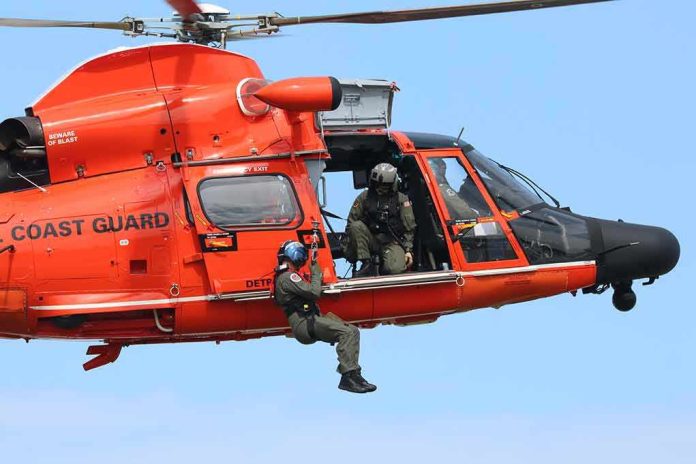
Six people vanished over cold Atlantic waters when a medevac jet went silent near Nantucket, and rescuers raced the clock.
At a Glance
- U.S. Coast Guard launched a major search off Nantucket for a missing medevac jet.
- The Federal Aviation Administration (FAA) triggered a search-and-rescue alert around 1:20 a.m. Eastern time.
- Crews later confirmed a debris field from the aircraft; the search for survivors pressed on.
- The flight was en route from Bermuda to Boston with six people aboard.
What Happened And Where Crews Are Searching
U.S. Coast Guard units began searching early Saturday after air traffic controllers lost contact with a Gulfstream G100 medical transport flight headed from Bermuda to Boston. The last known position put the jet near Nantucket, a patch of ocean notorious for swift currents and fickle weather. The FAA issued a search-and-rescue alert at about 1:20 a.m. Eastern time, which set air and surface crews in motion across a growing grid south of the island.
By nightfall, Coast Guard teams located and confirmed a debris field tied to the missing aircraft. The discovery sharpened the search area but raised the stakes for time. Rescuers focused on locating life rafts, survival gear, or signals from locator beacons. Officials said the jet carried six people. The mission profile, a medical evacuation, suggested a possible patient and medical staff on board, in addition to flight crew.
How The Search-and-Rescue Machine Works At Sea
Coast Guard search commanders model drift, wind, and currents to place aircraft and cutters where survivors most likely are, not just where wreckage sits. The National Search and Rescue Plan details steps for estimating distress locations and probable movement after impact, which guides every flight track and search sector. Night operations rely on infrared sensors, powerful searchlights, and coordinated passes. Response speed matters because cold water and fatigue cut survival odds by the hour.
Overwater aviation adds a tracking challenge. Radar fades with distance. Radios go quiet if power fails. Investigators often piece together the last minutes from air traffic audio, flight plans, and any satellite or surveillance pings. A Government Accountability Office review underscored these gaps and pushed for better oceanic tracking and faster data handoffs to rescue centers. That is why the early FAA alert is a key pivot from uncertainty to action.
Why Medevac Flights Face Extra Risk
Medical flights operate under pressure and often at night, over water or remote terrain. Safety studies show that such missions can face a higher risk profile when weather closes in or when crews feel urgency to complete the transport. Past investigations of medical missions cited hazards like controlled flight into terrain in darkness and degraded visibility, especially in self-dispatch environments without robust oversight. Over water, those factors meet the added burden of distance from divert fields.
This mission fit several of those stress points: a nighttime timeline, a long overwater leg, and the duty to move a patient fast. None of that assigns blame; it explains why search-and-rescue mobilized at scale and without delay. The duty to attempt rescue comes first. Accident causes come later with evidence, wreckage recovery, and formal findings. For now, the priority is locating survivors and securing anything that aids investigators and families waiting ashore.
What We Know, What Comes Next
Officials confirmed three core facts. The aircraft lost contact near Nantucket on a Bermuda-to-Boston route. The FAA triggered a search-and-rescue alert at about 1:20 a.m. Eastern time. Coast Guard units later confirmed a debris field from the missing aircraft. These points anchor the response and frame the next steps: targeted searches for people, locator beacons, and key parts that can narrow the impact point and timeline.
4 AM Top-of-the-Hour News
The Coast Guard now saying it has found a debris https://t.co/27fM0SycLs air ambulance vanished over the Atlantic early Saturday morning. There were six people on board…four crew members from Canada and two passengers from Bermuda..
The plane was… pic.twitter.com/VHkTly1qUI— Worldwide News Network (@WorldwideNNX) October 4, 2026
Accident investigation will follow the search. Agencies will look at crew communications, maintenance history, flight planning, weather, and any signs of electrical or systems issues reported before contact was lost, if documented. Families deserve clear answers and an honest chain of facts. American common sense says you marshal every asset fast, tell the truth as you learn it, and keep the mission focused: save lives if possible, and learn enough to prevent the next loss.
Sources:
cbc.ca, thespec.com, aviationlawgroup.com, tsb.gc.ca, dco.uscg.mil, nbcboston.com