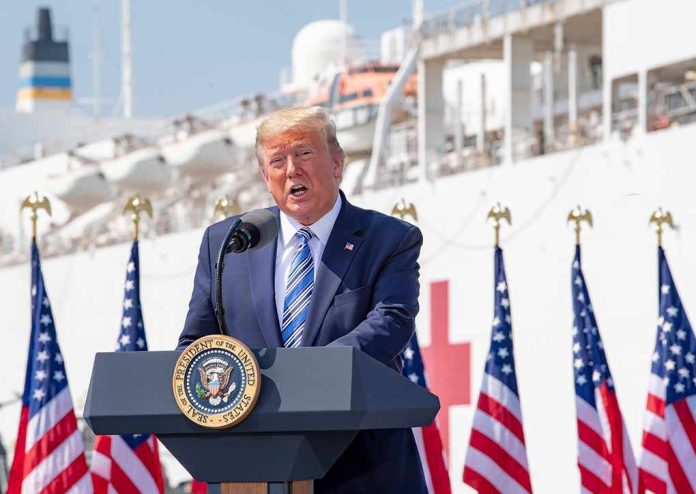
At an Arizona rally, President Trump said leakers “should be shot,” tying the line to a claimed leak that delayed a U.S. strike by two days.
Story Snapshot
- Trump called for shooting people who leak U.S. military secrets at a Bullhead City rally.
- He said a leak of attack timing forced a two-day delay of a planned strike.
- He linked leaks to mass-casualty risk if an enemy gained a powerful weapon.
- Critics warned such talk could chill whistleblowers and the press.
What Trump Said, Where He Said It, And Why It Landed
Trump told supporters in Bullhead City, Arizona, that “leakers should be shot,” and repeated it for emphasis. He framed the threat as deterrence, not a grudge. He said an insider shared attack timing and troop movement details, which he claimed delayed a U.S. operation by two days. The crowd cheers showed the message resonated with many in the audience. News outlets captured the exact quotes and the setting at the campaign-style event on October 14, 2026.
He described the target as a foreign program capable of mass killing if left unchecked, and he argued the strike was defensive in nature. He said leaks that reveal when U.S. forces plan to move put American lives at risk and help the enemy set an ambush or scramble defenses. He also knocked reporters as “almost as bad,” blurring the line between sources who disclose secrets and the media that publish them.
The Concrete Claim: A Leak And A Two-Day Delay
Trump said a “sleazebag” leaked a precise departure time from Missouri, which he blamed for a two-day postponement of a planned strike. The Hill linked his comments to reports about strikes on Iranian nuclear sites and “Operation Midnight Hammer,” though the public record does not include a named leaker, a charge sheet, or a declassified after-action report that proves the leak caused the delay. The causal link remains Trump’s assertion in the available reporting.
That gap matters for policy. If an unauthorized disclosure truly forced a delay and raised risk, most Americans would demand tough penalties. But execution is the sharpest tool the law can swing, and the United States has used it rarely in national-security cases. The debate should separate espionage on behalf of a hostile state from leaks to the press, and then match punishment to proof and harm, with due process at every step.
How Deterrence Meets American Law And Tradition
Supporters of Trump’s view will say clarity saves lives: telegraphing zero tolerance may keep mouths shut and missions safe. That aligns with a core duty of government to protect the country and its troops. But American law has handled most unauthorized disclosures through prison terms, not firing squads. The modern expansion of prosecutions under the Espionage Act focused on leakers, yet executions for peacetime spying have been extremely rare in American history, which shows how cautious the system has been with death as a penalty.
Press-freedom advocates warn that broad threats chill whistleblowers and reporters. They point to leak probes, subpoenas, and sharp rhetoric as a squeeze on accountability. They argue that the First Amendment protects newsgathering and that any subpoena to a reporter should be rare and tied to urgent, life-or-death needs. They say equating journalists with leakers makes the job of exposing wrongdoing too risky for sources and newsrooms alike.
Drawing The Bright Lines We Actually Need
Common sense and conservative principles both call for bright lines. Start with intent: did the person knowingly give properly classified, time-sensitive military plans to harm the country or help an enemy? Did the disclosure cause death or clear, measurable damage to an operation? Reserve the harshest penalties for those cases, proven beyond a reasonable doubt, with full due process. Keep routine classification spats, negligence, and protected whistleblowing out of the same bucket as treasonous espionage.
Congress and the administration can tighten the system without trampling rights. Require faster damage assessments when leaks occur. Set clear charging standards that distinguish espionage for a foreign power from disclosures to the press. Increase maximum prison time for revealing active operational timing and troop movements, where harm risk is highest. Protect lawful whistleblowing channels so service members can report misconduct without running to the press or a foreign service.
The Open Questions That Should Be Answered Next
Americans deserve clarity on the event Trump described. The Pentagon or the Department of Justice can confirm, in declassified form, whether a leak delayed the strike, what was leaked, and by whom. If prosecutors brought a case, they can unseal redacted filings. If they did not, they can explain why the facts or the law did not support charges. That transparency would ground the penalty debate in facts rather than rally heat and headlines.
Until then, the country sits between two risks: weak leak control that endangers troops, and overreach that chills the watchdogs a free republic needs. The first risk demands discipline and sharper laws. The second demands restraint and respect for the press and due process. We can do both. Punish proven betrayal hard. Keep the First Amendment safe. And stop treating every leak like a firing-squad case when prison, or policy repair, will do.
Sources:
nypost.com, azcentral.com, thehill.com, washingtonexaminer.com, straitstimes.com, irishstar.com, galvnews.com