
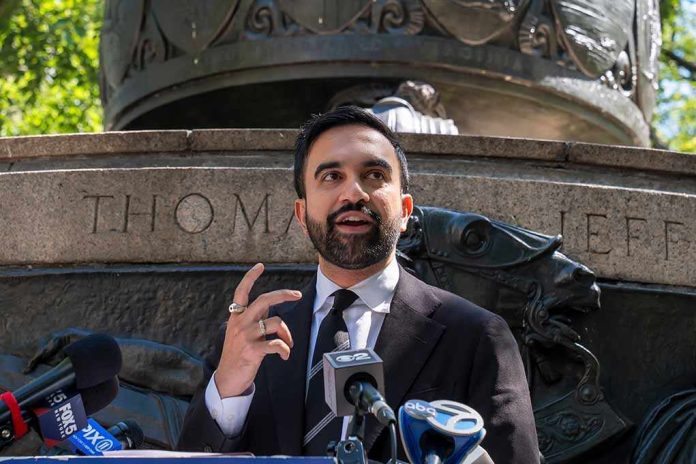
Zohran Mamdani posted a Spanish-language “know your rights” video about Immigration and Customs Enforcement and then told voters what they do not need to bring to the polls.
Story Snapshot
- Mamdani shared step-by-step guidance for encounters with immigration agents, in Spanish and English.
- The video explains how to check a warrant and when to keep a door closed.
- The message urges calm, no interference with arrests, and no resistance.
- Mamdani capped the push with a reminder that voters do not need certain documents at polling places.
Mamdani’s Video Spells Out What To Say And Do
CBS News reported that New York City Mayor Zohran Mamdani published a video explaining what New Yorkers can say and do if immigration agents approach them at home or on the street. The clip walks through a door knock: check the paper for “United States District Court,” look for a judge’s signature, and ask officers to slide the order under the door. If the paper is not a judicial warrant, the guidance says you can keep the door closed and state you do not consent.
For street stops, the video instructs people to ask, “Am I free to go?” If the answer is yes, it says to walk away calmly. El País reported the same advice in its coverage of the Spanish-language version, which it placed amid continuing federal operations in New York. The outlet tied the timing to public tension after agents reportedly shot a Dominican man in the Bronx earlier that month, which raised fears in immigrant neighborhoods.
Rules For Filming And The Line Against Interference
The Hill reported that Mamdani told viewers they can record immigration enforcement activity from a public place, with a bright-line warning not to interfere with an arrest or impede an investigation. The Washington Examiner covered critics who called the guidance resistance, yet it also noted the same boundaries: stay calm, do not block officers, and do not resist arrest. This mix reflects a common pattern with rights videos: one side sees civic education, the other sees evasion.
Civil-liberties groups and law schools have long published similar “know your rights” materials that cover silence, warrants, and how to record officers. The American Civil Liberties Union hosts guides and videos that mirror several of Mamdani’s core steps, including how to handle a knock at the door and your right to film from public space. The political flashpoint here is not the genre itself; it is the messenger, the moment, and the citywide stakes.
Why The Message Landed Now, And What He Told Voters
El País placed the video in an environment of active federal sweeps and community fear. That context explains the direct tone and the use of Spanish to reach recent arrivals as well as long-settled families. CBS News described the audience simply as New Yorkers, which suggests a broad frame: calm, rule-bound encounters that lower the risk of panic at a door or curb. The instruction to ask for a judicial warrant speaks to order, not chaos, and it sets a clear standard for entry.
Mamdani posted a video of himself on X on Friday, with the caption, "If you encounter ICE, here's what every New Yorker should know." https://t.co/JcYytdcCBw
— CNY Central (@CNYCentral) October 26, 2026
Mamdani then turned to election rules and told voters what they do not need to bring. The thrust is simple: show up ready to vote without extra documents that are not required at polling places. That add-on fits his larger theme of lowering fear at the door, whether the knock comes from an immigration agent or the drumbeat of rumors about voting rules. For conservatives, the key test is clarity and compliance. Voters deserve plain rules; officers deserve space to do lawful work.
What This Means For Public Safety And Common Sense
Clear rules cool tempers. The video’s street script—ask if you are free to go, then calmly leave—tracks with basic policing norms. The door script—check for a judge’s signature before entry—tracks with due process. The warnings—do not resist, do not interfere—track with public safety. These are not radical moves; they are rails. The political fight will continue, but the practical playbook is short: know the rule, state the rule, stay calm, and let the courts sort the rest.
Sources:
redstate.com, fox5ny.com, elpais.com, thehill.com