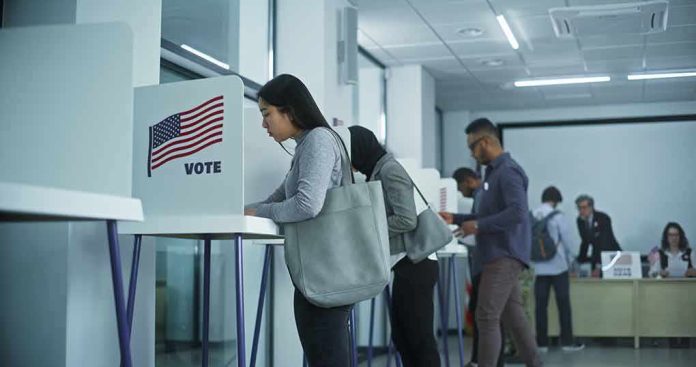
Early ballots are piling up fast in Senate battlegrounds, and Democrats plus unaffiliated voters are growing their share faster than Republicans.
At a Glance
- North Carolina early ballots accepted passed 1.2 million; Democrats and unaffiliateds rose far faster than Republicans.
- States deciding Senate control are logging big early-vote gains over 2022, led by Texas and Kansas.
- Unaffiliated voters are surging in several states, adding real uncertainty to final outcomes.
- Early-vote leads show mobilization strength, not guaranteed results on Election Day.
Democrats and unaffiliated voters widen early vote growth in key states
North Carolina’s early vote shows the sharpest partisan growth gap so far. More than 1.2 million early ballots were accepted at this point, up 37 percent from 2022. Within that surge, registered Democrats rose 47 percent, unaffiliated voters rose 60 percent, and Republicans rose 2.6 percent, according to a review cited by The Hill. That spread does not decide winners. It does show which campaigns organized their voters first and who is banking votes before lines form on Election Day.
Other battlegrounds echo the same theme. An Associated Press analysis reports Texas up 74 percent versus 2022, Kansas more than doubled, and Maine, North Carolina, and Ohio up more than 30 percent at the same point two weeks out. Those lifts signal an electorate that wants to vote early and avoid a crush on November’s final day. Campaigns that built mail and in-person early operations are now cashing those checks in real time.
What the surge means—and what it does not
Early-vote totals are not polls. They measure who showed up and when, not which candidates got marked on the ballot. Registration labels also do not fix loyalties. Unaffiliated voters can break in either direction, and some registered partisans split tickets. The safest read is simple: the side that treats voting like a habit and lowers friction tends to bank an edge early, while the other side must answer with a strong finish on Election Day.
Conservatives should read these numbers with clear eyes and common sense. High early participation is not a threat to election integrity by itself; it is a test of ground game and message discipline. If Democrats and unaffiliated voters grow faster in returned ballots, Republicans cannot wish it away. They must convert late deciders, push low-propensity supporters to polls, and meet voters where they are—by mail, in person, and on Election Day.
State snapshots that set the stakes
Texas, with a top-tier Senate race, leads the nation in growth. Early voting stands 74 percent above the same point in 2022, the kind of jump that strains field programs and lights up campaign war rooms. National trackers show tens of millions of early and mail ballots requested and returned across the map, underscoring that convenience voting is now the norm in many states, not the exception. That shift rewards parties that invest in voter education, reminders, and ballot chase from day one.
🇺🇸 U.S. Midterm Elections 2026 — Political Analysis
Sunday, October 25, 2026 | 9 days until Election Day
The infographic brings together the campaign developments, polling figures, Senate battlegrounds and early-voting statistics from your briefing.
Key analytical comments
1.… pic.twitter.com/nq99nRCjbQ— Letros Antonis (@AntonisLetros) October 25, 2026
North Carolina draws special attention because the growth gap between Democrats, unaffiliated voters, and Republicans is so stark. Local news notes Democrats have cast more than twice as many early votes as Republicans at key points, adding to the story line of a built-out early operation. Iowa also shows signs of Democratic early strength based on secretary of state data, though Republicans often claw back ground on Election Day itself.
How to read the final week
Campaign pros track three dials now: who has banked ballots, who still needs a nudge, and where late media can still move votes. Research on early voting laws suggests convenience alone does not hand one party a permanent edge; campaigns that invest in turnout reap the benefit. That is the actionable lesson. If Republicans want to match these surges, they should embrace early options, target infrequent voters with clear messages on costs and safety, and run an all-channels get-out-the-vote push.
Sources:
thehill.com, apnews.com, nbcnews.com, nytimes.com, mynorthwest.com, yahoo.com, preprints.apsanet.org, link.springer.com