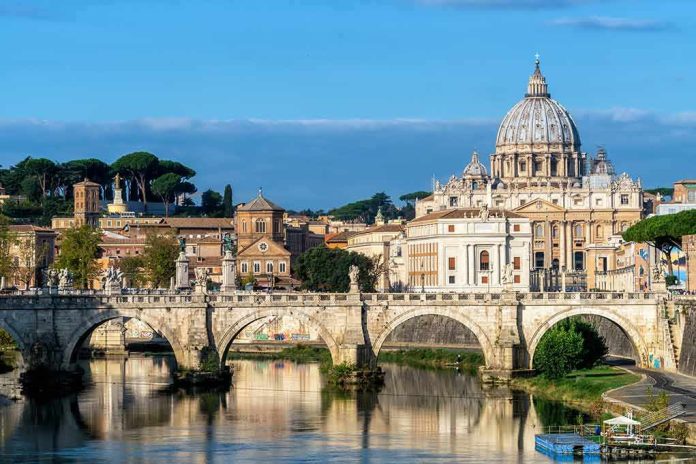
A letter signed by a top Vatican official confirms what organizers feared: this year’s Latin Mass pilgrims were told they could not walk into St. Peter’s Basilica.
Quick Take
- A September 30 letter from Archbishop Paolo Rudelli denied the Summorum Pontificum pilgrimage’s request to enter St. Peter’s Basilica in procession.
- The letter offers no reason for the refusal, only stating the request could not be answered favorably.
- In 2025, Cardinal Raymond Burke celebrated the traditional Latin Mass inside the basilica for the same pilgrimage; this year’s Mass was moved to St. Mary Major.
- Bishop Athanasius Schneider called the move selective, saying the pilgrims were Catholics in good standing who pray for the pope.
- Reports describe pilgrims being physically stopped from crossing St. Peter’s Square to reach the basilica entrance.
The Letter That Confirms the Denial
Archbishop Paolo Rudelli, Substitute for General Affairs at the Vatican Secretariat of State, wrote to pilgrimage chaplain Abbé Claude Barthe on September 30. His message was short and final. “I inform you that it is not possible to respond favorably to your request,” he wrote. The request asked for permission to enter in procession, pray at the Confession, and adore the Blessed Sacrament at the Altar of the Chair.
The letter itself gives no explanation. It does not mention security, crowd size, liturgical rules, or any broken agreement. It simply says no. That silence matters, because it means the public is left guessing at the real reason behind a decision made by one of the Vatican’s most senior offices.
A Pilgrimage With a History of Being Welcomed
This was not the group’s first visit. The Summorum Pontificum pilgrimage has brought traditional Latin Mass Catholics to Rome every year for over a decade. Last year, Cardinal Burke offered the traditional Latin Mass at the Altar of the Chair, one of the most honored spots inside St. Peter’s Basilica. That permission makes this year’s refusal stand out. Nothing in the public record shows the group changed how it behaved between 2025 and 2026.
Organizers say the restriction went further than denying a Mass. According to reporting, the Vatican told them plainly: “Your procession is not allowed to enter into St. Peter’s Basilica.” That message reportedly blocked priests, religious sisters, and lay pilgrims from entering together to pray at the tomb of St. Peter, a tradition central to the pilgrimage’s purpose.
Pilgrims Say They Were Physically Stopped
Photos and video from the pilgrimage show participants being kept from crossing St. Peter’s Square to reach the basilica entrance. A separate report of the same scene describes faithful Catholics being blocked in real time, not told about a decision after the fact. Whatever paperwork existed beforehand, the restriction played out publicly, in front of cameras, in one of the most visited public squares in the world.
Bishop Schneider Calls the Policy Selective
Bishop Athanasius Schneider did not hold back. He said the Vatican’s public talk about welcoming everyone does not match how it treated these pilgrims. “The Vatican’s speech of inclusiveness and tolerance is not true, it is ideological and selective,” he said. He added that the group consisted of Catholics in good standing who recognize the pope and pray for him and the bishops, making the exclusion hard to justify on loyalty grounds.
Latin Mass pilgrims flock to Rome despite Vatican ban on Mass and procession — The Catholic Herald https://t.co/Xf25AWzGbW
— Walter (@WalterC90372390) October 26, 2026
Schneider also pushed back on the idea that pilgrims reject the Second Vatican Council, a claim he called a possible pretext rather than a fact. His comments reflect a broader argument from traditionalist Catholics: that the group being shut out was not disruptive, dangerous, or disobedient, just devoted to an older form of worship the Vatican has limited since 2021 under the policy known as Traditionis Custodes.
What the Vatican Has Not Explained
The Vatican has not issued a public statement spelling out why this year’s request was refused while last year’s was granted. No published basilica rule explains when a pilgrimage group can process inside and when it cannot. That gap leaves room for competing explanations, from concerns about how the 2025 Mass was publicized to broader discomfort with the traditional Latin Mass movement itself.
What is clear is this: a formal letter from the Vatican’s own Secretariat of State confirms the denial happened, and pilgrims were kept from entering as a group. Whether the decision reflects sound judgment or unexplained favoritism, Catholics deserve a clearer answer than a one-line letter offers. Faith communities function best when rules are written down, applied evenly, and explained openly, not announced after pilgrims have already traveled to Rome.
Sources:
lifesitenews.com, insidethevatican.com, dianemontagna.substack.com, infovaticana.com, actssocial.com, pt.gloria.tv