

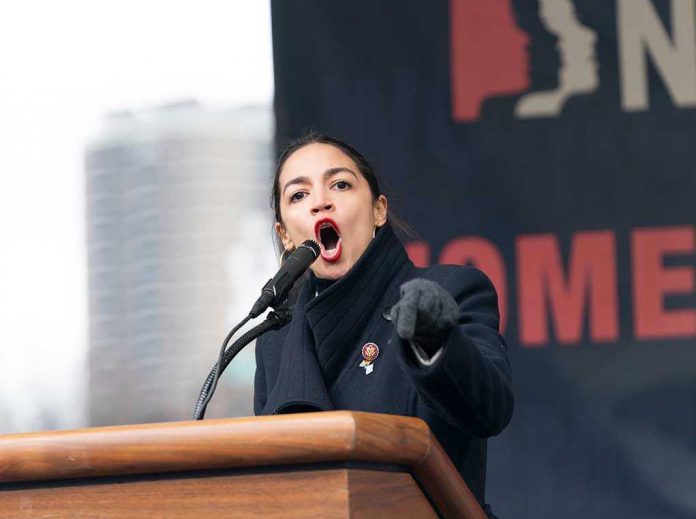
Alexandria Ocasio-Cortez’s recent polling lead over JD Vance in a hypothetical 2028 presidential matchup has sparked a wave of speculation and intrigue.
Story Snapshot
- AOC leads JD Vance 51% to 49% in a new poll for the 2028 presidential race.
- The poll highlights Vance’s perceived weaknesses and AOC’s strong Latino support.
- AOC’s dismissive comments about Vance fuel social media narratives.
- This is the first publicly reported poll showing AOC ahead in a 2028 matchup.
AOC’s Rising Political Influence
The poll conducted by The Argument and Verasight places Alexandria Ocasio-Cortez, the Democratic U.S. Representative from New York, ahead of Vice President JD Vance in a potential 2028 presidential race. This result is significant, as it suggests that AOC’s progressive platform might have broader national appeal than previously assumed. The poll was conducted among 1,521 registered voters from December 5 to 11, and Lakshya Jain, the pollster, emphasized that AOC’s coalition is particularly strong among Latino voters.
Ocasio-Cortez’s ascent in the political arena began with her upset victory in 2018 over a senior Democrat, which catapulted her into the national spotlight as a leading voice of the progressive wing. Her focus on climate policy, economic justice, and social issues has resonated with younger voters and minority communities. Her current lead over a sitting Republican vice president challenges the narrative that her policies are too far left to win a national election.
JD Vance’s Position and Challenges
JD Vance, a prominent figure within the Republican Party and currently serving as vice president, represents a contrasting ideology to AOC’s progressive stance. Vance gained political prominence through his memoir “Hillbilly Elegy” and has since aligned himself with Trump’s nationalist conservatism. The poll results, however, indicate a vulnerability in Vance’s appeal, particularly when facing off against a candidate like AOC who has a strong base among Latino voters.
Vance’s political strategy has focused on cultural issues and appealing to white working-class voters, but the poll suggests he may struggle to expand his appeal beyond the Republican base. This perceived weakness could open the door for other Republican contenders to challenge him for the 2028 nomination, as party strategists seek a candidate who can secure swing states.
The Role of Social Media and Public Perception
AOC’s reaction to the poll was characteristically irreverent, as she quote-tweeted the results with a simple “Bloop!” and later referred to Vance as “a goober” in an interview with The Independent. This approach resonates with her online-savvy base and keeps her in the media spotlight. Her reaction also exemplifies her ability to leverage social media to shape narratives and maintain her relevance in political discourse.
Ocasio-Cortez’s use of social media as a tool for political engagement highlights her understanding of modern political communication. Her dismissive tone towards Vance not only keeps her supporters engaged but also adds to the narrative of a potential 2028 clash between two ideologically distinct candidates.
Implications for the 2028 Presidential Race
The poll’s findings have significant implications for both parties as they prepare for the 2028 presidential race. For Democrats, AOC’s strong showing may challenge the assumption that more moderate candidates are necessary to win nationally. It positions her as a viable contender for the party’s nomination and could influence the party’s platform and strategy.
For Republicans, the perception of Vance’s weakness could lead to a reevaluation of potential candidates who can appeal to a broader electorate. The poll suggests that while AOC performs similarly to a generic Democrat, Vance is underperforming compared to a typical Republican, highlighting the need for the GOP to reassess its approach to winning key demographic groups.