A 2.5‑inch cardboard tube with flash powder and a fuse shut down a California airport checkpoint and opened a much bigger question: when does suspicious become truly dangerous?
Story Snapshot
- Federal prosecutors say a Sacramento man tried to carry a viable homemade explosive onto a commercial flight.
- Agents report finding knives, zip ties, a torch lighter, and five taped‑over phones alongside the device.
- The criminal complaint claims the bomb could have damaged an aircraft window at altitude.
- The public has heard almost nothing from the defense, leaving prosecutors’ version to define the narrative.
What Happened At The Sacramento Airport Checkpoint
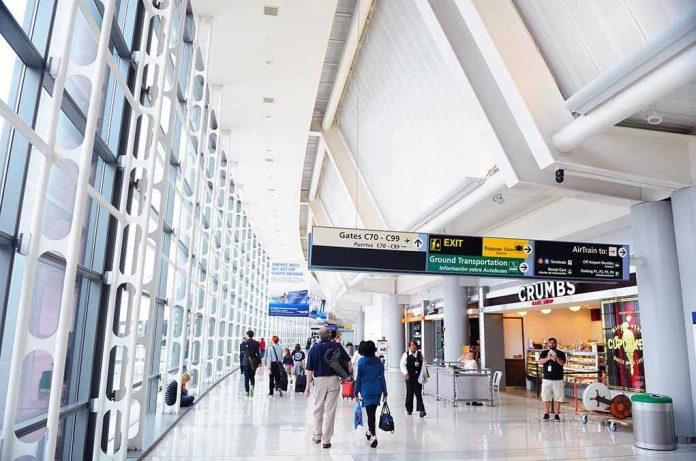
Federal authorities say Transportation Security Administration screeners at Sacramento International Airport stopped forty‑nine‑year‑old Kimani Osayande Jones on a Saturday night as he tried to board an American Airlines flight to Charlotte.[3][5] Court documents quoted in news reports describe him approaching the checkpoint around 9 p.m., wearing a scarf over his face and blue latex gloves.[3][1] Screeners flagged his carry‑on bag, pulled it aside, and called in law enforcement when they saw something that looked a lot more serious than shampoo over three ounces.[3][5]
According to the United States Attorney’s Office for the Eastern District of California, the bag held a small brown cylinder about two and a half inches long with a one‑inch green fuse attached.[3][5] Investigators label it an improvised explosive device, essentially an “M‑type” firework‑style bomb packed with energetic powder and designed to be lit by fuse.[2][3] Federal prosecutors responded by filing a criminal complaint charging Jones with unlawfully possessing explosive material in an airport, a federal felony that carries up to five years in prison and a substantial fine.[3][5]
The Device, The Phones, And The “Ominous” Details
The explosive itself is only part of what rattled investigators. The complaint and follow‑on reporting say the bag also contained a knife, other loose blades, zip ties, a butane torch lighter, an aerosol can, and five cellphones.[2][3][5] Reporters who reviewed the charging documents say each phone had its front camera covered with painter’s tape.[1][3] One screen allegedly displayed the message “We will be awaiting your call,” while another showed a fifteen‑minute timer cued up but not yet started.[1][3][5]
Federal Bureau of Investigation bomb technicians from the local joint team with the Sacramento County Sheriff’s Department removed the device, placed it under a blast‑suppression device, and took it offsite for testing.[3][5] According to the complaint, the lab found both the fuse and the powder to be “viable and energetic,” meaning they would burn and deflagrate as an actual explosive rather than a harmless prop.[3] An FBI bomb technician further concluded that if such a device detonated near an aircraft window above ten thousand feet, it could damage the window and potentially cause a dangerous loss of cabin pressure.[3][4][6]
Prosecutors’ Narrative Versus The Thin Public Defense Record
On the government’s telling, these facts build a tight story: a masked, gloved passenger walks into an airport with a working homemade explosive, a torch‑style lighter capable of igniting it, blades and zip ties, and several oddly prepared phones with a threatening message and a timer.[1][2][3][5] For a public already conditioned by post‑September 11 security culture, that bundle of details naturally reads as hostile intent even before any trial record exists.[1][6]
The defense side of the ledger is far thinner in the public record. News outlets quoting the complaint say Jones told officers he did not know the prohibited items were in his bag and said he was willing to discard them once they were discovered.[3] He then invoked his Miranda rights and declined to answer further questions from the Sacramento County Sheriff’s Office or the Federal Bureau of Investigation.[3][5] Beyond that, there is no sworn defense filing, no alternative explanation for the items, and no independent expert publicly calling the device non‑functional.[1][2][6]
How The System, And The Narrative, Tend To Work
This case fits a pattern anyone paying attention to federal explosive prosecutions will recognize. The first thing the public sees is almost always the criminal complaint and a press release from the United States Attorney’s Office, not a full trial transcript.[3] Media outlets then report the government’s allegations in detail, because that is the only concrete story available in the early days.[1][2][5] By the time defense counsel can hire experts, pull surveillance footage, and challenge the science, the initial “bomb at the airport” narrative has already settled in the public mind.[1][2]
Common sense and traditional American conservative instincts push in two directions here. One side says society cannot shrug off a viable explosive and a bag of weapons in a boarding line; security has to treat that combination as a serious threat until it is proven otherwise. The other side warns that prosecutors and federal agencies gain enormous narrative power when only their version is public, and that power needs constant skepticism, especially when intent is inferred from circumstantial data rather than a clear admission.[1][2][3]
Sources:
[1] Web – Man nabbed with bomb in California airport
[2] Web – Sacramento man facing explosives charge after SMF arrest
[3] Web – Sacramento man found with explosive during airport security check …
[4] Web – Sacramento Man Charged with Bringing Explosive Material into …
[5] YouTube – Sacramento man charged with bringing explosive to …
[6] Web – California man attempts to board plane with explosive, 5 phones …