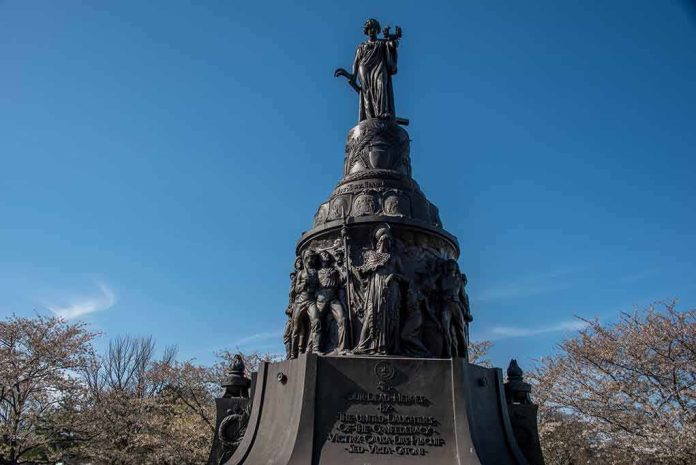
The Pentagon will reinstall Arlington’s Confederate memorial by 2027 after a full conservation, with taxpayers likely footing about $9 million for the job.
Story Snapshot
- Defense Secretary Pete Hegseth directed the Army to restore the memorial.
- Arlington officials expect reinstallation in 2027 after conservation work.
- Estimated public cost is about $9 million, with details still unclear.
- Critics say officials scrubbed slavery context from displays and webpages.
What Hegseth Ordered And What Arlington Plans Next
Defense Secretary Pete Hegseth told the Army to restore the Confederate memorial that once stood at Arlington National Cemetery. Cemetery officials say plans call for conservation and a return to the grounds in 2027, not a simple relabeling or quiet display in storage. The project involves moving, repairing, and reinstalling a complex bronze-and-stone work. Officials have presented the work as preservation of American history and as a long-standing part of Arlington’s landscape.
Arlington placed a sign noting the conservation plan near the former site and updated public materials to align with the restoration timeline. The focus is on stabilizing the bronze, addressing corrosion, and preparing a secure foundation for reinstallation. The site will also need new access controls and revised interpretive text, which has become a flash point. Supporters call the piece a “Reconciliation Monument,” tying it to national healing after the Civil War, a label Hegseth has used in public remarks.
The Price Tag And The Missing Paper Trail
Task and Purpose reported the expected cost at about $9 million. The outlet also reported that Arlington and Army officials have not released a line-item breakdown, contract details, or the internal cost estimate behind that figure. That gap matters. Big restoration projects can overrun when transport, scaffolding, and security costs stack up. Conservative stewardship demands hard numbers and named contracts. The Pentagon should publish the directive, schedule, and budget so the public can judge value and discipline.
The Army also confirmed it did not ask service members how the restoration might affect morale or unit cohesion, according to the same reporting. That seems like a miss. If leaders argue that restoring heritage supports esprit de corps, leaders should test it. A short, independent survey would go a long way. Taxpayers deserve to know whether nine figures of pennies on the dollar will buy unity, division, or simple neutrality among the ranks.
The Fight Over Words: Context Removed, Trust Erodes
Several outlets reported that officials removed language from a plaque and federal webpages that had described the memorial as presenting a nostalgic, mythologized view of the Confederacy with sanitized depictions of slavery. The previous text flagged “Mammy” and “faithful slave” stereotypes and identified Black figures on the sculpture as enslaved people. The revised materials dropped that framing. Historians Karen Cox and Stephen West defended the removed context as accurate and necessary.
Confederate family members of those who advocated for the installation of the Confederate Memorial at Arlington oppose its return…..my ask in 2026, please stop idolizing my family members who killed US soldiers. https://t.co/ypZgloz9Hb
— K. Denise Rucker Krepp (@kdrkrepp) October 21, 2026
Reuters reported that retired Army Brigadier General Ty Seidule called the memorial “pro-slavery” and “anti-United States,” and said returning it would clash with Congress’s purpose for removal. These critics do not dispute the conservation plan itself; they dispute the message it sends and the meaning officials choose to publish. The strongest charge is not about bronze and granite. It is about trust. When the government edits its own labels midstream, people assume the edit serves politics, not clarity.
Reconciling Reconciliation With Hard History
Backers frame the memorial as a symbol of national healing after a brutal war. That theme has deep roots in American life. Yet reconciliation does not wipe away what the artwork depicts or how it was read over time. A credible restoration can face both truths. Keep the sculpture. Keep the full story beside it. Explain who commissioned it, what it shows, how people saw it then, and why many see it differently now. That approach honors history without endorsing every image.
The path forward is basic good governance. First, release the Defense Department directive, the Army project plan, and the conservation scope. Second, publish a plain-English budget with contracts and safeguards. Third, restore interpretive text that squarely addresses slavery, Lost Cause narratives, and the memorial’s commissioning history. Finally, survey troops and veterans on morale impacts before and after the reinstallation. These steps match common sense and conservative transparency: show the receipts, show the sources, and let citizens judge.
Sources:
realcleardefense.com, crbcnews.com, people.com, newsweek.com, yahoo.com, ms.now